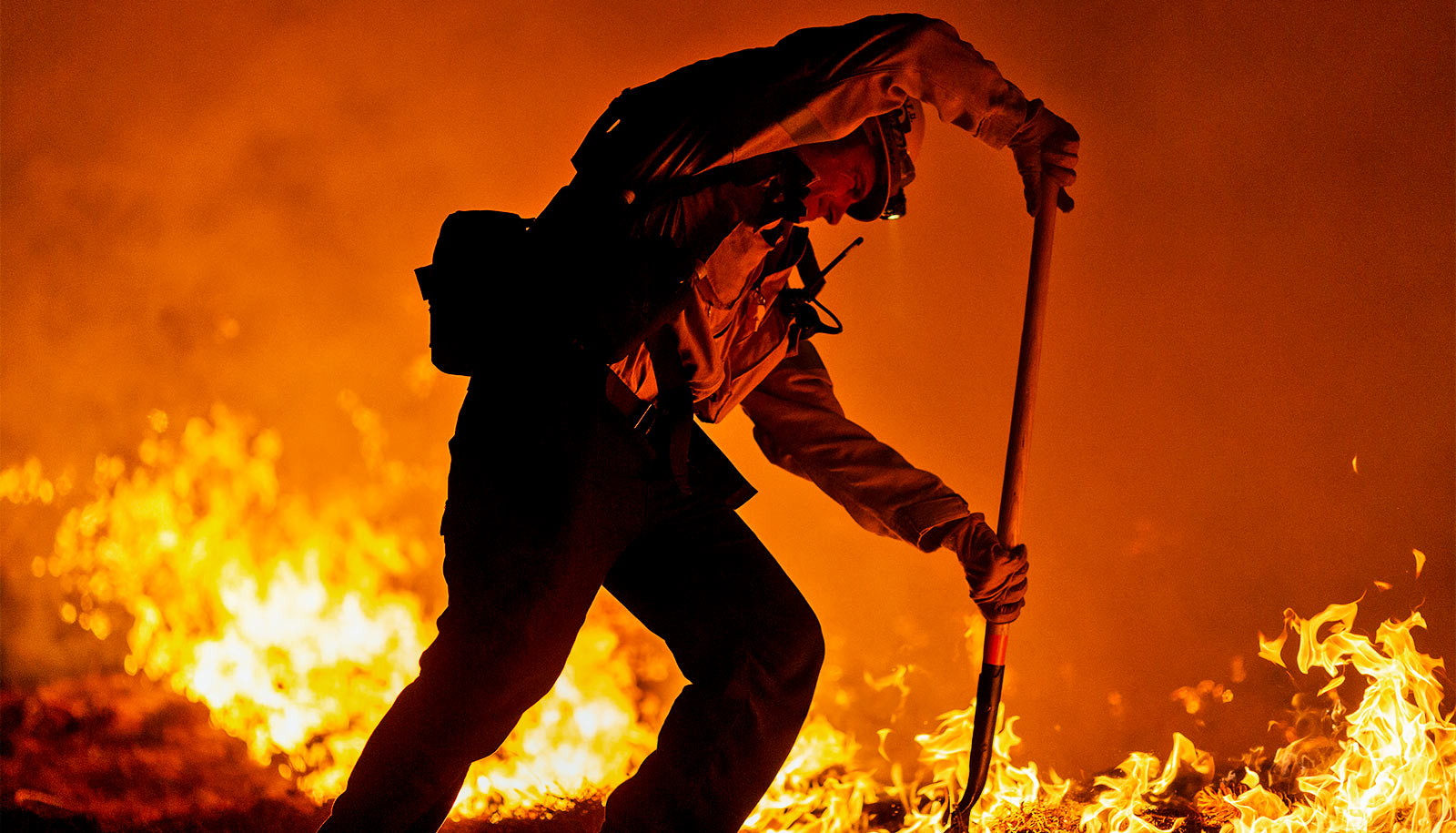
Thousands of American cultural landmarks and historic sites face significant wildfire threat as shifting climate patterns expand high-risk hazard zones across the United States. A comprehensive national assessment published in Nature Scientific Reports reveals that more than half of the 100,117 sites listed on the National Register of Historic Places encounter measurable wildfire exposure, leaving irreplaceable pieces of national heritage and community identity increasingly vulnerable to sudden destruction.
The study, completed by researchers at the University of California, Santa Barbara’s National Center for Ecological Analysis and Synthesis (NCEAS), provides the first national-scale evaluation of wildfire risk directed specifically at cultural resources. Recent disasters underscore the urgency of the findings. In January 2025, the Palisades Fire in Los Angeles destroyed the Will Rogers Ranch House, a celebrated California landmark. Six months later, the Dragon Bravo wildfire swept through Grand Canyon National Park, consuming the historic Grand Canyon Lodge, which was originally constructed in 1927.
Rebuilding portions of the Will Rogers site is projected to cost $5.1 million, according to project planners who managed to evacuate key historic elements that will now guide reconstruction efforts. Meanwhile, the future of the Grand Canyon Lodge remains undecided following its destruction, marking the second time the structure has faced devastation from fire after a previous rebuild following a 1932 blaze. Researchers stress that these high-profile losses are not isolated incidents but rather an early warning of systemic vulnerabilities facing historical architecture nationwide.
Assessing National Scale Vulnerability
To quantify the exposure, researchers cross-referenced every mappable site on the National Register of Historic Places with high-resolution wildfire burn probability models. The analysis categorized risk levels by geographic location, place type, and cultural significance. Out of more than 100,000 cataloged locations, exactly 3,446 places face severe wildfire risk.
“These places anchor community identity, collective memory, and national heritage,” noted corresponding author Caitlin Fong, a researcher at NCEAS. “Unlike homes, they cannot simply be rebuilt—and in many cases, once lost, they are gone forever.”
The geographic distribution of the threat is heavily concentrated in the western United States, though additional risk hotspots are emerging in Oklahoma, Arkansas, and along the southeastern coast. States including California, New Mexico, Colorado, and Oklahoma exhibit particularly acute concentrations of at-risk properties. Furthermore, climate change is projected to widen hazard zones, pulling previously lower-risk regions directly into the path of future blazes.
Structural Disparities and Preservation Challenges
Buildings and historic districts account for roughly 90 percent of all listed resources on the national register. Because their cultural value is inseparable from their physical form, the destruction of the structure equates to the complete loss of the heritage it represents. The assessment also revealed that nationally significant sites face disproportionately high wildfire exposure relative to state and locally significant properties, placing America’s most historically important landmarks among the most vulnerable.
Despite these mounting threats, cultural heritage remains largely absent from dedicated wildfire planning frameworks in most states. California stands as a notable exception through CAL FIRE’s Cultural Resources Management Program, which actively integrates resource protection into emergency planning. In most other jurisdictions, historic sites must compete for attention within broad all-hazards planning processes that were originally designed for modern infrastructure rather than heritage conservation.
Researchers argue that traditional wildfire assessments focus too narrowly on homes, physical infrastructure, and ecological habitats, ignoring the profound psychological and cultural dimensions communities experience when historic touchstones vanish. “The connection people have to places, their sense of place, is a profound and deeply underappreciated dimension of what communities stand to lose from wildfire,” explained coauthor Benjamin Halpern, a professor at UCSB’s Bren School of Environmental Science and executive director of NCEAS.
Proactive Mitigation and Strategic Planning
To prevent further losses, the research team outlined several mitigation strategies designed to comply with strict historic preservation standards. Recommended measures include targeted vegetation management, structural hardening using modern fire-resistant materials, and the installation of concealed fire suppression systems. These technological safeguards allow property managers to protect fragile structures without compromising their historic aesthetic.
Funded by the Gordon and Betty Moore Foundation, the study provides federal, state, and local agencies with an open-source dataset and methodology. This standardized foundation enables emergency planners and preservationists to prioritize which sites require immediate reinforcement before an active wildfire forces a crisis response.
“By identifying where and what is most at risk, this study provides a foundation for proactive planning to safeguard the places that anchor community identity and national heritage before they are permanently lost,” stated lead author Mona Farnisa.
We welcome your thoughts on how local communities should balance historical preservation with modern wildfire mitigation. Please share your perspectives and join the discussion below.
Worth a look