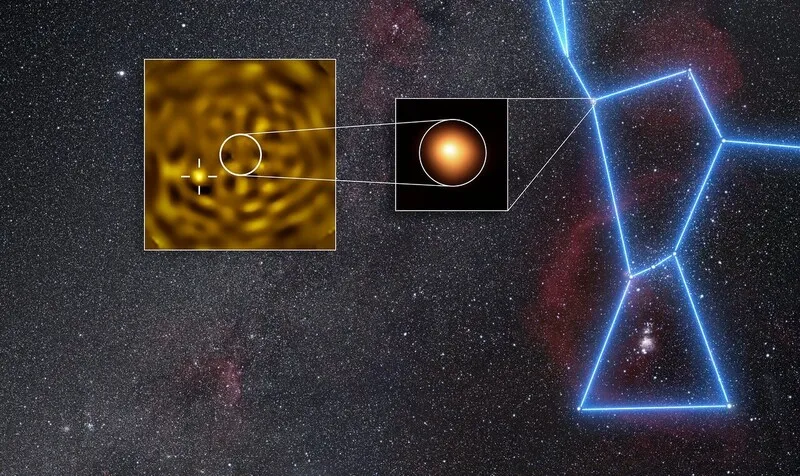
Astronomers tracking the historic red supergiant star Betelgeuse have uncovered evidence pointing toward a long-sought stellar companion, marking a significant step in understanding the complex behavior of one of the night sky’s most prominent celestial objects. For roughly a century, researchers have debated the mechanics behind Betelgeuse’s dramatic brightness fluctuations and mass-loss events, suspecting that an unseen secondary star might influence the primary giant. Recent observational analyses and modeling efforts by astrophysicists have begun to shed light on this suspected binary system, offering a clearer picture of how the primary star interacts with its environment.
Located roughly 640 light-years from Earth in the constellation Orion, Betelgeuse is well-known for its periodic dimming phases and immense physical scale. If placed at the center of our solar system, the star would extend past the orbit of Jupiter. Despite decades of study, reconciling its erratic pulsation cycles with standard stellar evolutionary models has challenged astronomers. The identification of a companion star provides a structural framework that helps explain anomalies in the primary star’s rotational speed and surface activity, according to recent findings discussed in astronomical literature.
The pursuit of Betelgeuse’s companion spans nearly a hundred years of spectroscopic and photometric observation. Early twentieth-century astronomers noticed irregularities in the star’s radial velocity measurements, prompting hypotheses about an orbiting body. However, confirming the presence of a companion has proven exceptionally difficult due to the overwhelming glare of the primary star, which outshines smaller stellar objects by orders of magnitude. Advanced interferometric techniques and high-resolution infrared imaging in recent years have finally allowed researchers to pierce through the dense dust shells surrounding the dying giant to detect signatures of the secondary star.
Decoding the Mechanics of a Red Supergiant Binary System
Understanding the interaction between Betelgeuse and its newly mapped companion involves examining mass transfer and orbital dynamics within late-stage stellar systems. Red supergiant stars shed vast quantities of gas and dust into the interstellar medium before eventually ending their lives in core-collapse supernovae. The gravitational influence of a companion star can shape these mass-loss patterns, creating asymmetric dust plumes and affecting the overall luminosity cycle observed by astronomers on Earth.
Astrophysicists utilize sophisticated computer simulations to model how a lower-mass companion orbits the behemoth star. These models indicate that the companion likely carves out a cavity within the expansive circumstellar envelope ejected by the primary star. Such interactions offer a compelling explanation for why Betelgeuse exhibits periodic variations in brightness that do not align with simple radial pulsation models alone. By factoring in the orbital period and mass ratio of the binary pair, researchers can refine timelines for when the primary star might exhaust its nuclear fuel.
Observational campaigns continue to target the system using ground-based telescopes equipped with adaptive optics and space-based observatories capable of capturing high-contrast imagery. These efforts aim to measure the exact orbital parameters of the companion, including its mass, semi-major axis, and spectral type. Confirming these physical characteristics will allow stellar evolution experts to test current theories regarding how massive stars interact in binary configurations during their final evolutionary stages.
Implications for Stellar Evolution and Future Observations
The confirmation of a binary partner for Betelgeuse carries broad implications for stellar astrophysics, particularly regarding how massive stars evolve in pairs rather than in isolation. Statistical studies show that a large percentage of massive stars have stellar companions, which significantly alters their lifespan, rotational rates, and ultimate demise. Recognizing Betelgeuse as part of a binary system helps researchers apply more accurate parameters to similar red supergiants throughout the Milky Way and nearby galaxies.
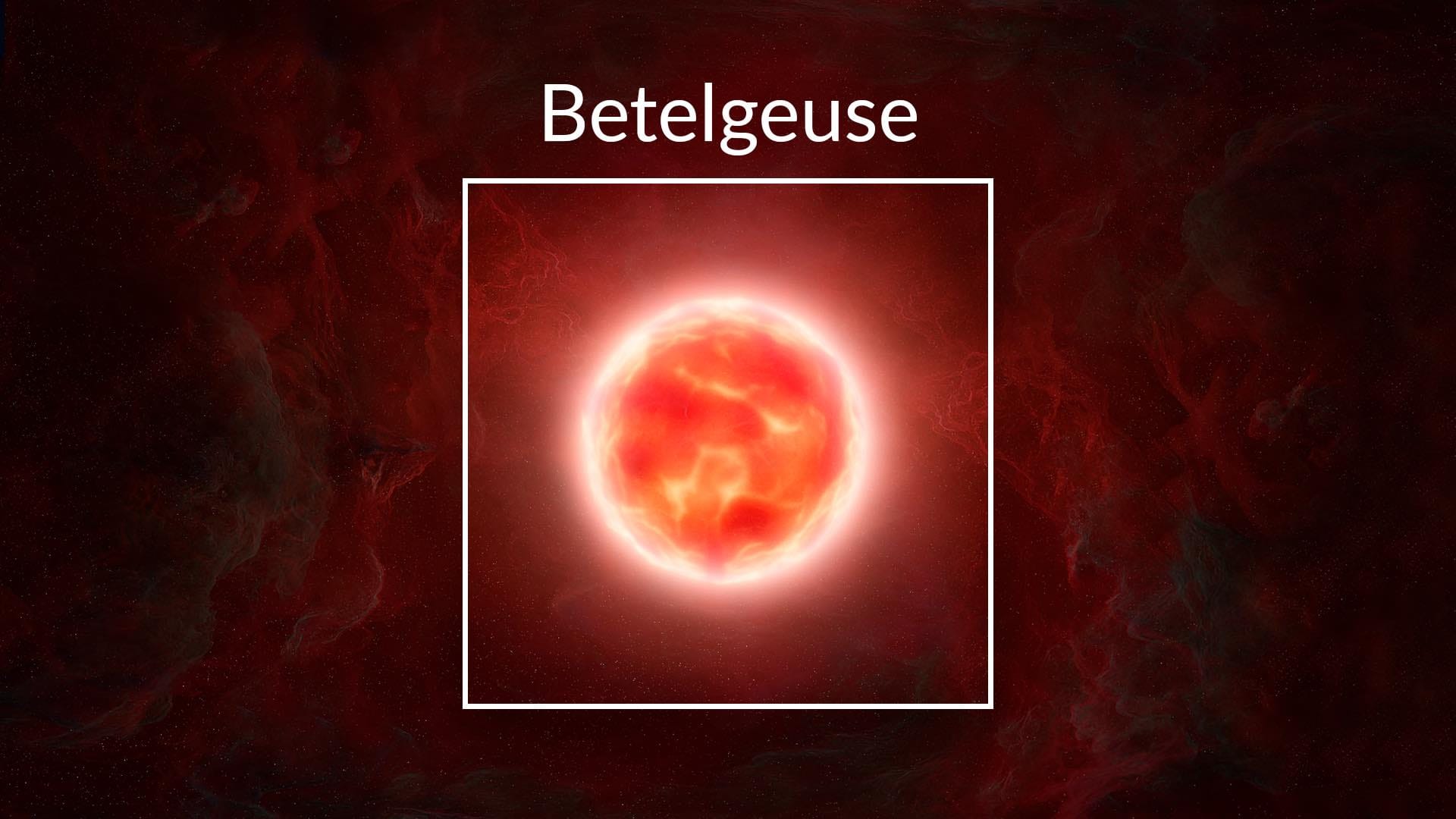
As observational technology advances, astronomers anticipate capturing even sharper direct imagery of the system. Upcoming telescope upgrades and dedicated monitoring programs will track the companion’s orbital motion across multiple seasons, providing empirical data that will either validate or refine current theoretical models. These ongoing studies ensure that Betelgeuse remains one of the best-tested laboratories for understanding late-stage stellar physics.
Researchers and amateur astronomers alike continue to monitor the star for unexpected behavior following its notable dimming event in 2019 and 2020. Official updates, scientific papers, and observational logs regarding the Betelgeuse system are regularly published through astronomical databases and institutional research portals, such as the American Astronomical Society and major space agency archives. Observers interested in tracking the star’s ongoing activity can consult professional monitoring networks and astronomical societies for the latest spectral analyses and imaging results.
Related reading