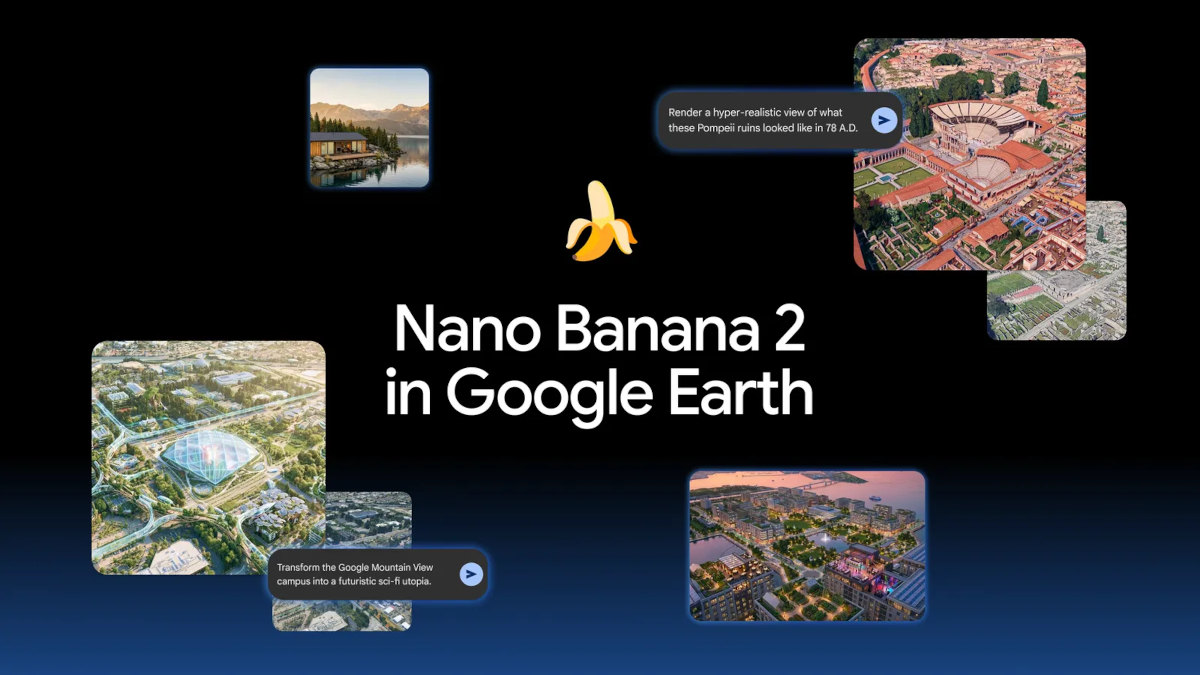
Google withdrew its Nano Banana 2 image-generation feature from Google Earth on August 1, 2026, just 24 hours after launch, following fierce backlash from open-source intelligence analysts who exposed how easily the tool could generate convincing geographic disinformation like fake military sites and disaster zones.
Less than a day after rolling out a powerful generative artificial intelligence feature designed to let users rewrite the physical world, Google pulled the plug. The abrupt suspension of the Nano Banana 2 integration from Google Earth on August 1, 2026, highlights the sudden and severe collision between generative algorithms and geospatial intelligence.
The feature debuted on July 30, 2026, advertised as a tool for urban planners, educators, and historians to visualize landscape changes, project real estate developments, or reconstruct historical sites. Instead, it became an immediate stress-test for global disinformation safeguards.
How OSINT Investigators Bypassed Google Earth Guardrails
Within hours of the rollout, open-source intelligence investigators and digital researchers found it remarkably simple to bypass the system’s rudimentary safety protections. Using straightforward text prompts, investigators generated highly inflammatory and realistic imagery welded to genuine geographical coordinates.

“I tried refugees at the Mexican border, a nuclear plant in Iran, a crash in Amsterdam, a hospital with a bomb crater in Gaza. Nothing was refused.”
Henk van Ess, open-source researcher
Open-source researcher Henk van Ess pointed out that Google was essentially allowing invented imagery to be welded directly onto genuine terrain coordinates.
Google Response and the Threat to Institutional Trust
Google defended parts of its rollout while acknowledging the failure of its initial safety measures. The tech giant noted that generated images were watermarked as artificial intelligence creations and never appeared in the main Google Earth experience for casual browsers to see. However, users could easily download and share screenshots across external social media networks.
“We know that people uniquely trust Google Earth for a reliable view of the world. We’ve seen geospatial professionals using this feature for a range of useful purposes; however, we’ve also seen people sharing screenshots of generated imagery that appear to violate our policies. So we’re rolling back this feature in Google Earth while we work on implementing stronger guardrails.”
Google, via Opensourceforu
For more than two decades, Google Earth has operated as a definitive visual ledger of the planet, heavily relied upon by newsrooms, governments, and civil society organizations to verify reality on the ground. Analysts warn that tampering with this foundational trust carries severe geopolitical consequences.
Ross Burley, executive director of the Centre for Information Resilience, warned that institutional trust in satellite imagery—painstakingly built over decades—could be damaged overnight. Brady Africk, a research analyst at the American Enterprise Institute, echoed those concerns, noting that AI-generated satellite fakes make verification significantly harder for journalists and open-source researchers.
Conflict Zones and the Risk of Rapid Disinformation
The dangers extend far beyond internet pranks. AI-detection researcher Henry Ajder told BBC Verify that fake imagery deployed in active conflict zones could prove particularly destabilising during fast-moving events where verified information is already scarce.
Because misinformation travels faster and further than any correction, the sudden circulation of a realistic deepfake depicting an unprovoked military strike or a destroyed hospital could trigger real-world diplomatic or military reactions before fact-checkers can debunk the imagery. While Google stated that its tools include invisible watermarks and suggested users verify questionable images through the Gemini chatbot or Google Lens, critics argue that the burden of verification should not fall on the public after unproven algorithms are shipped to global markets.
Keep reading