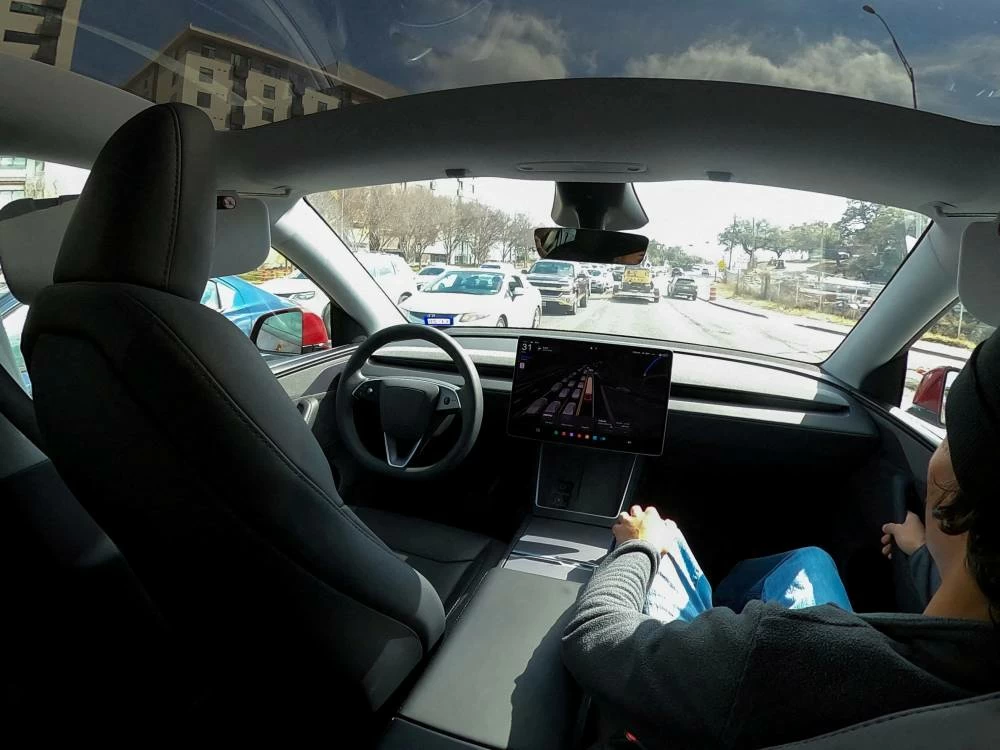
Tesla has slowed its robotaxi network rollout, with CEO Elon Musk adopting a guarded tone on Wednesday following previous predictions of hyper-exponential growth. Executives cited city-specific regulatory hurdles and operational snags, leaving fleet sizes in the dozens while competitors like Alphabet’s Waymo maintain a massive deployment lead.
A year after CEO Elon Musk projected that Tesla’s robotaxi network would expand at a hyper-exponential rate
and reach half of the U.S. population by the end of 2025, the company’s vehicle deployment has faced a much more measured reality, Reuters reported. During an earnings call on Wednesday, Musk and his executive team addressed analysts’ questions regarding the slower-than-expected expansion.
The updated outlook triggered a sharp sell-off in Tesla shares, which were down 13% in afternoon trading and on track for their biggest percentage drop in more than a year. Barclays analysts noted that while investors previously viewed Tesla’s key advantage as its ability to scale more rapidly,
the actual rollout has been seen by many investors as somewhat ‘slow.’
Regulatory Hurdles and Operational Snags in Texas and Florida
Since launching its initial small robotaxi pilot in Austin in June 2025, Tesla has expanded to only a handful of additional cities across Texas and Florida, with service often restricted to outlying areas. Prior to the Austin launch, Musk maintained that Tesla’s technology was a general solution that works anywhere, contrasting it with the deliberate, city-by-city strategy employed by Alphabet unit Waymo.
Regulatory situations are different city by city. The reason we’re expanding city by city is to make sure that we’re meeting all of those one at a time. Lars Moravy, Tesla Vice President of Vehicle Engineering, via Reuters
Chief Financial Officer Vaibhav Taneja added that there are different kinks … not just on the software front, but on the operations front, that they were trying to tackle. Taneja noted that management intends to sort those things out in a smaller fleet in a controlled manner before ramping up deployment.
Fleet Size Questions and the Gap Behind Waymo
During the earnings call, Wells Fargo analyst Colin Langan questioned why Tesla’s active vehicle counts remained in the dozens as opposed to hundreds, asking executives to identify the primary roadblock to start adding more vehicles on the ground?

In response, Tesla Vice President of AI Ashok Elluswamy argued that even a limited number of cars can accumulate substantial mileage, describing the growth in robotaxi distance as literally exponential. Just, it’s in the early part of the exponential. That’s why it’s hard for others to comprehend.
Paying customers have accumulated 2.5 million miles in Tesla’s robotaxi service, which includes 380,000 miles driven without an in-vehicle safety monitor. However, Forrester analyst Paul Miller pointed out that these unsupervised miles remain far behind the more than 220 million autonomous miles logged by Waymo through the end of March, highlighting Waymo’s commanding lead in commercial deployment.
Expanded City Footprint Versus Actual Availability
An investor presentation in January outlined plans for Tesla robotaxis to reach seven major metropolitan areas by the end of June: Dallas, Houston, Phoenix, Miami, Orlando, Tampa, and Las Vegas. By Tuesday ahead of the earnings call, service had launched in Dallas, Houston, and Miami, while the company formally announced it was now live in Tampa and Orlando.
Despite the broader geographic footprint, service in cities like Houston and Miami remains confined to less-trafficked neighborhoods outside city centers. Testing conducted by Reuters in the weeks following the initial Dallas and Houston rollouts revealed prolonged wait times and occasional complete unavailability of vehicles.
Elon Musk stated that they wanted to grow as fast as possible with the robotaxi without harming anyone. Elon Musk, Tesla CEO, via Reuters
With Tesla stock trading at more than 166 times forward earnings estimates—far above typical valuations for traditional automakers and major tech firms—investors continue to weigh the slower pace of autonomous deployment against the long-term revenue promises tied to both robotaxis and Optimus humanoid robots.
Related reading