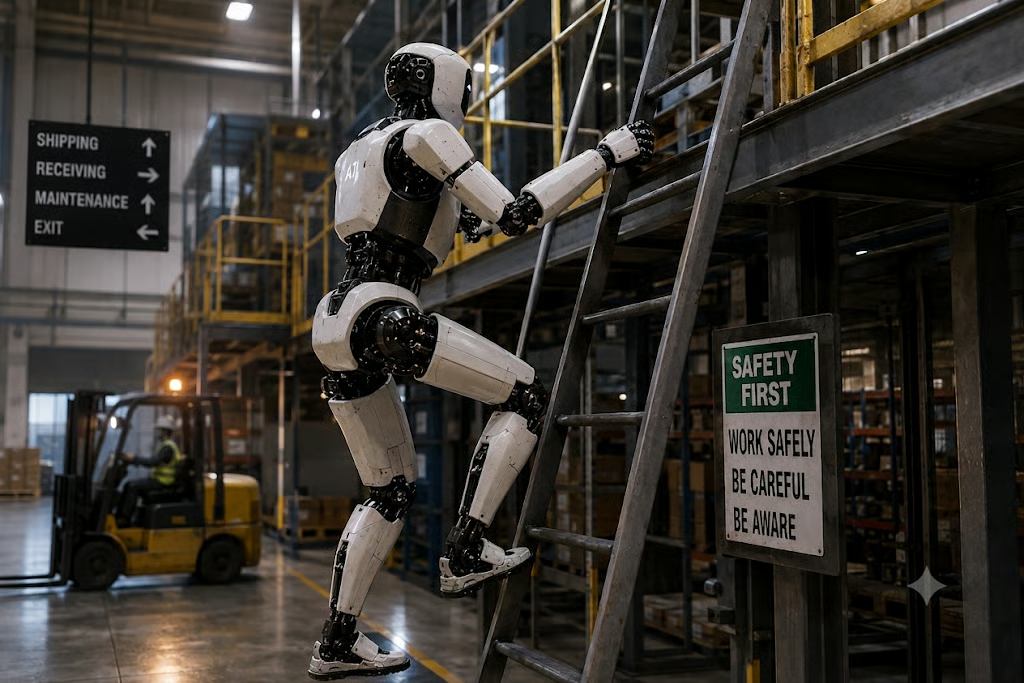
Humanoid robots are stepping out of controlled laboratory environments and into real-world workplaces, facing a fundamental engineering test: navigating stairs, ladders, and uneven terrain. As robotics developers scale up production, deployment strategies require careful evaluation of hardware durability, software adaptability, and workplace safety standards, according to recent industry analyses.
For years, bipedal robots excelled primarily on flat indoor surfaces. Today, companies deploying hardware in logistics hubs and industrial plants must account for dynamic environments where footing is unpredictable. According to engineering assessments from robotics firms, maintaining balance while climbing stairs demands advanced sensor suites, real-time torque adjustments, and sophisticated path-planning algorithms that can instantly react to shifting weight distributions.
Deploying humanoid systems at scale involves substantial operational hurdles. Facilities managers evaluating these technologies must look beyond basic mobility demonstrations to examine battery life, payload capacities, and maintenance cycles under rigorous daily use. Industry data indicates that while bipedal platforms offer versatile form factors suited for human-designed spaces, stairs and vertical ladders remain high-risk zones requiring redundant safety failsafes.
Engineering Mobility on Stairs and Ladders
Moving from flat floors to vertical obstacles shifts the computational load on onboard processors. When a humanoid robot approaches a staircase, its computer vision systems must calculate riser heights, tread depths, and slip resistance in fractions of a second. Unlike wheeled or tracked systems, bipedal robots must continuously manage their center of mass over a single supporting foot during mid-stride transitions.
Ladders present an even greater mechanical challenge, requiring coordinated multi-limb gripping and continuous stability monitoring. Robotics engineers utilize reinforcement learning models trained in simulated environments to help machines adapt to physical perturbations, such as a loose rung or an oily surface. However, translating simulation training to physical hardware deployed in messy industrial settings requires extensive field testing.
Operational Considerations for Enterprise Deployment
Businesses considering large-scale robotic rollouts must address infrastructure compatibility alongside software readiness. Warehouses and manufacturing plants rarely feature standardized staircases or pristine environments. Debris, moisture, and varying lighting conditions can degrade sensor accuracy, leading to navigation errors.
Integration costs also encompass workforce training and safety protocol updates. Facilities must establish clear operational perimeters and emergency stop procedures before autonomous bipedal systems operate near human personnel. Industry safety groups emphasize that comprehensive risk assessments are mandatory prior to introducing mobile robots into multi-level workspaces.
As technological capabilities advance, developers continue refining the hardware and control algorithms needed for reliable multi-floor navigation. Businesses exploring these deployments can monitor updates from standards organizations and robotics consortia for ongoing safety guidelines and deployment frameworks.
What are your thoughts on humanoid robots entering multi-level workplaces? Join the conversation by leaving a comment below or sharing this article with your professional network.
Worth a look