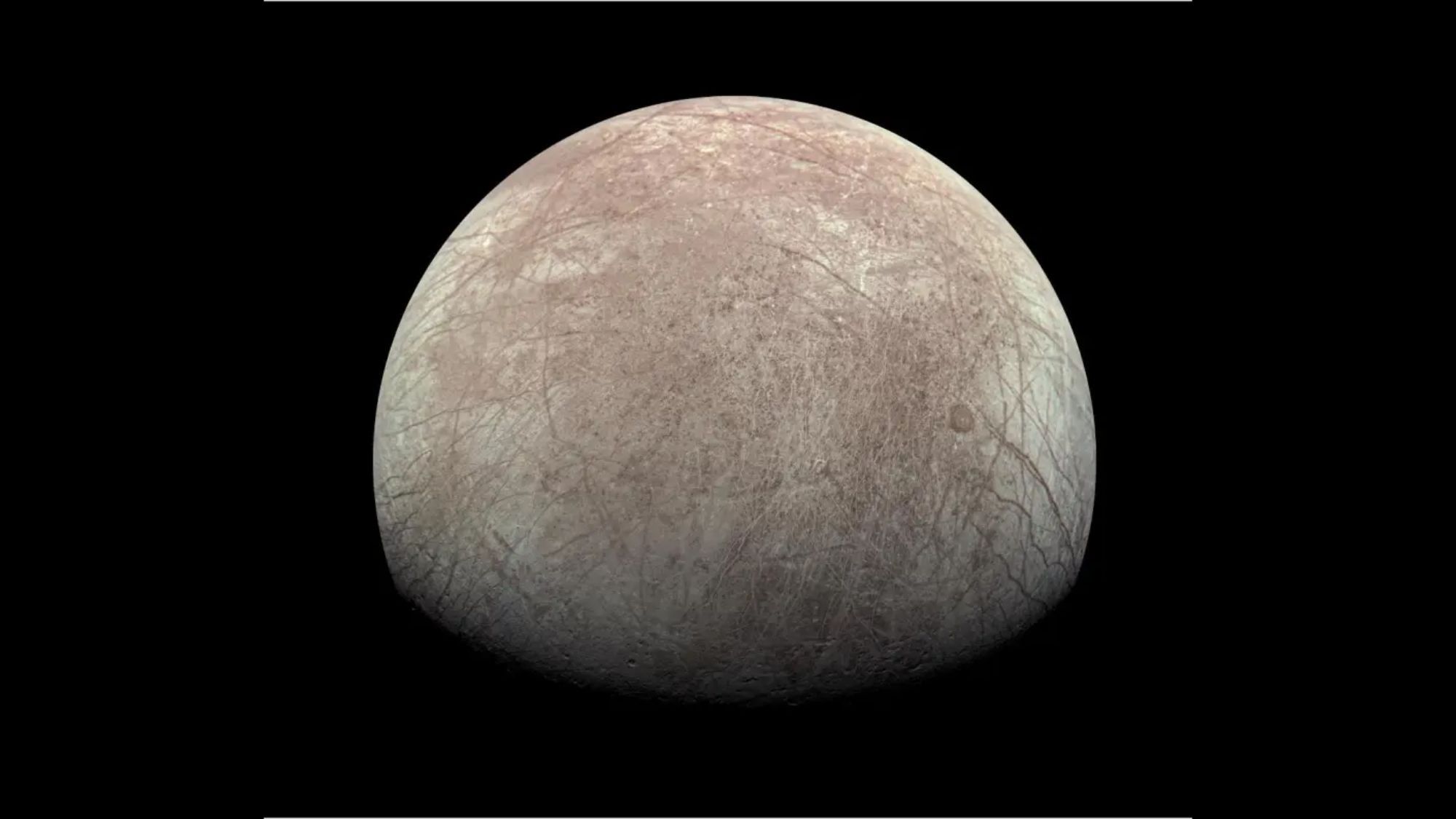
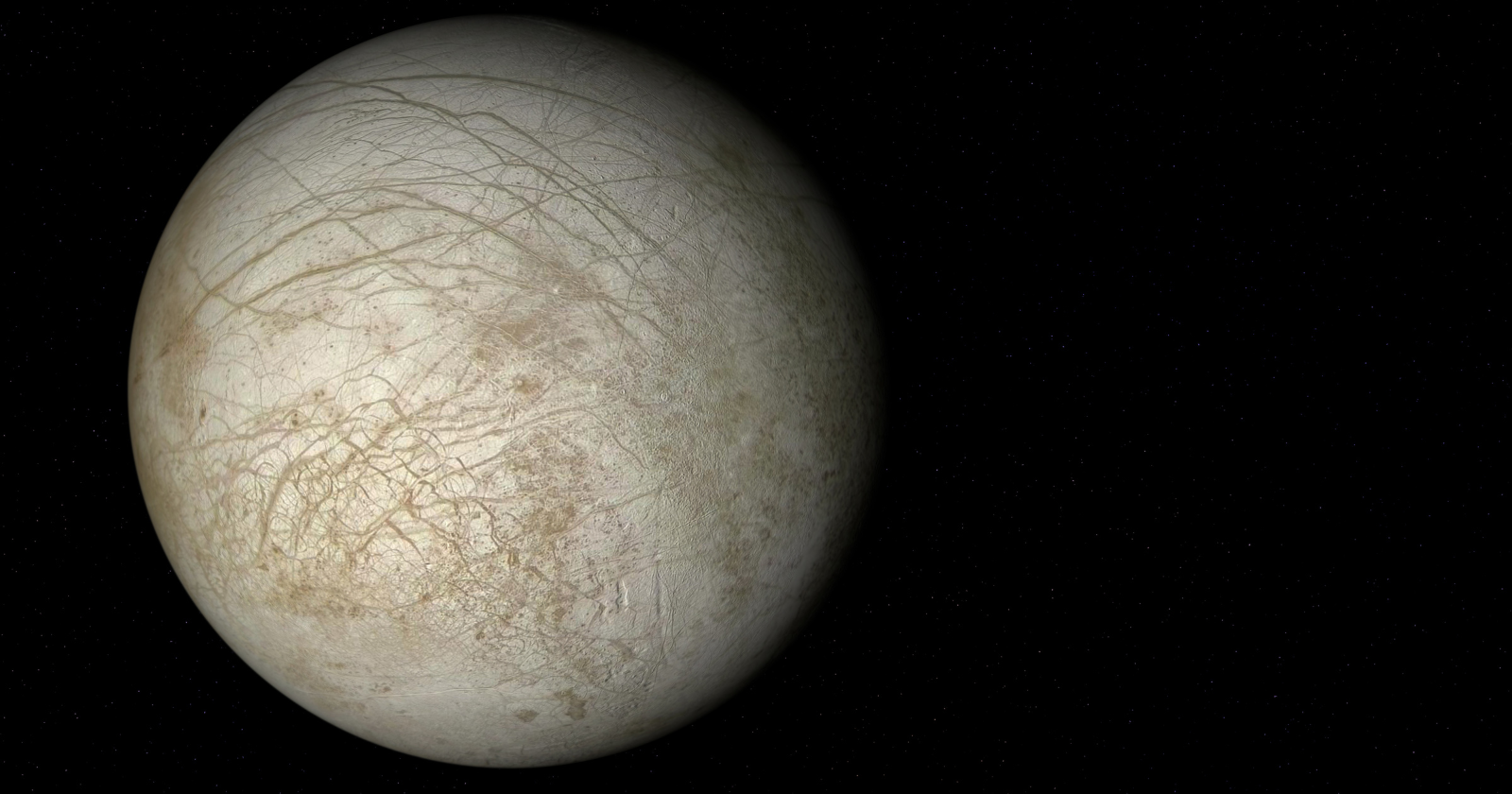
NASA’s Europa Clipper spacecraft is currently traveling on a 1.8-billion-mile trajectory toward Jupiter’s moon Europa, following an October 14, 2024, launch from Cape Canaveral. Set to arrive in April 2030, the mission will evaluate whether the Jovian moon’s subsurface ocean can support life, despite new scientific debates regarding the feasibility of reaching that liquid water.
When a SpaceX Falcon Heavy rocket lifted off from Cape Canaveral, Fla., on the morning of October 14, 2024, it cleared a hurdle that planetary scientists had advocated for over decades. The launch put NASA’s Europa Clipper on a complex 1.8-billion-mile route designed to reach the outer solar system by utilizing planetary gravity assists rather than a direct, fuel-prohibitive flight path.
The spacecraft passed Mars on March 1, 2025, using the planet’s gravity to adjust its speed and direction, and it is currently scheduled for an Earth gravity assist on December 3, 2026. Those maneuvers will shape its trajectory toward a rendezvous with the Jupiter system in April 2030, where it will spend more than four years examining the icy moon.
Inside Europa’s Global Saltwater Ocean and Radiation Shielding Orbit
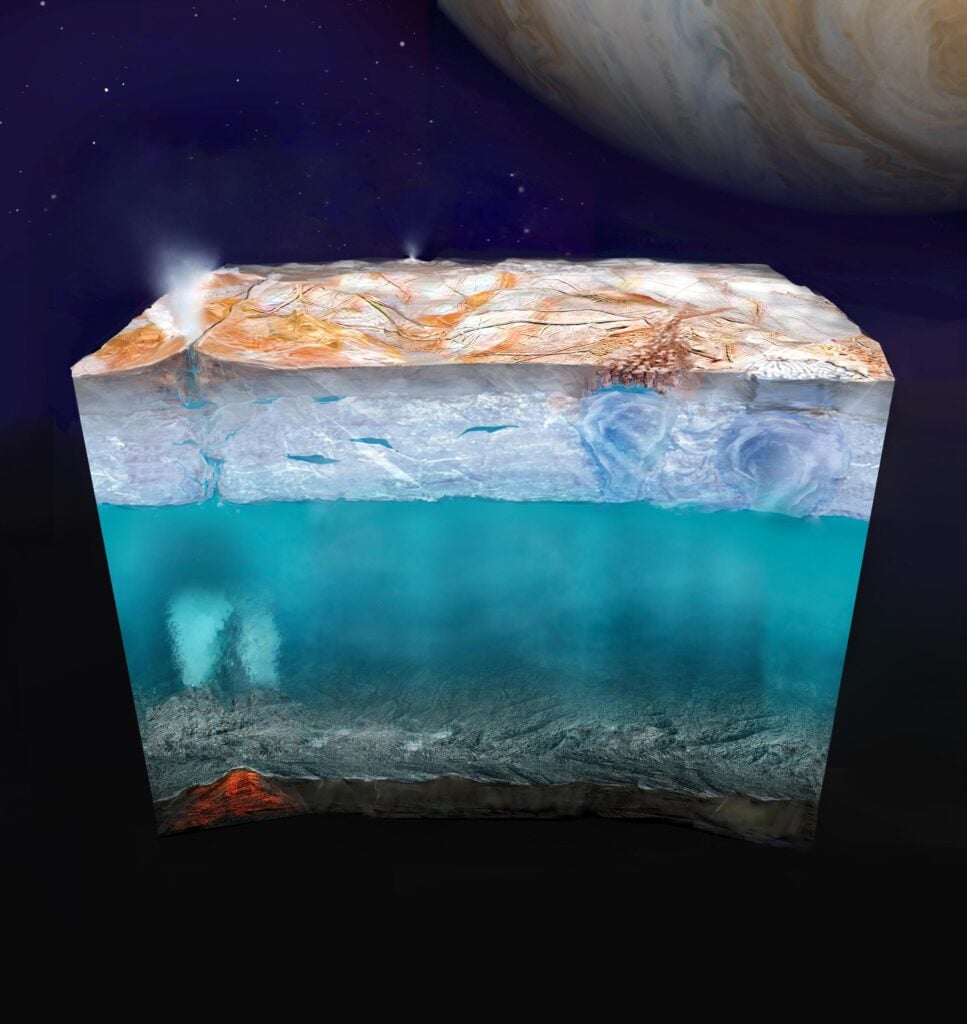
Europa is roughly 3,100 kilometers across, making it slightly smaller than Earth’s Moon, yet multiple lines of evidence suggest it harbors a global saltwater ocean beneath a frozen exterior shell. NASA estimates that this hidden layer of liquid water may span 60 to 150 kilometers in depth, potentially containing more than twice as much water as all of Earth’s oceans combined.
Because Europa sits deep inside Jupiter’s punishing magnetic radiation environment, a spacecraft parked in a continuous orbit around the moon would degrade rapidly. To circumvent this hazard, mission planners designed a stretched orbital architecture around Jupiter that relies on 49 close flybys of Europa. These encounters will bring the probe as low as about 25 kilometers above the surface while keeping it clear of the harshest radiation for the majority of each orbit.
Challenging Assumptions About Hydrothermal Vents and Upwelling Plumes
While the prospect of a subterranean ocean has fueled decades of speculation about extraterrestrial life, recent studies published in January have complicated traditional models of how that environment might function. Research led by Paul Byrne at Washington University in St. Louis and published in Nature Communications modeled how much heat Europa’s interior generates through tidal flexing from Jupiter’s gravity.
Why Does NASA Want to Explore Jupiter’s Ocean Moon? (Europa Clipper Science Overview)
The team’s calculations indicated that tidal forces acting on the moon’s rocky interior are likely insufficient to drive active hydrothermal venting or tectonic activity comparable to the deep-sea vent ecosystems found on Earth.
“Everything would be quiet.”
Photo: Space Daily
Paul Byrne, Washington University in St. Louis, via Space Daily
Computer simulations run by Ojha’s team showed that rising water would churn turbulently against frigid fracture walls, lose heat rapidly, and freeze completely long before reaching the surface.
“There’s an icy shell, there’s water underneath, and there’s all this speculation about how that water can come from deep underground and make its way all the way up without freezing en route,” Ojha said in a statement. “That’s really what we think we disproved.”
Lujendra Ojha, Rutgers University, via Space
Instead of a steady, smooth flow, the simulations demonstrated that the liquid water would experience supercooling, triggering the rapid formation of slushy frazil ice crystals that clog ascent pathways in a matter of hours.
Alternative Nutrient Delivery and the Mission Ahead
While the new geophysical models suggest deep-vent activity and direct ocean upwellings may be far less viable than once hoped, alternative mechanisms for sustaining habitability are under consideration. A separate paper published in January by Austin Green of Virginia Tech and Catherine Cooper of Washington State University in Spacedaily proposed that nutrients and chemical compounds altered by surface radiation could be carried downward into the ocean by sinking pockets of dense, salty ice.
Photo: Spacedaily
NASA explicitly clarifies in its mission documentation that Europa Clipper is not designed as a direct life-detection instrument.
Following its scheduled December 2026 Earth gravity assist, the probe will continue its journey toward its April 2030 arrival at Jupiter, where its observations will test competing theories about what lies beneath the ice.