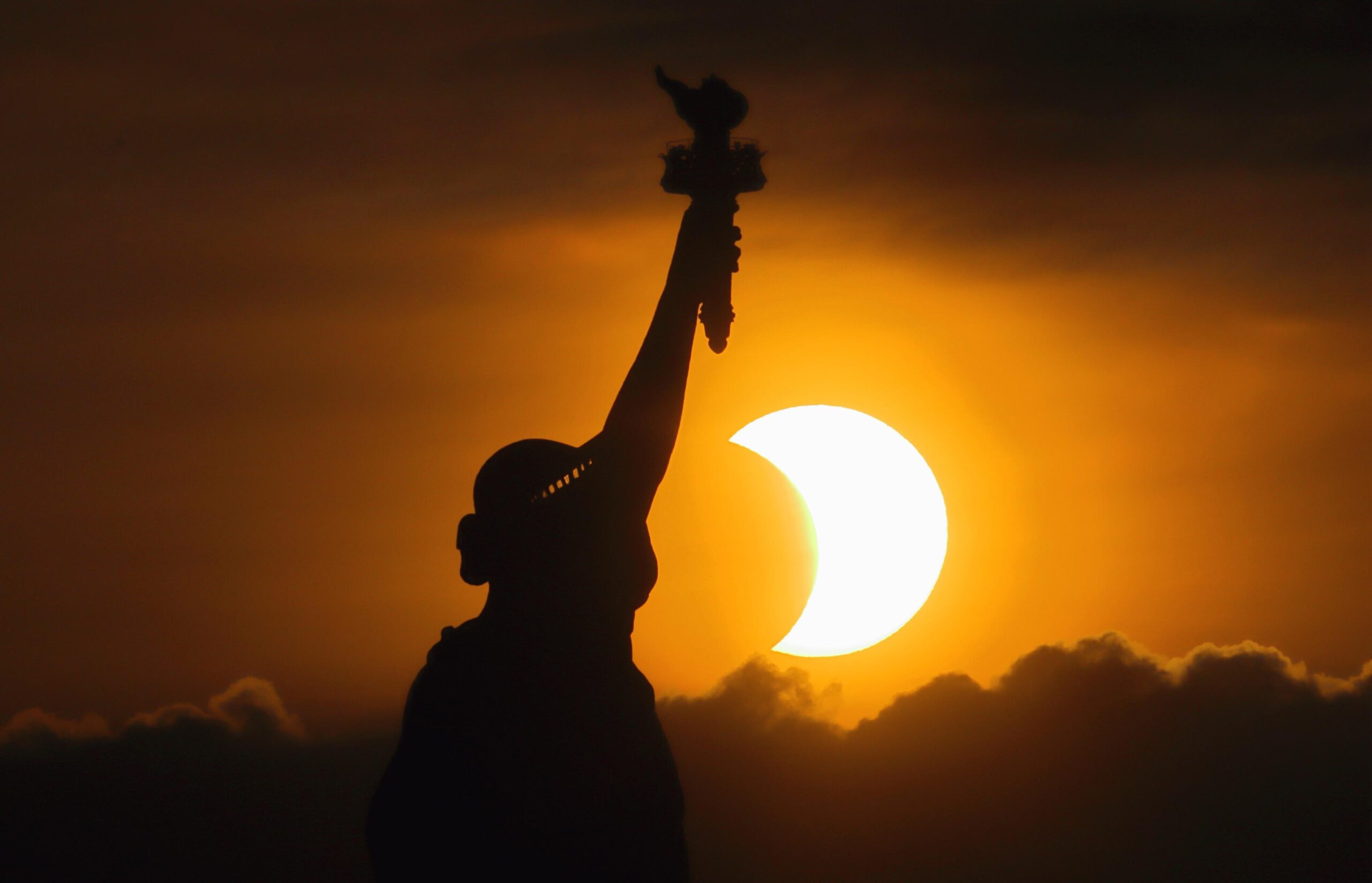
Skywatchers across North America and Europe can witness a rare double celestial event on August 12, 2026, combining a partial solar eclipse during daylight hours with the peak of the annual Perseid meteor shower that night, enhanced by optimal dark-sky conditions from a new moon.
Timing and Visibility for the August 12-13 Celestial Double Feature
While Europe experiences a total solar eclipse, millions of Americans witness a partial solar eclipse followed by the annual Perseid meteor shower within a matter of hours.
The partial solar eclipse occurs during daylight hours on Wednesday, August 12, with viewing times varying by location. In the contiguous U.S., the event runs from 10:27 a.m. MDT in Montana and North Dakota to 2:52 p.m. EDT in Maine, while observers in Alaska see the eclipse from 7:34 to 9:31 a.m. AKDT. Later that same night, the yearly Perseid meteor shower arrives, reaching its peak between 2:00 a.m. and 4:00 a.m. local time on August 13.
Where to View the Partial Solar Eclipse Across U.S. States
Twenty-six U.S. states see at least some portion of the partial solar eclipse, though coverage levels vary significantly by geography. Unlike the total eclipses seen in 2017 and 2024, the path of totality on August 12 does not cross the United States; viewers seeking a total eclipse must travel to Iceland or Spain, where a total solar eclipse crosses northern Russia, Greenland, Iceland, and northern Spain.
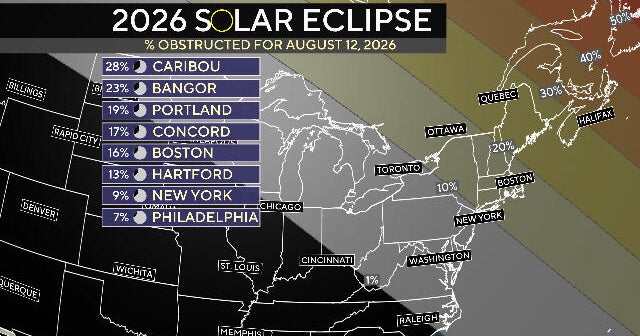
In the United States, the deepest views of the partial eclipse occur in Alaska and northern Maine. The point at which the event becomes clearly visible through proper eyewear is a 10 percent eclipse. According to data provided by TimeAndDate.
- Fairbanks, Alaska: 37 percent at 8:27 a.m. AKDT
- Anchorage, Alaska: 28 percent at 8:18 a.m. AKDT
- Presque Isle, Maine: 28 percent at 1:50 p.m. EDT
- Boston, Massachusetts: 16 percent at 1:55 p.m. EDT
- New York City, New York: about 10 percent at 1:54 p.m. EDT
Observers in Boston witness the partial eclipse beginning just after 1:00 p.m. on Wednesday and ending at 2:46 p.m., with the maximum obscuration occurring at 1:55 p.m., as reported by CBS Boston. Viewers are cautioned that normal sunlight reduction is hardly noticeable at these percentages without magnification or filters.
Safety Requirements and Equipment for Solar Observation
NASA warns that observers must use certified equipment whenever any portion of the sun remains visible. Regular sunglasses do not provide enough protection against solar radiation.
“Solar eclipses are among the most watched astronomical events because they are relatively uncommon and offer a dramatic visual reminder of the precise alignment of the Earth, moon, and sun. NASA warns that viewers should use certified eclipse glasses or approved solar filters whenever any portion of the sun remains visible, as regular sunglasses don’t provide enough protection.”
Newsweek
All observers must wear ISO 12312-2-certified eclipse glasses for every stage of the partial solar eclipse. Experts emphasize that viewers should never look at the sun through binoculars, cameras, or telescopes unless those devices have a securely fitted solar filter.
Perseid Meteor Shower Peak Conditions and Viewing Guidance
The Perseid meteor shower occurs annually when Earth passes through a stream of debris left behind by Comet Swift-Tuttle. Tiny fragments of dust and rock enter the atmosphere at high speeds, burning up to create bright streaks of light.
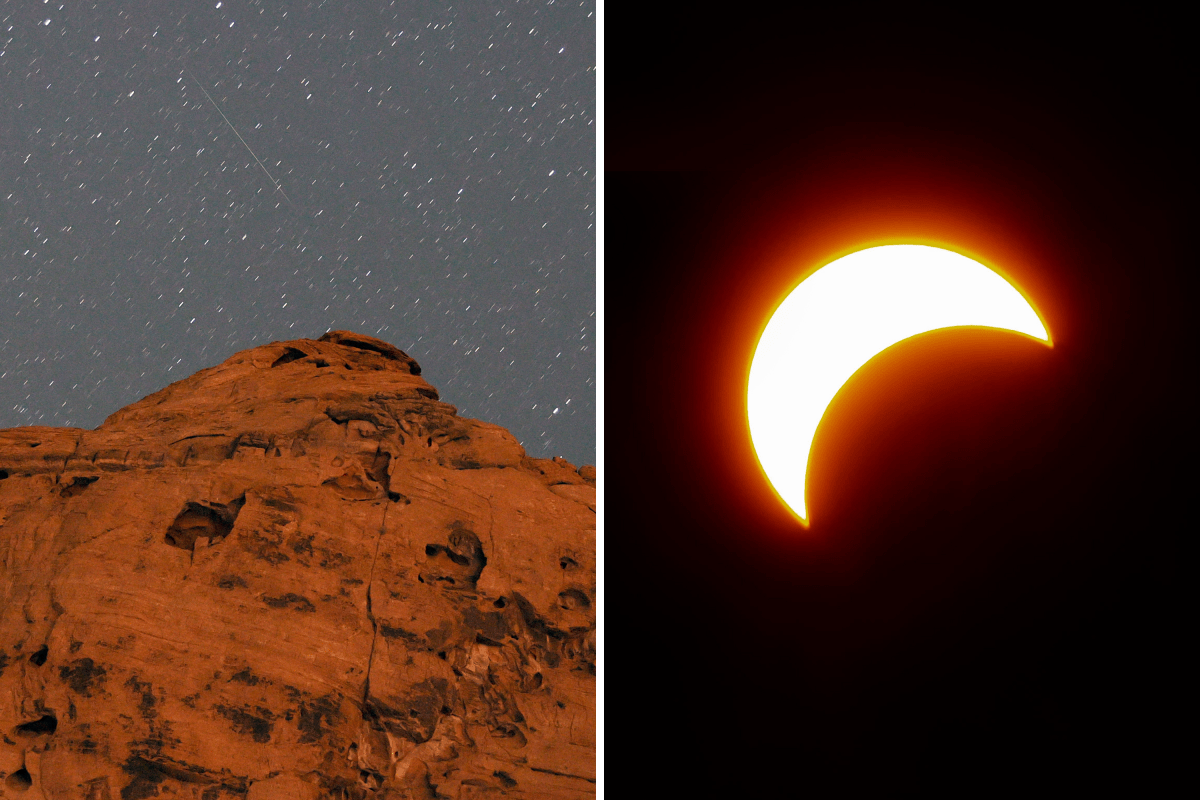
The 2026 Perseid display benefits from exceptional viewing conditions. Because a new moon coincides almost exactly with the shower’s maximum, there is little moonlight to interfere with faint meteors. Under dark skies, observers can expect 60 to 100 meteors per hour, including bright fireballs, with rates potentially approaching 100 per hour in ideal locations according to the Farmer’s Almanac.
Unlike the solar eclipse, the Perseids require no special eye protection and can be viewed safely with the naked eye. NASA recommends finding a dark location away from city lights, allowing approximately 30 minutes for eyes to adjust to the dark, and seeking out rural areas in states such as Maine, Vermont, New Hampshire, Massachusetts, Connecticut, and upstate New York where observers have a chance to catch both the afternoon eclipse and the nighttime meteor display under clear skies.
Related reading