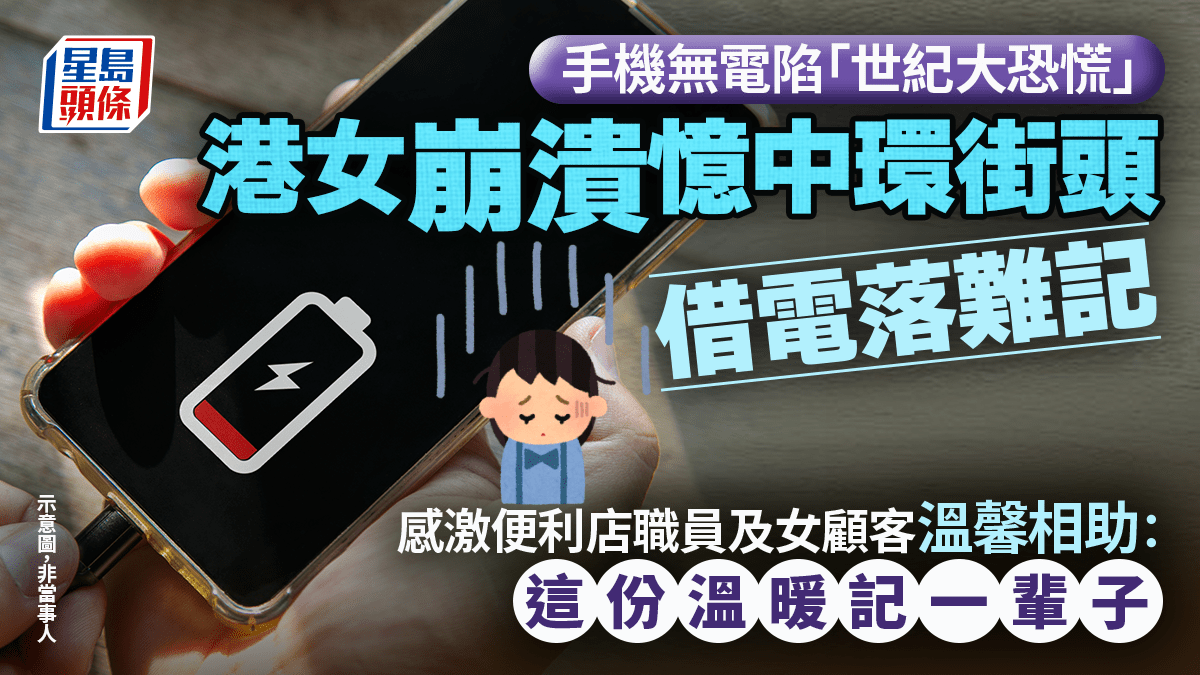
A dead smartphone battery in the bustling commercial district of Central in Hong Kong can quickly turn into a modern-day crisis, leaving commuters without navigation, digital wallets, or communication tools. That sense of vulnerability recently prompted a local commuter to share her experience of sudden device failure on a busy city street, highlighting an unexpected encounter with kindness from a stranger who stepped in to help.
The incident, which resonated widely across local online forums, underscores a growing urban anxiety around digital dependency. As daily life becomes increasingly reliant on smartphones for transit codes, electronic payments, and work coordination, running out of power is no longer a minor inconvenience—it can paralyze a traveler’s routine in seconds.
According to user accounts shared on the discussion platform Sing Tao Headline, the woman described a moment of genuine panic when her device shut down completely while she was navigating the crowded streets of Central. Stranded without access to maps or transport apps, she feared being entirely cut off until a passerby offered immediate assistance to restore power to her device.
The Anatomy of a Modern Digital Panic
Urban mobility in densely populated metropolitan areas like Hong Kong relies heavily on seamless digital integration. From the MTR transit network to local dining and retail, physical cash and printed maps have largely been replaced by mobile applications. When a battery dies unexpectedly, users face an immediate barrier to completing basic daily tasks.
For the commuter in Central, the sudden blackout meant an immediate loss of wayfinding tools during peak hours. Urban sociologists note that hyper-connectivity has raised the stakes for unexpected technological failures, transforming minor logistical hurdles into high-stress events. Without a backup battery pack or immediate access to a charging station, individuals find themselves abruptly isolated in the middle of crowded thoroughfares.
Public awareness campaigns by utility companies and transport operators frequently remind commuters to monitor their device power levels before embarking on long journeys. Yet, unexpected delays, heavy data usage, and aging hardware continue to catch travelers off guard across major transit hubs.
Acts of Kindness in a Fast-Paced City
Despite the fast-paced and often transactional nature of daily life in financial districts, the incident highlighted a contrasting current of community support. Rather than being ignored in the crowd, the stranded commuter received help from a helpful stranger who provided a temporary power source to revive her phone.
Writing in the online community thread, the woman expressed deep gratitude, noting that the warmth shown by the anonymous helper left a lasting impression. Such spontaneous gestures of assistance frequently surface in local forums, serving as a reminder of community resilience amidst the pressures of city living.
Community commentators often point out that while technology disconnects people from physical surroundings, it also creates shared points of empathy. Everyone who relies on a mobile device understands the sinking feeling of a blank screen, making battery-related distress a universally relatable modern dilemma.
Practical Strategies for Avoiding Power Failures
To prevent similar situations, urban commuters rely on a mix of portable hardware solutions and municipal infrastructure. Public venues, shopping malls, and transport interchanges across Hong Kong increasingly feature emergency charging stations, though availability varies during peak congestion.
Experts recommend several standard practices for maintaining mobile connectivity:
- Carrying a compact, certified portable power bank with sufficient capacity for at least one full charge.
- Downloading offline maps and essential transit guides for areas with heavy foot traffic.
- Enabling low-power mode early when battery levels drop below twenty percent to preserve core communication functions.
- Identifying public charging kiosks located within major MTR stations and shopping complexes before an emergency arises.
As urban centers continue to digitize public services, discussions around digital resilience and mutual aid on platforms like Sing Tao Headline reflect how residents adapt to the pressures of hyper-connectivity. Further updates and community discussions regarding urban commuter habits can be followed through local news portals as public transit networks evolve.