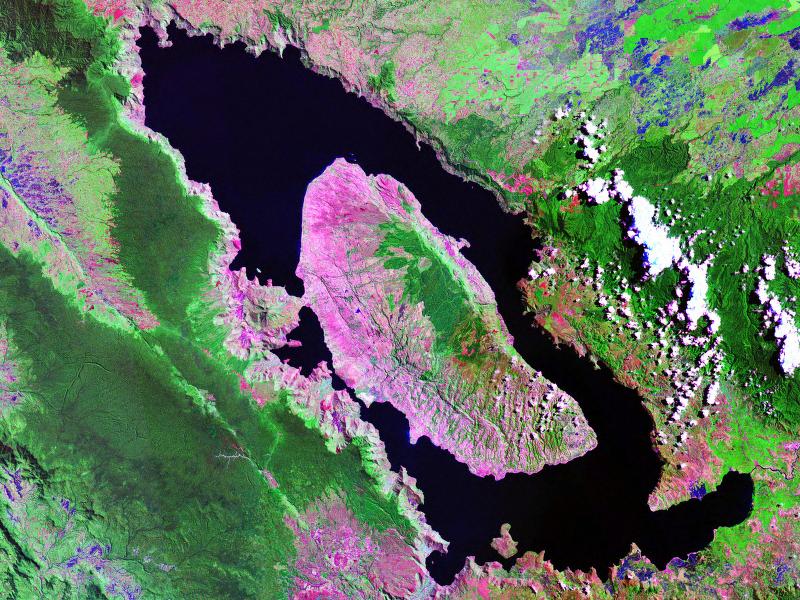
Did the cataclysmic eruption of Mount Toba 74,000 years ago nearly wipe out humanity? New scientific evidence suggests the “volcanic winter” and population bottleneck may be vastly overstated. According to a study published by researchers examining sediment layers from a crater lake on the Kenya-Tanzania border, the climatic impacts of the biggest volcanic eruption in the last 2.6 million years lasted under two years and resulted in perhaps half a degree of cooling.
The findings challenge long-held assumptions about the supervolcano, which emptied thousands of cubic kilometers of magma from a caldera on what is now Sumatra in roughly two weeks. That prehistoric explosion hurled out about a thousand times more material than Mount Pinatubo’s 1991 eruption, inspiring decades of scientific debate over whether it triggered a near-extinction event for early human ancestors.
“People thought it might have caused massive cooling of the planet, and hence threatened the survival of our ancestors,” says Jinheum Park, a geoscientist at Johannes Gutenberg University in Mainz, Germany.
Crater Lake Sediments Reveal Short-Lived Impact
To reconstruct the environmental toll of the ancient disaster, Park and his colleagues analyzed mud taken from the bottom of a small crater lake on the Kenya-Tanzania border.
Instead of discovering decades of deep freeze and widespread ecological collapse, the researchers found that the atmospheric disruption caused by Toba’s sulfur dioxide injection was surprisingly short-lived. The cooling phase persisted for under two years, with temperatures dropping by perhaps half a degree. This brief fluctuation falls far short of the volcanic winter models previously theorized.
Why Supervolcanoes Fail to Freeze the Planet
The study highlights a fundamental physical limit in how volcanic eruptions influence climate. During major eruptions, volcanoes inject sulfur dioxide into the stratosphere. Once there, the gas becomes a haze of tiny droplets that reflect sunlight back into space, driving surface temperatures down.
While conventional modeling assumes that larger eruptions equate to proportionally greater cooling, scientists now understand that this trend breaks down when an event exceeds a certain magnitude. According to Park, bigger sulfate aerosols settle quickly, because they are heavier. This quick settling makes them less effective in scattering incoming solar radiation, blunting the climatic fallout of hyper-massive eruptions.
Reassessing Human Resilience in Prehistory
The realization that Toba’s climatic footprint was relatively modest reshapes our understanding of human evolution. With the geological evidence now pointing toward a transient weather disruption rather than a multi-decade global ice age, scientists must look to other environmental, ecological, or demographic pressures to explain early human migration and survival patterns.
Researchers continue to analyze geological archives to map out local environmental responses to the eruption more precisely. Further updates on prehistoric climate reconstructions are expected as laboratory analyses of deep-lake core samples progress.
What are your thoughts on this revised timeline of ancient climate history? Share your insights and join the discussion in the comments below.
Worth a look