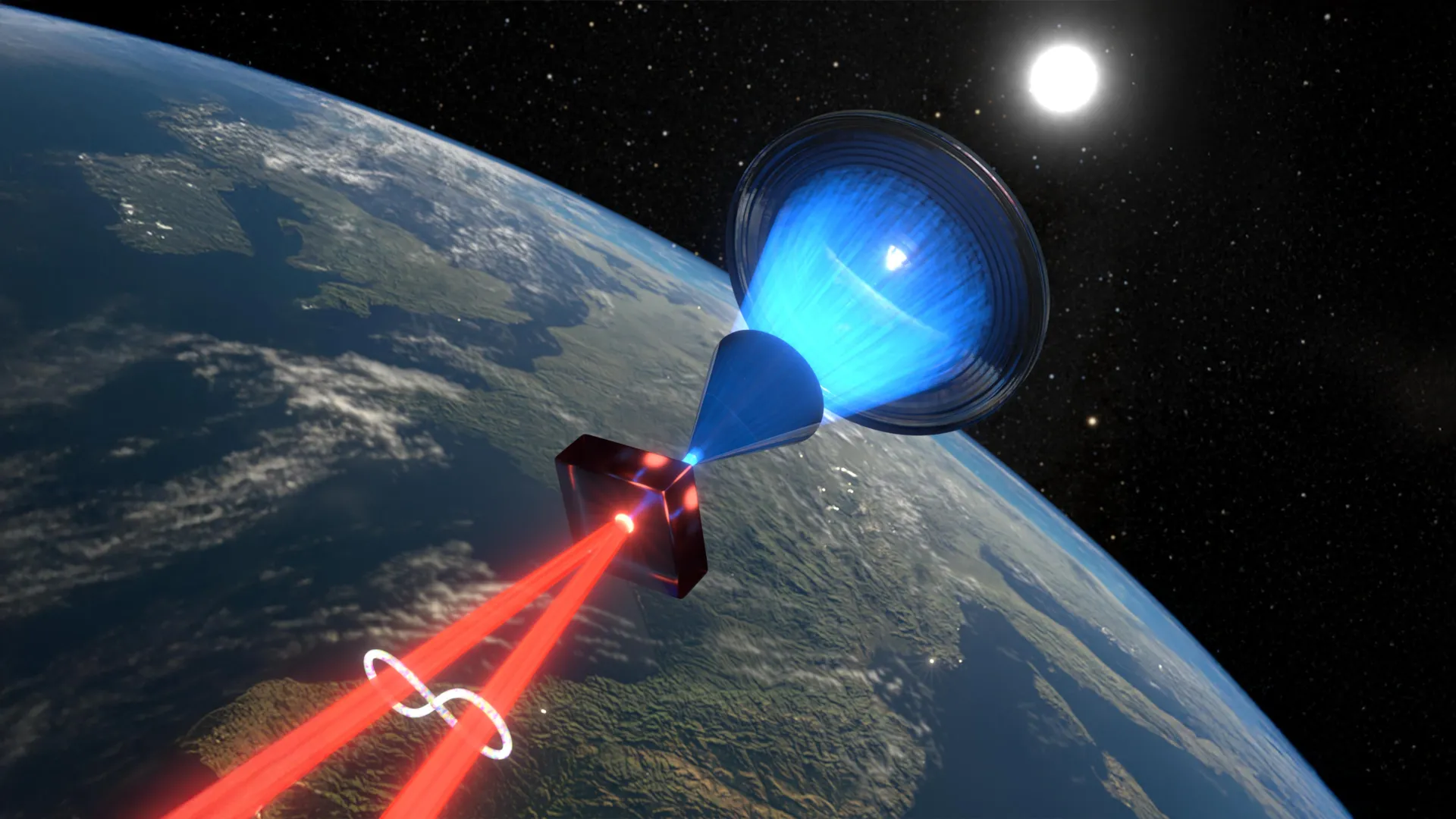
Researchers have generated quantum entanglement directly from sunlight, bypassing the energy-intensive lasers traditionally required for quantum technology and achieving an outdoor experimental similarity of about 94% to an ideal state, according to recent scientific findings.
Today’s quantum systems rely heavily on powerful lasers that consume significant amounts of electricity. As these applications scale up, their power demands pose a growing operational challenge. By demonstrating that natural sunlight can produce polarization-entangled photons, researchers have opened a potential route toward more energy-efficient and accessible quantum computing, secure communications, and space-based encryption.
“Quantum entanglement is crucial for applications such as secure communication, ultra-precise sensing and high-performance computation,” said Cheng Li, a recent graduate of the University of Ottawa in Canada, as reported by Optica Publishing Group. “Our work shows that abundant natural light sources can be used for quantum entanglement, opening the possibility of more energy-efficient and accessible quantum technologies.”
Challenging Assumptions About Quantum Light Sources
Physicists have traditionally believed that generating the strong correlations required for photon entanglement demanded coherent light. In a coherent light wave, peaks and valleys synchronize in a predictable pattern, which is why single-color lasers have served as the standard pump source.
Earlier theoretical predictions and experiments led by Robert Boyd’s research group at the University of Ottawa began to challenge that assumption. The team previously demonstrated that incoherent light from a light-emitting diode (LED) could produce polarization-entangled photons. That prior work established that light can remain disordered in one characteristic, such as its direction of travel, while still generating entangled photons through another property like polarization.
The new experiments push that concept further by substituting LEDs with direct sunlight, which spreads across multiple paths and encompasses a wide spectrum of colors.
Spontaneous Parametric Down-Conversion Using Natural Sunlight
To produce the entangled photon pairs, the research team utilized spontaneous parametric down-conversion (SPDC). In this standard optical process, a pump beam enters a nonlinear crystal, causing individual photons to split into entangled pairs.
Instead of using a conventional laser beam, the system was fed with sunlight that was strongly polarized yet highly incoherent across space and time. Although the sunlight contained varied colors traveling in multiple directions, its overall light field oscillated in a uniform direction.
“We designed our experimental setup so that differences introduced by the different colors and propagation directions didn’t influence the photons’ polarization,” said Li. “As our theory predicts, if the entanglement lives only in polarization, then it should only depend on the pump’s orderliness in its oscillation direction and not on its direction or color. This allowed us to produce high-quality polarization entanglement from highly spatially and temporally incoherent sunlight.”
To overcome the challenge of focusing diffuse natural sunlight onto a tiny, millimeter-sized nonlinear crystal, the project incorporated a specialized solar concentrator developed by Hanieh Fattahi’s team at the Max Planck Institute for the Science of Light (MPL) in Germany. The collaborative effort combined the theoretical framework from the University of Ottawa with advanced optics.
Implications for Quantum Satellites and Computing
The successful outdoor experiment yielded entangled photons exhibiting roughly 94% similarity to an ideal quantum state. Researchers suggest the breakthrough could simplify hardware requirements for future space missions.
“This technology could one day enable satellites to create secure encryption keys using the sunlight already abundant in space, reducing the need for onboard lasers and much of the supporting hardware,” said Li. “Sunlight-driven entanglement generation could also provide the crucial ingredient needed to scale up quantum computing without adding to the energy burden.”
The findings have been published in Optica, the high-impact research journal of the Optica Publishing Group.
What are your thoughts on harnessing natural sunlight for quantum networks? Share your perspective in the comments below.
Related reading