NASA’s Perseverance Mars rover has achieved a major navigation milestone, completing over 90% of its total distance across the Martian surface through autonomous driving. Operating in Jezero Crater, the six-wheeled vehicle combines advanced hazard-detection software with rugged hardware designed to withstand long-term exploration through 2031.
After nearly five years on Mars, NASA’s Perseverance rover has traveled almost 25 miles, or 40 kilometers, according to agency records. More than 90% of Perseverance’s journey has relied on autonomous driving, a capability that allows the robot to make real-time decisions without waiting for instructions beamed from Earth.
Enhanced Autonomous Navigation and Record Drives in Jezero Crater
The secret behind this autonomous stamina is an upgraded system known as Enhanced Autonomous Navigation, or ENav. While past rovers faced limitations when approaching clustered hazards like sand pits, rocks, and ledges, ENav evaluates terrain elevation and wheel-to-wheel trade-offs up to 50 feet ahead. The software picks an unobstructed route independently, allowing the rover to maintain steady progress across difficult Martian landscapes.
This software capability directly enabled a record-breaking drive on June 19, 2025. Perseverance utilized its navigation cameras to capture a single drive of 1,350.7 feet, or 411.7 meters, as detailed in mission logs. Engineers at NASA’s Jet Propulsion Laboratory combined these navcam images with rover telemetry into a three-dimensional virtual environment, mapping drive progress at high resolution.
Ono emphasized the broader implications for space exploration, noting that as humans go to the Moon and even Mars in the future, long-range autonomous driving will become more critical to exploring these worlds. Beyond ENav, the mission added Mars Global Localization, a feature enabling the rover to match onboard images against orbital maps to determine its position independently.
Hardware Durability Testing and Subsystem Lifespans Through 2031
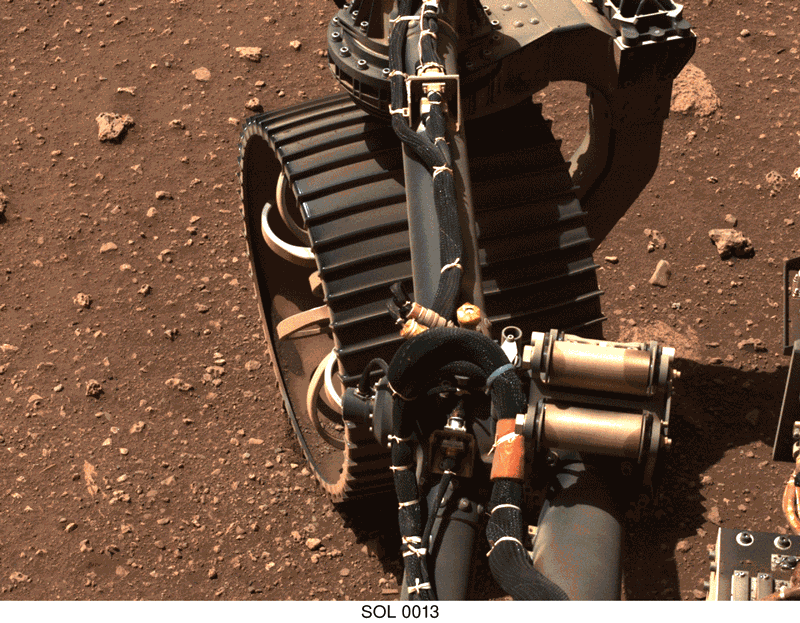
Autonomous software is only effective if the physical machinery survives the harsh Martian environment. Drawing lessons from Curiosity, which suffered wheel damage from sharp rocks, engineers redesigned Perseverance’s wheels. The rover features narrower wheels with a larger diameter and thicker aluminum construction. Each of the six wheels operates on an individual motor, while the front and rear wheels feature steering motors capable of full 360-degree turns.
To ensure the mission can extend far into the future, engineers at NASA’s Jet Propulsion Laboratory in Southern California have conducted extensive ground testing. Over the past two years, testing programs evaluated nearly all vehicle subsystems, leading experts to conclude that the hardware can operate until at least 2031.
Ground testing also certified that the rotary actuators turning the rover’s wheels can perform optimally for at least another 37 miles, or 60 kilometers. Comparable brake testing remains underway. Speaking at the American Geophysical Union’s annual meeting, project leadership shared encouraging assessments of the vehicle’s structural health.
“These tests show the rover is in excellent shape,” All the systems are fully capable of supporting a very long-term mission to extensively explore this fascinating region of Mars.”Steve Lee, Perseverance’s deputy project manager at JPL
Exploring the Margin Unit and Searching for Past Microbial Life
Perseverance spends its operational days investigating Jezero Crater, an ancient lake and river system holding rich reserves of olivine. This mineral typically forms at high temperatures deep within a planet’s interior. Between September 2023 and November 2024, the rover ascended 1,312 feet of a geologic boundary known as the Margin Unit, collecting three core samples from the area.
🔴 LIVE: Mars Perseverance Rover 4K | Real-Time NASA Mars Images | Jezero Crater | 24/7 Space Stream
Scientists examine these olivine-bearing rocks to understand how deep-interior magma intrusions interacted with ancient surface water and atmospheric carbon dioxide. These interactions created conditions that could have supported ancient life. This line of scientific inquiry gained intensity following the discovery that a rock sample nicknamed “Cheyava Falls” contains a potential fingerprint of past microbial life.
With its mobility hardware certified for operation until at least 2031, the rover is currently navigating toward a new exploration zone nicknamed Lac de Charmes. There, the vehicle will continue searching for rocks to sample in the coming year.