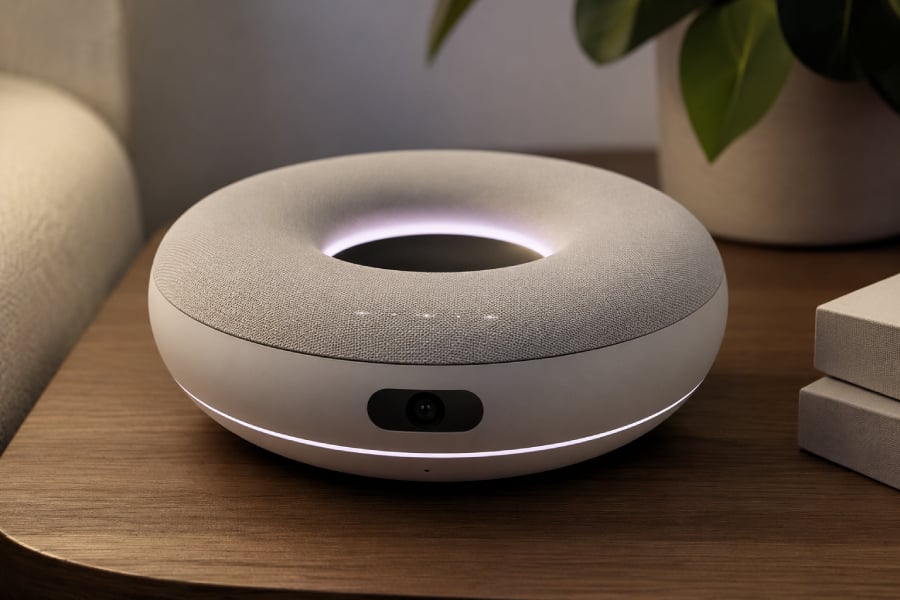
OpenAI is preparing to launch a screenless, artificial intelligence-first smart speaker shaped like a doughnut by 2027, according to reporting from Bloomberg citing people familiar with the matter. The battery-powered hardware is engineered in collaboration with former Apple designer Jony Ive and his design studio LoveFrom, marking a significant step for the artificial intelligence firm as it looks to build a consumer device ecosystem beyond traditional screens.
The compact device, roughly the size of a hockey puck and crafted from high-quality metal, is designed to be carried easily in one hand or tucked into a pocket. Internal discussions place the expected retail price between $300 and $400, according to industry reports. The hardware aims to serve as a mobile, highly personalized companion that learns user habits over time, operating as a proactive evolution of ChatGPT’s voice mode.
Unlike stationary market devices such as the Amazon Echo or Google Nest, OpenAI’s planned product features mechanical moving parts and dynamic lighting built to give the object a distinct personality. The moving components are intended to physicalize responses, making interactions feel more lifelike while processing ambient visual and auditory context through advanced microphones, speaker grills, camera systems, and environmental sensors.
Hardware Ambitions and the Jony Ive Partnership
The upcoming hardware project builds on OpenAI’s acquisition of Jony Ive’s device startup last year, bringing legendary industrial design expertise into the artificial intelligence sector. Sources cited by Bloomberg indicate that OpenAI is targeting ambitious production runs of up to 100 million units for the device over its lifecycle.
The product represents the foundational pillar of OpenAI’s long-term hardware strategy. By creating a portable, pocket-sized device equipped with advanced ambient sensors, the company is laying the groundwork for a platform that could eventually compete with or replace the modern smartphone. While tech giants like Apple explore stationary home displays driven by robotics, Apple’s current lineup lacks a portable, battery-powered smart speaker of this nature, according to industry analyses.
A representative for San Francisco-based OpenAI declined to comment on specific hardware roadmaps when contacted by reporters. However, internal development reportedly continues at full speed ahead of an anticipated official product unveiling later this year.
Legal Friction With Apple Over Design and Production
OpenAI’s hardware push unfolds amidst a high-stakes legal feud with Apple Inc., which recently filed a trade secrets lawsuit and requested a court injunction against the artificial intelligence developer. Apple alleges that OpenAI inappropriately instructed a shared supply-chain partner to deploy a proprietary metal-finishing technique originally developed for Apple’s own consumer products.
OpenAI has forcefully rejected the allegations, labeling them in court filings as “careless, aggressive, and oddly personal.” In a motion to dismiss filed in court late Wednesday, OpenAI maintained that an internal corporate investigation confirmed no trade secrets were infringed. The filing argues that the ring-shaped, screenless design represents an entirely new product category untouched by Apple’s existing intellectual property.
“OpenAI is building something entirely new and different from anything at Apple,” the filing stated. If granted by the presiding judge, Apple’s requested injunction could complicate OpenAI’s intended production timeline and disrupt preparations for the 2027 rollout. Legal teams on both sides continue to spar over discovery and manufacturing details as the litigation moves forward.
Market Positioning and What Happens Next
The intersection of advanced generative artificial intelligence and bespoke consumer hardware places OpenAI in direct competition with entrenched electronics manufacturers. By focusing on ambient sensing and physical movement rather than standard touchscreens, the device attempts to redefine how users interact with voice-driven large language models in daily life.
Legal analysts and tech industry observers are closely monitoring the ongoing trade secrets litigation in federal court, where the outcome of Apple’s injunction request will heavily influence manufacturing schedules. Meanwhile, internal engineering teams at OpenAI and LoveFrom continue development toward the anticipated product unveiling slated for later this year.
Keep reading