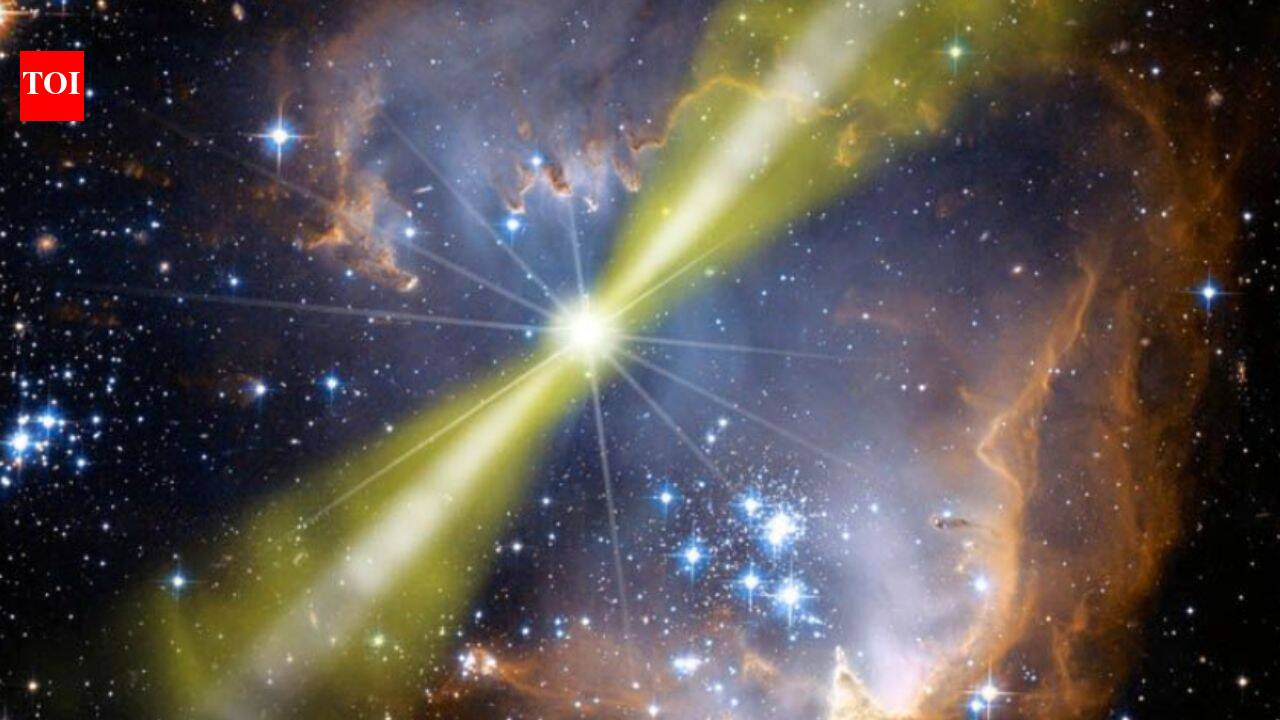
In July 1967, United States military satellites searching for secret nuclear detonations accidentally detected mysterious high-energy flashes originating from space. That unintended signal marked the first recorded observation of a gamma-ray burst, a cosmic phenomenon that continues to puzzle astronomers.
For more than half a century, gamma-ray bursts have remained among the most baffling occurrences in astrophysics. These events appear suddenly as brief flashes of high-energy radiation, lasting anywhere from a fraction of a second to several minutes. They can emerge from nearly any direction across the sky, leaving scientists to untangle how nature can produce such extreme outbursts of energy without leaving an obvious immediate trace behind.
Vela Satellites and the Accidental 1967 Detection
The story of gamma-ray burst research began with an entirely different mission. In July 1967, US military satellites known as Vela 3 and Vela 4 were monitoring for signs of clandestine nuclear weapons tests that might breach the Nuclear Test Ban Treaty. Instead of tracking man-made detonations, the onboard detectors picked up unexpected bursts of high-energy photons.
The first recorded gamma-ray burst occurred on July 2, 1967, although researchers did not immediately understand the true nature of the signal. The hardware was engineered specifically to identify X-rays, gamma rays and neutrons characteristic of a nuclear blast, not cosmic anomalies. Because the flashes vanished almost as quickly as they materialized, they left behind no visible stars or galaxies that astronomers could study.
Early hypotheses varied widely. Some researchers theorized that the bursts originated relatively close to Earth within the Solar System or the Milky Way, while others suspected much greater distances. The lack of identifiable counterparts created a persistent scientific puzzle that resisted quick answers.
Los Alamos Analysis and the Interplanetary Network
Progress came in incremental steps as researchers accumulated more data. Scientists at Los Alamos National Laboratory examined a series of similar events recorded by the Vela spacecraft. In 1973, they published an analysis of 16 bursts observed between July 1969 and July 1972, concluding that the signals possessed a cosmic origin.
Additional confirmation followed quickly. Soviet Konus satellites published supporting data in 1974, validating the existence of the cosmic flashes. To pinpoint where the signals originated, scientists established the Interplanetary Network in 1976. This collaborative effort linked gamma-ray detectors aboard various spacecraft monitoring the Sun and planets, allowing researchers to triangulate approximate burst locations.
Even when triangulation narrowed the coordinates down to a few arc minutes, the targeted positions still failed to match known X-ray emitters or other familiar astronomical objects. The exact mechanism and distance remained elusive.
Compton Observatory and Extragalactic Breakthroughs
A major turning point arrived after NASA launched the Compton Gamma Ray Observatory in 1991. Equipped with the Burst and Transient Source Experiment, the observatory was built explicitly to monitor these elusive events. Over nine years of operation, the instrument detected more than 2,700 separate bursts.
The distribution of these detections provided a vital clue. Rather than clustering along the plane of the Milky Way, the bursts were scattered uniformly across the entire sky. That pattern proved that the sources resided far outside our galaxy.
The realization that gamma-ray bursts were billions of light-years away implied staggering power requirements. If detectors on Earth could capture signals from such vast distances, the underlying explosions had to be extraordinarily energetic.
Afterglow Discoveries and Supernova Connections
Research entered a new phase in 1997 when the Italian-Dutch BeppoSAX satellite detected an X-ray afterglow linked to a gamma-ray burst. Tracking the fading afterglow allowed astronomers to examine the aftermath of the initial flash, confirming that some bursts originate billions of light-years from Earth.
Subsequent observations revealed the true scale of these events. Peak luminosities for gamma-ray bursts can reach 100 billion billion times that of the Sun, and a billion times greater than the brightest supernovas.
Detecting chemical elements such as iron, silicon, sulfur, and argon around the explosion sites later strengthened the scientific link between specific gamma-ray bursts and the cataclysmic deaths of massive stars. Observations of events like GRB990123 further suggested that the explosion energy is channeled into narrow, focused jets, meaning instruments on Earth observe a burst primarily when one of those jets points toward us.
Related reading