
Residents in Gilroy, California, are pushing back against a newly established 438,500-square-foot Amazon artificial intelligence data center that was approved at the staff level without a City Council vote or Planning Commission review. Built on a 56-acre parcel of land at 8050 Camino Arroyo, the facility was greenlit by Community Development Director Sharon Goei utilizing an industrial zoning classification written in 1981, according to official project documents and state environmental filings.
The controversy centers on a lack of public visibility and community engagement regarding the massive infrastructure project, which sits thirty miles south of San Jose. While local officials and company representatives defend the development as a standard industrial addition, community members argue that outdated municipal codes effectively bypassed public scrutiny.
The facility runs at 49 megawatts during its first phase and is situated above the Llagas Subbasin, which serves as the sole-source drinking water aquifer for Gilroy, San Martin, and Morgan Hill. Public opposition intensified following a packed June 15, 2026, public hearing where seventeen out of twenty-one speakers voiced strong opposition to further data center expansion in the area.
Outdated Zoning Rules and Staff-Level Approval
The approval process hinged on Gilroy’s M2 General Industrial zoning district, a legal framework established forty-five years ago before modern internet infrastructure or large-scale computing facilities existed as distinct land-use categories. Because the classification permits warehouse and industrial uses by right, the project required only a staff-level Architectural and Site Review Permit.

This administrative mechanism meant no elected body reviewed the application and no formal public comment window was opened for neighborhood residents. According to local reporting and public records, Amazon first purchased the 56-acre agricultural parcel in 2020. However, many residents stated they remained unaware of the project until construction activity was already underway. When one resident attempted to file a complaint, she was informed that the public comment period had closed in 2024.
Community organizers with the Stop Gilroy Data Center group highlighted significant transparency gaps during council meetings. Lead organizer Britt Smith told local officials that the existing letter of the law failed to provide adequate community access or proper notification, pointing out that no Spanish-language notices were distributed in the surrounding neighborhood, which organizers describe as a majority Latino and state-designated disadvantaged community.
Community Opposition and Environmental Concerns
Local anxiety focuses heavily on resource consumption, particularly water availability in a drought-prone region, alongside potential noise pollution from continuous generator operations. The California Energy Commission’s SPPE filing documents a buildout of diesel backup generators across the facility’s phases to support the heavy electrical load.
During the June 15 city council meeting, elementary school teacher Coleen Crew told administrators that many residents only discovered the facility after construction equipment arrived on site. College student and organizer Landon Sepulveda told the Wall Street Journal that the situation exposed a deeper trust gap between citizens and municipal leadership, stating that residents should not have to constantly watch over the shoulders of elected officials to understand what is being built in their neighborhoods.
In response to the backlash, Gilroy Mayor Greg Bozzo acknowledged that the situation reflects shifting public awareness regarding the environmental footprints of modern technology infrastructure. Mayor Bozzo framed the development as an opportunity to update municipal procedures, stating that the city views the controversy as a chance to review future urban planning processes to adapt to changing times.
Corporate Response and Economic Tradeoffs
Amazon Web Services defended the approval pathway, with Vice President of Economic Development Roger Wehner asserting that the project followed standard approval processes. Wehner noted that company representatives have since met directly with residents and hosted an open house to answer questions and gather feedback.
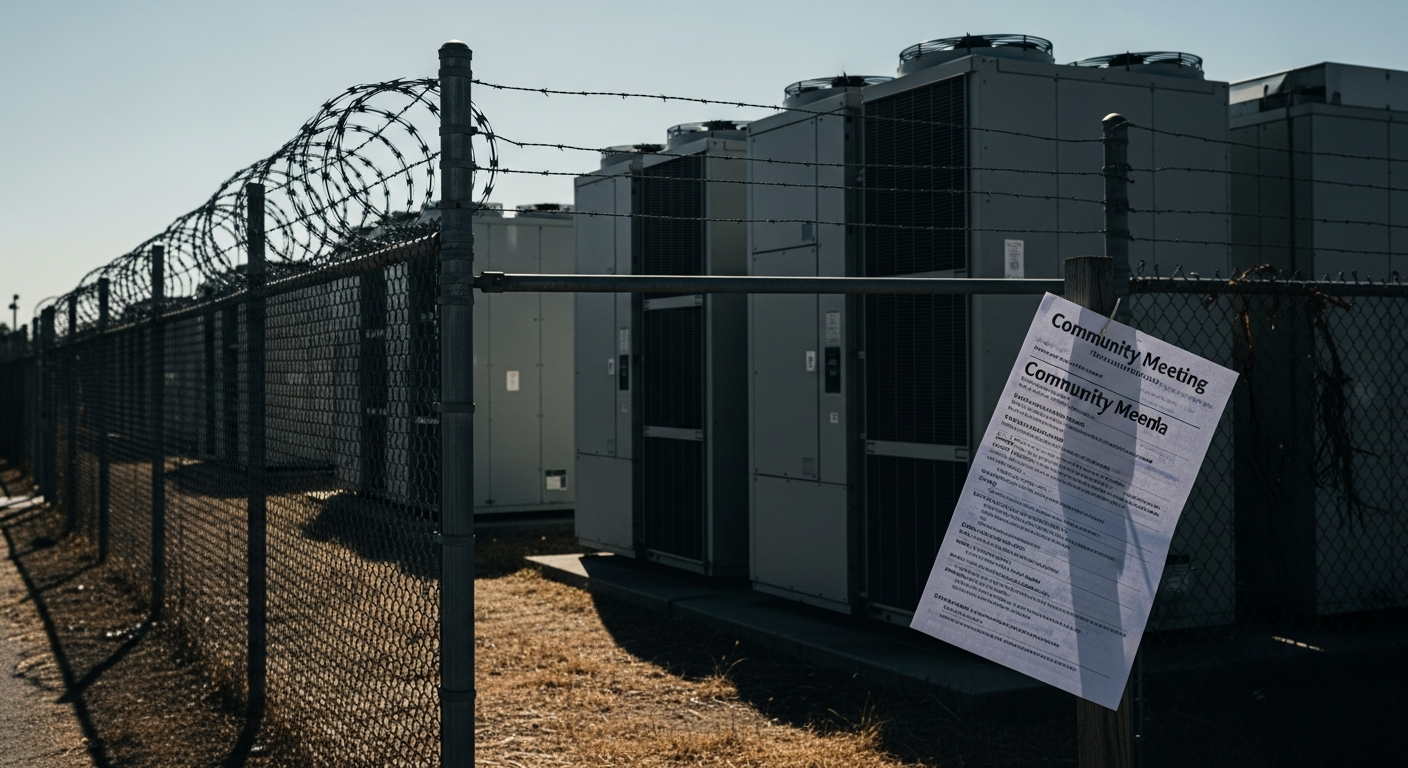
To offset local resource pressures, Amazon outlined plans to construct a wastewater reclamation system and install dedicated pipelines to supply reclaimed water to the data center. Furthermore, proponents of the project point to substantial economic benefits, including increased municipal tax revenue, construction-phase job creation, and a $1 million donation from Amazon toward a new city fire truck. Additional corporate sponsorships have funded local non-profits and the annual Gilroy Garlic Festival.
Despite these provisions, the pushback in Gilroy mirrors a broader national trend. Trade data indicates that more than sixty-nine jurisdictions across the United States have enacted data center bans or moratoriums amid mounting grassroots resistance to hyperscale computing expansions.
What’s Next for Gilroy Zoning Reform
In response to community pressure, the Gilroy City Council is actively pursuing zoning reforms to overhaul how industrial classifications handle high-capacity computing facilities. These legislative changes are being pursued before any Phase 2 permits for the Amazon development are formally filed. Residents and organizers continue to monitor council proceedings as municipal leaders attempt to balance commercial expansion with local environmental protections.
Keep reading
- Xiaomi 18 Leaks: Snapdragon 8 Elite Gen 6 2nm Chip and 5 Color Options Rumored
- NYSE to Develop On-Chain Payment Platform for Tokenized Securities
- Saros Hits Its Lowest Price Yet at Amazon with a $20 Discount on PS5 (world-today-news.com)
- Proposed UK Pub Regulation Sparks Outrage Among British Citizens (newsdirectory3.com)