Shenzhen Moliang Technology Co., Ltd. has successfully closed a Pre-A funding round securing tens of millions of yuan to accelerate its tactile sensor infrastructure development. The investment was led jointly by Falcon Investment and Yihua Capital, with Dian Shi Capital serving as the financial advisor for the transaction, according to industry reports. Founded in late 2024, the emerging firm plans to channel the new capital into expanding its research and development teams, scaling up its production lines, and driving global business development as tactile sensing becomes a critical pillar for embodied intelligence.
As humanoid robotics and automated industrial systems advance toward commercial manufacturing, the demand for sophisticated tactile perception has surged. Moliang Technology specializes in building a robust tactile infrastructure encompassing perception modules, data collection products, and tactile AI models. According to company disclosures, the enterprise centers its operations around two core tracks: humanoid robots equipped with dexterous hands, and industrial intelligent manufacturing.
The company’s technological foundation began with self-developed high-sensitivity materials and micro-structure fabrication processes. By optimizing material formulations and applying multi-scale micro-structure designs, Moliang Technology achieved dual perception capabilities for both pressure and temperature. By combining high-pressure-resistant elastomers with micro-nano structuring, the firm improved the measurement range, accuracy, and sensitivity of its sensors. Furthermore, the company explored cost-effective, large-scale manufacturing pathways utilizing micro-nano stereolithography technology.
Dual Tactile Solutions for Humanoid Robots
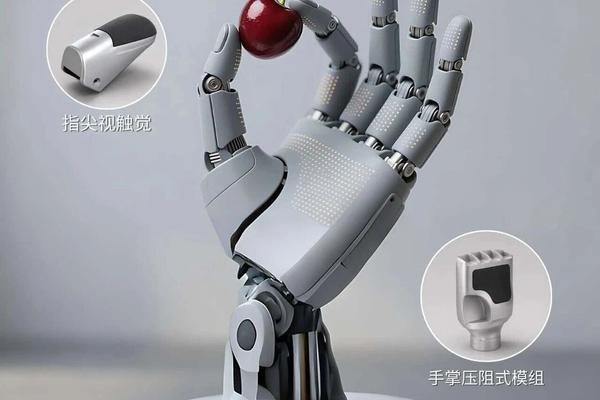
To address the complex needs of modern robotics, Moliang Technology develops both piezoresistive tactile modules and visual-tactile six-force modules simultaneously. The MoFi piezoresistive module utilizes flexible micro-nano perception technology alongside 3D force-sensing algorithms to deliver real-time feedback on gripping force, contact position, and surface conditions. Meanwhile, the MoVi visual-tactile six-force module relies on optical imaging principles to capture 3D shapes, slip trends, and force-torque information during a single contact event, providing high-resolution tactile feedback suited for precision assembly and dynamic gripping.
Different areas of a robot’s hand structure require distinct tactile approaches. The fingertip zone demands high-resolution visual-tactile solutions to manage delicate tasks like fine gripping, slip detection, and object deformation tracking. Conversely, space constraints on finger pads and palms make thin, flexible piezoresistive electronic skin a better fit. By combining these two technological routes, robots can achieve both fine-grained perception and large-scale tactile coverage. According to the company, this collaborative “visual-tactile plus piezoresistive” schema has already begun shipping in small-batch series.
Co-founder Zhou Jianlin noted that few firms in the industry simultaneously develop piezoresistive and visual-tactile solutions while successfully integrating both into dexterous hands. Beyond core modules, Moliang Technology has introduced wearable tactile data collection gloves. Built on a textile base integrating tactile and posture sensors, these gloves capture natural gripping motions to gather richer human-computer interaction data than traditional setups involving a gripping tong and a camera.
Algorithmic Innovation and Industrial Applications
To overcome consistency challenges inherent in modularized sensors, the company developed a neural network-based calibration algorithm. Traditional calibration methods often introduce errors across multiple points and measurement ranges, but Moliang Technology applies Multi-Layer Perceptron (MLP) neural networks to improve calibration accuracy across the entire span. For its visual-tactile offerings, the firm utilizes neural networks for AI inference matching, yielding accuracy levels significantly higher than conventional image processing algorithms.
Outside of robotics, the company targets industrial manufacturing scenarios with products like the MoTe pressure distribution test module. Deployed in EV battery manufacturing, industrial automation, 3C electronics assembly, and automotive component production, the module captures and analyzes multi-dimensional pressure data to visualize distribution states for battery disassembly testing and automated production line checks.
The company reports it has supplied more than ten leading robot and dexterous hand manufacturers, delivering complete tactile perception solutions to two key clients with million-yuan scale bulk orders scheduled for upcoming delivery. On the industrial side, commercial shipments have reached over three industry leaders.
Leadership and Investor Perspective
Moliang Technology’s leadership team brings multidisciplinary expertise from hardware, software, and academic research. Founder Guan Hua previously worked at a New York Stock Exchange-listed wearable smart device company, managing strategic cooperation and investment across supply chains, chips, and sensors. Co-founder Zhou Jianlin holds a master’s degree in engineering and served as a vice president at a 3D printing firm. Co-founder Gao Libo earned a doctorate from the City University of Hongkong, serves as a professor at Xiamen University, and brings over a decade of research experience in flexible sensors.
Investors have expressed strong confidence in the firm’s trajectory. Representatives from Falcon Investment highlighted the team’s combination of large enterprise experience and academic expertise in flexible tactile perception, noting that the company successfully tailors multiple technical routes to downstream customer requirements in embodied intelligence and consumer electronics. Yihua Capital emphasized that tactile sensors sit at the intersection of three major growth drivers: the mass production of dexterous hands, rising tactile penetration rates, and expanding application domains across automotive and smart manufacturing.
As the robotics industry accelerates toward mass production, Moliang Technology continues to build out its supply chain partnerships and pilot production lines.
Keep reading