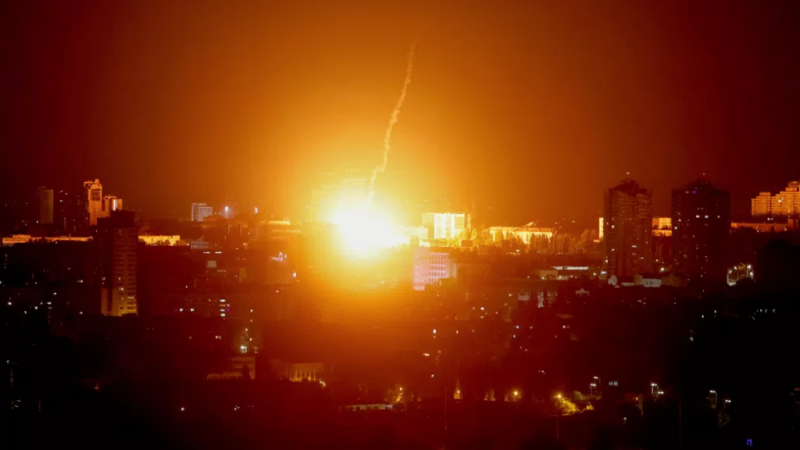
The Russian military launched a massive overnight bombardment against Kyiv, deploying an estimated 600 drones and 90 missiles that struck at least 40 buildings, killed four people, and injured more than 50, according to reports from Ukrainian authorities cited by Bild.
Kiews military administrator Tymur Tkatschenko stated that the capital became the target of a massive ballistic missile strike, urging residents to remain inside designated shelters, as reported by Bild. Mayor Vitali Klitschko described the event on Telegram by writing, “Es war eine schreckliche Nacht für Kiew,” noting that a school in the Shevchenkivskyi district sustained a direct hit that triggered a fire.
The extensive barrage also struck international media infrastructure stationed within the Ukrainian capital. The Westdeutscher Rundfunk announced that its Kyiv studio suffered severe structural damage, including collapsed walls, shattered windows, and destroyed technical equipment, though staff members were absent and uninjured at the time of the impact, according to Bild. A spokesperson for Deutsche Welle confirmed that its primary Kyiv office, situated mere hundred meters from the ARD location, also sustained damage to ceilings and windows.
Retaliation Context and Oreschnik Missile Warnings
The intensive overnight bombardment followed explicit retaliatory threats issued by Russian leadership following a reported Ukrainian drone strike on the Russian-occupied Luhansk region that reportedly resulted in 18 fatalities, details covered by Bild. Ukrainian officials contested the notion of a deliberate attack on civilians, asserting that the target was a specific drone unit belonging to the Russian army near Starobilsk.
In the hours preceding the strike, Ukrainian President Volodymyr Zelenskyy reported that national intelligence services had received corroborating data from European and American partners warning of an imminent deployment of Russia’s new Oreschnik missile, as noted by Bild. Zelenskyy stated in a video message that Russian forces fired the nuclear-capable hypersonic weapon against Bila Tserkva in the Kyiv region, calling the action irresponsible and demanding accountability.
International Reactions and Regional Security Measures
Diplomatic missions and neighboring states reacted swiftly to the escalating aerial campaign. The United States embassy in Kyiv issued a formal security alert warning that a significant airborne assault could occur within a 24-hour window, while Polish authorities ordered military aircraft to scramble and placed the national air defense network on heightened alert, according to Bild.

The Oreschnik missile, characterized as a nuclear-capable intermediate-range ballistic system designed to travel at hypersonic speeds exceeding 12,000 kilometers per hour, represents an escalation in the conflict’s technological profile.
Official updates regarding recovery efforts, casualty counts, and structural assessments will be released by the Kyiv City State Administration and emergency services as inspections proceed. Readers are encouraged to share their perspectives or local observations in the comments below.
Worth a look
- FDA Approves Orzeyful (Oveporexton) as First-in-Class Treatment for Narcolepsy Type 1
- Gestational Diabetes Cases Surge 60% in UK: Risks to Mother and Baby Explained
- UN Reports 95% of Ukrainian POWs Faced Torture in Russian Captivity (time.news)
- Ukraine Strikes Russian Oil and Chemical Plants Amid Deadly Missile Attacks (archynewsy.com)