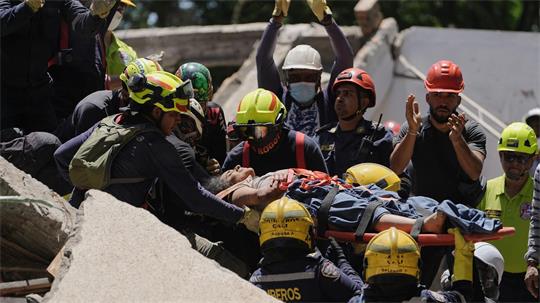
Rescue operations in western Colombia face a race against time as teams work through a critical third day following a destructive 7.4-magnitude earthquake, according to disaster management updates and local reports. The disaster has left at least 181 people dead and more than 2,500 injured, according to government figures. Authorities emphasize that the first 72 hours following the tremor represent the vital window for locating survivors trapped beneath collapsed infrastructure.
The powerful seismic event struck on Monday morning, heavily affecting urban centers including Pereira, Cali, Manizales, Quibdó, and Armenia. Officials describe it as the strongest earthquake to hit the South American nation in decades, triggering numerous subsequent aftershocks that have repeatedly interrupted recovery efforts. According to police and municipal authorities, more than 1,100 residential buildings and structures have collapsed across the region.
Among those rescued was 31-year-old Diana Troncoso, who spent nearly 30 hours trapped beneath the rubble of a fallen building in Cali before local firefighters freed her amid applause and cheers from bystanders. While international aid offers pour in from global governments and organizations, emergency personnel continue their grueling work against the ticking clock.
The Search for Thousands of Missing Persons
President Abelardo de la Espriella addressed the crisis during a visit to Pereira on Tuesday, stating that locating missing residents remains an absolute priority for the government. While official figures place the number of missing individuals at 195, unofficial online databases have logged more than 4,000 inquiries from desperate family members seeking information about their loved ones.
Families have gathered in front of massive piles of debris, utilizing platforms such as the “Colombia te busca” registry to share photographs and details of missing relatives, including individuals identified in public records as Leticia, Juan Ramón, James, Luz Elena, and Bernardo. Specialized rescue teams, accompanied by canine units from the Colombian police, are systematically searching the ruins of more than 1,100 damaged and destroyed structures.
Colombianos, ella es Diana. Estamos muy cerca de rescatarla. Todas sus oraciones con ella y con todas las víctimas que estamos buscando. Gracias a los rescatistas que están luchando por ella y por todos. ¡No descansaremos hasta lograrlo! #TodosSomosCali 🙏🏻 pic.twitter.com/sp7eNKuIx4
— Alejandro Eder (@alejoeder) August 11, 2026
Volunteers and professional rescue workers clear away rubble using buckets while heavy trucks transport the debris away from impact zones. The deployment of specialized rescue dogs has proven critical in detecting signs of life beneath unstable concrete slabs and twisted metal framework.
🐕 Ellos también ayudan a salvar vidas. 🐾Nuestros caninos especializados en búsqueda y rescate son parte fundamental de este gran equipo. Héroes de cuatro patas que, con su entrenamiento y olfato extraordinario, se convierten en protagonistas de cada misión y ayudan a salvar… pic.twitter.com/C5g8OiIzoD
— Policía de Colombia (@PoliciaColombia) August 11, 2026
Infrastructure Damage and Community Impacts
The human toll of the disaster extends across multiple provinces, leaving residents grappling with total loss. In Pereira, a local resident recounted to Caracol Radio the moment the earthquake struck while she was returning from a yoga class, describing her apartment as a scene of total devastation marked by cracked walls and broken glass. Further north in Roldanillo, local baker Hugo Gómez described his town as resembling a ghost town where his business was entirely destroyed within seconds.
Transportation networks have experienced significant disruptions, though aviation authorities confirmed that five regional airports have resumed full or partial operations following technical inspections. The airport in Cali is among those functioning again, while facilities in Pereira and Cartago maintain restricted access limited exclusively to official flights and emergency humanitarian transport.
International Aid and Official Responses
Global reactions and support have mobilized quickly. Meanwhile, El Salvador's President Nayib Bukele noted via social media that the Colombian government initially requested primarily humanitarian supplies, noting that domestic medical and rescue teams were already fully deployed.
In Europe, the German Federal Foreign Office stated that the full scope of the disaster remains difficult to estimate and warned that casualties may rise. German Chancellor Friedrich Merz and Foreign Minister Johann Wadephul both expressed their condolences to the victims. The European Union allocated an initial 100,000 euros to support the hard-hit Chocó region and activated the Copernicus satellite mapping service to evaluate structural damages.
Authorities have confirmed that the German embassy in Bogotá remains in close communication with Colombian officials to monitor the situation, with no current reports of German nationals among the casualties. Recovery operations continue around the clock as emergency personnel push through the remainder of the critical 72-hour window.
Keep reading
- Anthropic to Add Invisible Watermarks to Claude AI-Generated Text
- Xiaomi Redmi 17 Series Launched: Specs, Battery Upgrades, and Digi Mobil Offers
- Zdenek Pohlreich Reveals the Harsh Reality of Gastronomy and Rising Restaurant Prices (newsdirectory3.com)
- Chilean Court Orders Civil Registry to Add National ID to Death Certificate (archynewsy.com)