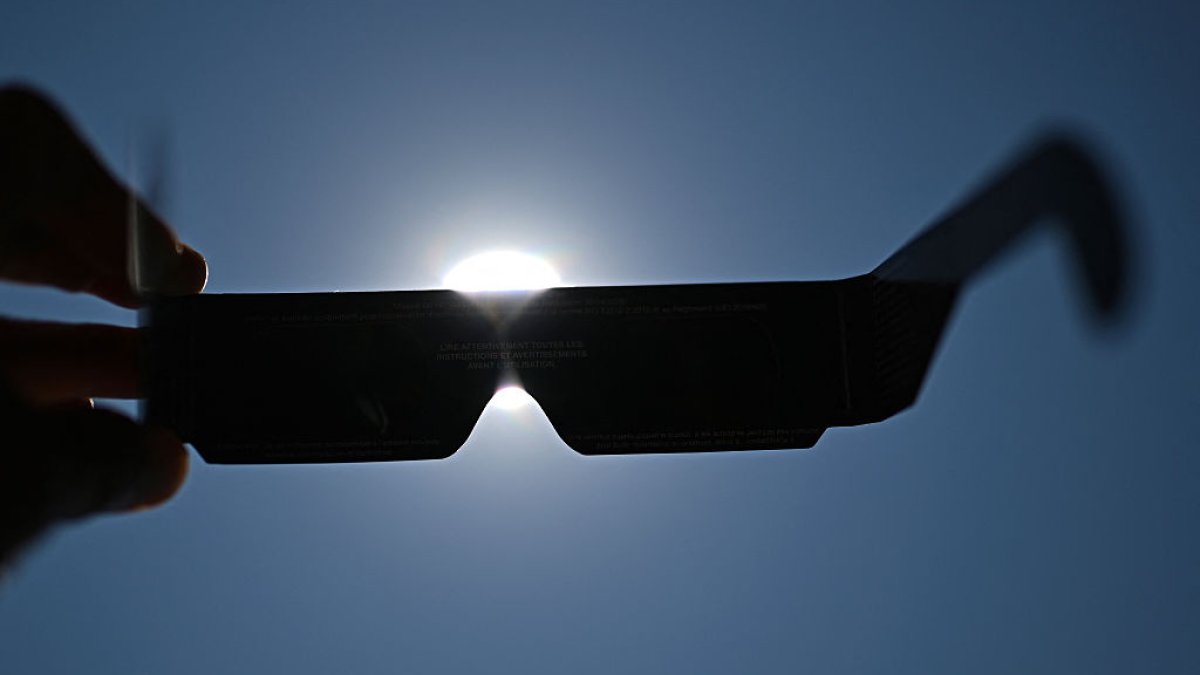
Skies across North America will witness a celestial alignment as a partial solar eclipse tracks across parts of the United States and Canada, though large portions of the continent will miss the event entirely. According to calculations from NASA, the astronomical phenomenon offers varying degrees of visibility depending on geographic location, ranging from minimal coverage in parts of the Midwest to substantial obscuration in northern territories.
The event’s trajectory begins near the North Pole before sweeping southward across Greenland, Iceland, Spain, and a portion of Portugal, where daytime darkness will last for no more than a couple of minutes. For observers in the United States, the partial eclipse commenced at approximately 10:34 a.m. CT, reaching its peak coverage at 11:52 a.m. CT before concluding around 1:52 p.m. CT, as detailed by University of Indiana astronomy professor Catherine Pilachowski.
While the path of the partial eclipse passes relatively close to major metropolitan areas, visibility varies significantly by region. Residents in Illinois and the greater Chicago area will experience minimal visual impact, with the moon covering less than 1% of the sun’s surface at the peak of the event. Similarly, NASA notes that only 3% of the solar disc will be obscured for observers looking toward the sky over Detroit.
Regional Visibility and Midday Timings Across North America
Visibility conditions and local schedules differ widely by city and state, dependent on clear weather and geographic positioning relative to the lunar shadow. NASA and observational data compiled by Time and Date outline the precise local schedules for various North American cities:
- Anchorage, Alaska: 28% coverage. Running from 7:36 a.m. until 9:09 a.m., with maximum local coverage occurring at 8:21 a.m. local time.
- Bangor, Maine: 24% coverage. Starting at 12:54 p.m. and finishing by 2:49 p.m., hitting its local peak at 1:53 p.m. local time.
- Detroit, Michigan: 3% coverage. Commencing at 1:03 p.m. and concluding at 2:08 p.m., achieving peak local time at 1:36 p.m. local time.
- Montreal, Quebec: 18% coverage. Initiating at 12:50 p.m. and wrapping up at 2:38 p.m., reaching maximum local intensity at 1:45 p.m. local time.
- New York City, New York: 9% coverage. Taking place between 1:07 p.m. and 2:38 p.m., with the peak happening at 1:54 p.m. local time.
- Philadelphia, Pennsylvania: 7% coverage. Spanning from 1:11 p.m. to 2:35 p.m., and peaking at 1:53 p.m. local time.
- St. John’s, Newfoundland and Labrador: 53% coverage. Lasting from 2:28 p.m. to 4:37 p.m., reaching its maximum local height at 3:35 p.m. local time.
- Toronto, Ontario: 8% coverage. Running from 12:55 p.m. through 2:23 p.m., attaining its peak local time at 1:40 p.m. local time.
- Washington, D.C.: 4% coverage. Starting at 1:17 p.m. and ending at 2:27 p.m., with the maximum local phase at 1:53 p.m. local time.
- Winnipeg, Manitoba: 5% coverage. Spanning from 11:25 a.m. to 12:40 p.m., and culminating at its peak of 12:02 p.m. local time.
In addition to these metropolitan areas, partial visibility extends across multiple U.S. states. According to tracking data, states experiencing partial eclipse activity include Alaska, Connecticut, Delaware, the District of Columbia, Illinois, Indiana, Iowa, Kentucky, Maine, Maryland, Massachusetts, Michigan, Minnesota, Montana, New Hampshire, New Jersey, New York, North Carolina, North Dakota, Ohio, Pennsylvania, Rhode Island, South Dakota, Vermont, Virginia, West Virginia, and Wisconsin.
Future Eclipse Outlook for North America
Observers who miss the current celestial alignment will face a significant wait for the next major coast-to-coast total solar eclipse in the United States, which is not scheduled to occur until 2045. However, partial eclipses will offer earlier opportunities for regional skywatchers.
NASA records indicate that a forthcoming partial solar eclipse on January 14, 2029, will provide significantly greater visibility for the Chicago area, obscuring nearly 60% of the sun’s surface. Official astronomical updates and safety viewing guidelines remain accessible through federal science agencies and academic observatories as local communities monitor weather forecasts for optimal viewing conditions.