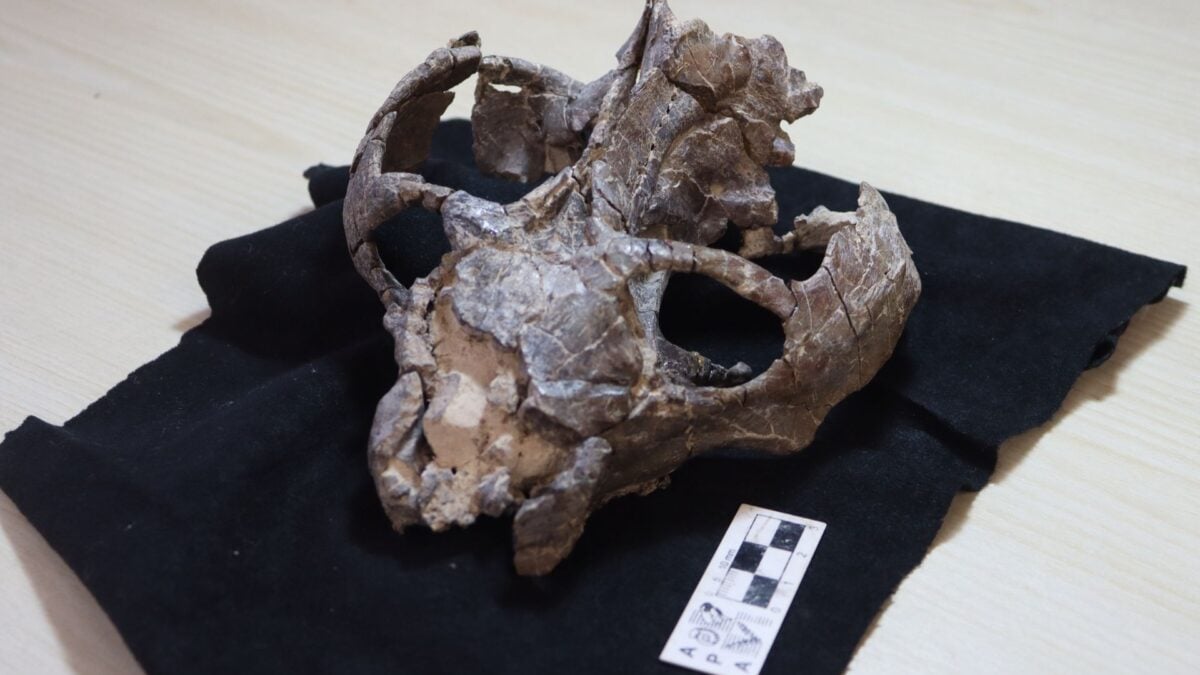
Researchers studying a 250-million-year-old fossil have uncovered the first ever proof that mammal ancestors laid eggs, a finding that reshapes our understanding of reproductive evolution. A PLOS One paper details that the specimen was found in South Africa and consists of a tightly coiled embryo belonging to a Lystrosaurus, a progenitor of mammals renowned for pulling through the “Great Dying” extinction event 252 million years ago.
High-resolution computer tomography and synchrotron scans revealed that the embryo’s jaws were not completely fused at the time of its death. Julien Benoit, an associate professor at the Evolutionary Studies Institute of the University of the Witwatersrand and lead author of the study, told CNN that this trait is only found in the embryos of modern birds and turtles, confirming that the Lystrosaurus embryo had been inside an egg when it died.
“This is the first time we can say, with confidence, that mammal ancestors like Lystrosaurus laid eggs, making it a true milestone in the field,” Benoit said in an interview covered by CNN. The discovery provides tangible insight into how our deepest animal forebears reproduced before the advent of live birth and lactation.
Shedding Light on the Great Dying and Survival Advantages
The fossil offers a potential explanation for how Lystrosaurus managed to endure the “Great Dying,” the mass extinction that ended the Permian geological period in which 90% of all living things on Earth died as the planet became much hotter and drier. According to details shared with CNN by Benoit, these ancient creatures lived in a very dry, desert-like environment, foraging in dry river beds and searching for soft, muddy ground in which to burrow and survive prolonged periods of drought.
The reproductive strategy of the animal played a critical role in this survival story. Benoit explained to CNN that the species would have laid comparatively large eggs for an animal of its size featuring soft, leathery outer shells—hard-shelled eggs did not evolve for at least another 50 million years. These leathery shells would lose less water than those of other species of that time. Furthermore, large eggs imply that baby Lystrosaurus would have already been quite developed when they hatched, allowing them to feed by themselves, run away from predators, and reach maturity faster so they could reproduce early.
Implications for the Evolution of Lactation and Viviparity
The study also sheds light on the timeline of mammalian lactation. Based on the new fossil evidence, researchers conclude that the ability to secrete milk to feed young would likely have evolved between the early and late Triassic period, spanning from 252 million to 201 million years ago, after the mass extinction.
Steve Brusatte, a University of Edinburgh paleontology and evolution professor unconnected to the research, communicated by email with CNN that the Lystrosaurus embryo is “a neat fossil.” Brusatte added that the find serves as “solid proof that some of our closest mammal ancestors and forebears were still laying eggs and reproducing like reptiles, and were not yet giving live birth and feeding their babies milk.”
Furthermore, Benoit pointed out that the data offer robust backing for the theory that milk secretion might have originated not to feed young offspring, but rather to hydrate and safeguard the leathery eggs deposited by early mammalian forerunners. Benoit and his colleagues plan to pursue further research on the evolution of lactation and viviparity—the development of an embryo inside the mother’s body—to map out the defining traits of the mammalian family tree.
Readers seeking further details on the study can review the published paper in the journal PLOS One or follow ongoing updates from the Evolutionary Studies Institute at the University of the Witwatersrand. Share your thoughts on this evolutionary discovery in the comments below.
Worth a look