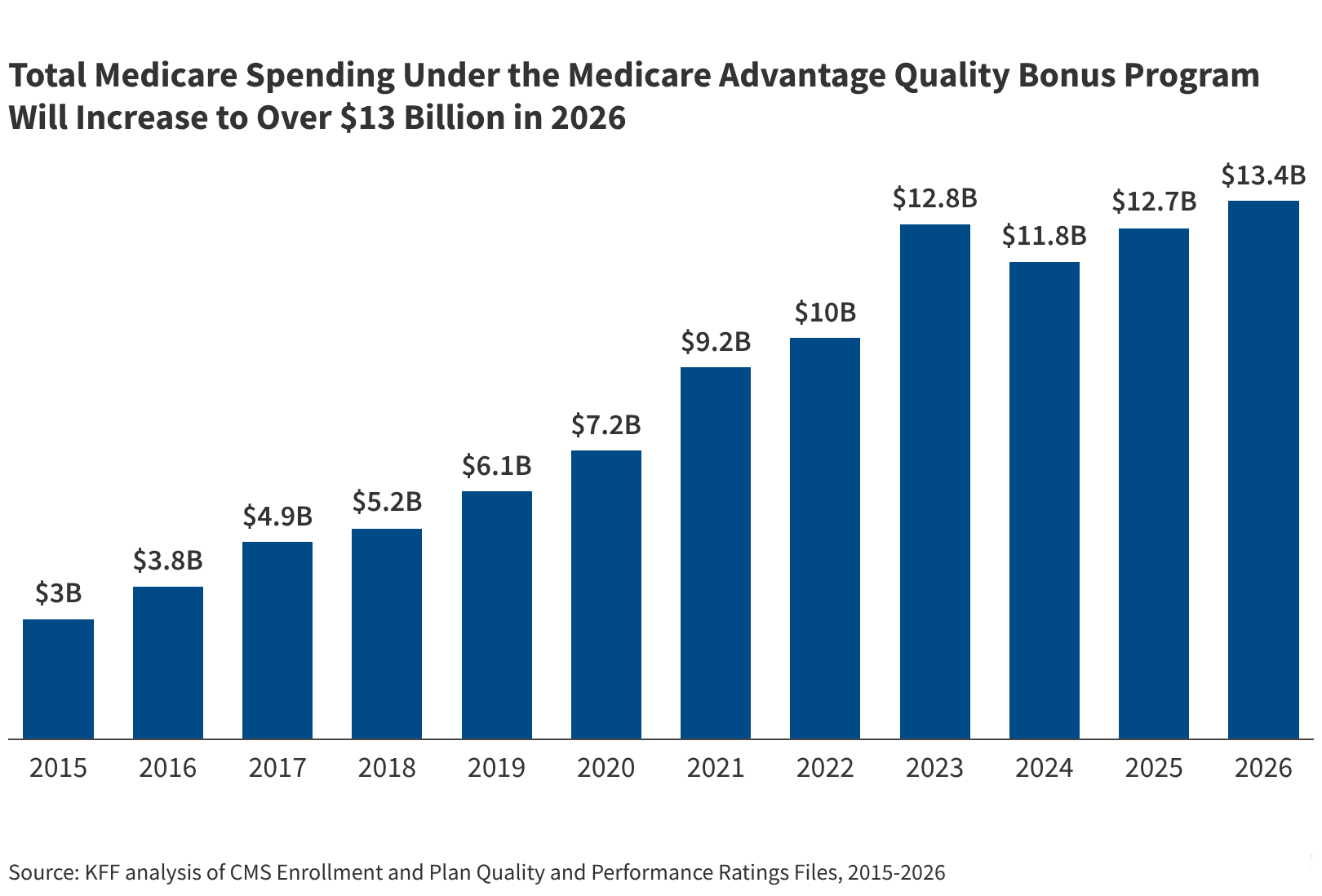
The Medicare program is projected to spend at least 13 billion dollars on the Medicare Advantage quality bonus program in 2026, driven by widespread plan performance ratings across the country. According to a brief published by the Kaiser Family Foundation, authored by Jeannie Fuglesten Biniek, Nancy Ochieng, and Meredith Freed, 68% of Medicare Advantage enrollees are in a plan that qualifies for higher payments under the program.
This federal outlay highlights the financial scale of the quality-based incentive structure within private Medicare plans. Established under the Affordable Care Act, the initiative uses a five-star rating system to grade plan performance, rewarding those that achieve a score of 4 or above with increased Medicare payments.
For Americans enrolled in private coverage alternatives to traditional Medicare, these bonus payments represent a financial lever. Companies can apply the extra revenue toward expenses like subsidized Part D prescription coverage, reduced cost sharing, decreased Part B premiums, and additional perks absent from standard Medicare.
How the Quality Bonus Program Operates
Under the statutory framework established by the Affordable Care Act, private health plans are evaluated using a five-star rating system. Plans achieving a star rating of 4 or above unlock additional federal funding designed to encourage plans to improve quality.
Insurers are not required to channel every dollar of their bonus revenue into direct patient care, but industry practices show that the revenue supports supplemental benefit packages. According to health policy researchers at the Kaiser Family Foundation, participating insurers may deploy these funds to cover extra services outside the scope of traditional Medicare. These additions often include reduced cost-sharing requirements, dental, vision, and hearing coverage, lower Part B monthly premiums, and subsidies for Part D prescription drug plans.
Federal officials intend for the star ratings to help consumers make informed decisions when choosing among Medicare Advantage plans.
Policy Debates and Structural Criticisms
Despite the distribution of bonus dollars, the program faces criticism from advisory bodies regarding its design and measurement integrity. The Medicare Payment Advisory Commission has suggested that the current star ratings incorporate too many measures.
Critics point out that the evaluation framework may not adequately account for social risk factors. Furthermore, because star ratings are reported at the contract level rather than the plan level, consumers may find it difficult to gauge the performance of a specific offering.
A single Medicare Advantage contract typically includes multiple plans, which may have different benefits, costs, networks, and service areas. Within these contracts, different groups of people can be enrolled—including special needs plans restricted to dual-eligible individuals alongside options that are available to the general public.
Financial Stakes and Outlook for Enrollees
The concentration of bonus payments among 68% of enrollees underscores how these ratings relate to insurance carrier revenue models.
Keep reading