Astronomers have discovered a brand-new type of astrophysical object known as a “black hole star,” potentially solving a mystery regarding strange red dots observed in the early universe. Detected by a U.S.-led team of astronomers using the James Webb Space Telescope (JWST) and detailed in a study published in the journal Nature, the object dates from approximately 660 million years after the Big Bang.
The newly identified anomaly, cataloged as MoM-BH*-1, resembles a star roughly the size of our solar system but produces 100 billion times more energy than any star. This colossal output of power aligns more closely with the energetic behavior of a black hole, offering a compelling explanation for the mysterious “little red dots” that have puzzled researchers since the powerful space telescope commenced operations in 2022.
“What exactly these objects are has been one of the most debated topics of the JWST era,” lead study author Rohan Naidu of Hawaii University said in a statement reported by CTV News. The research team initially sought to understand why JWST kept uncovering bright galaxies in the universe’s infancy—a time when it was thought to have been too early for them to have become so huge.
Decoding the Red Color and the Balmer Break
When analyzing distant cosmic bodies, astronomers typically attribute a reddish hue to surrounding clouds of cosmic dust, such as soot or ash. According to Robert Simcoe, a study co-author from the Massachusetts Institute of Technology (MIT), this is comparable to how wildfire smoke can make skies appear intensely red through a veil of particulate matter.
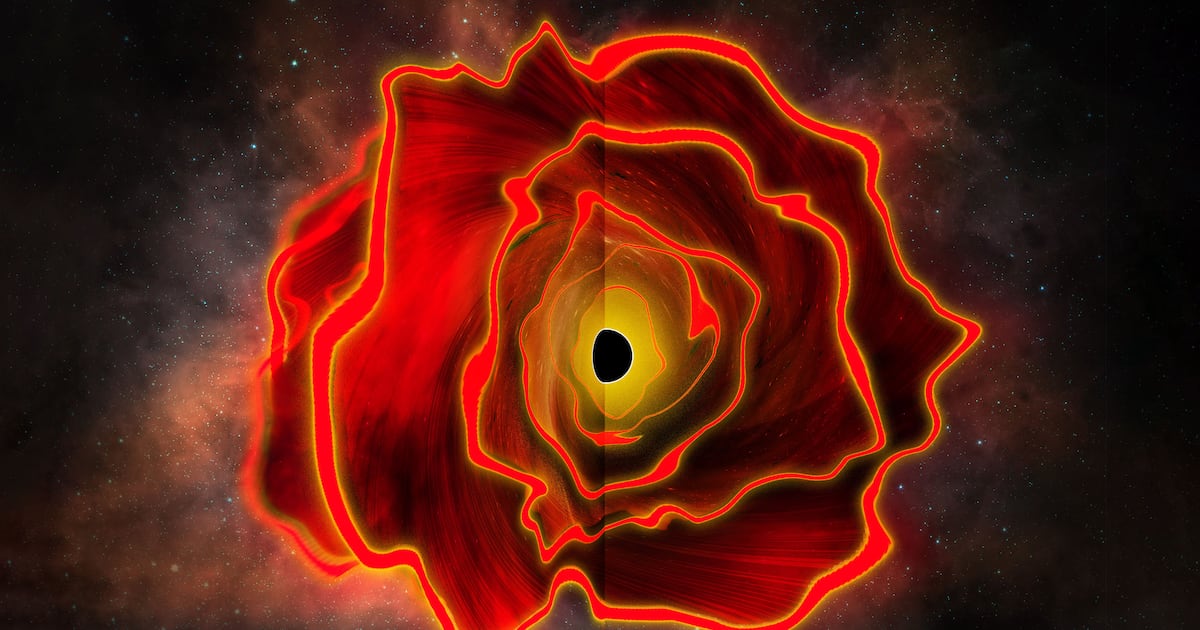
However, the data collected from MoM-BH*-1 revealed a different spectral signature. At specific wavelengths, the light from the dot completely disappeared. Physicists refer to this sharp drop-off as a “Balmer break,” a phenomenon traditionally linked to dense gas absorbing photons in the atmospheres of stars that are a few hundred million years old, much like the bright star Vega observed in our night sky. Naidu noted that the break recorded in this object is the deepest ever observed in any object, effectively ruling out ordinary stars as the source. Furthermore, the light contained almost no signature of metals or chemical elements other than hydrogen and helium.
Simulations Point to a Hydrogen-Cocooned Black Hole
To determine what could generate such unique characteristics, the research team ran computer simulations testing various astrophysical scenarios. They discovered that a screen of hydrogen so dense it resembles the surface of an enormous star—rather than a wispy nebula—could produce the observed red color without requiring dust.
Yet, a hydrogen cocoon alone could not account for the extreme energy output. “You have something that looks a bit like a star but is 100 billion times brighter,” Naidu explained, as noted by MIT News. “That means you can’t be powering this by nuclear fusion, which is the energy source that sits at the heart of all the stars we have.”
Because black holes routinely generate energy at such scales, the team incorporated an active, accreting black hole into their models. By varying the mass and other parameters, they found a close match: a central black hole roughly 100,000 times as massive as the sun, encased in a solar-system-sized cocoon of dense hydrogen gas.
Implications for Future Astronomical Discoveries
The designation MoM-BH*-1—combining the survey name with the acronym for a black hole star and the number one—suggests researchers believe this unique entity is the first of others. While other little red dots spotted in JWST imagery are less luminous, the researchers suspect that similar black hole stars may be embedded within generic early galaxies throughout the universe.
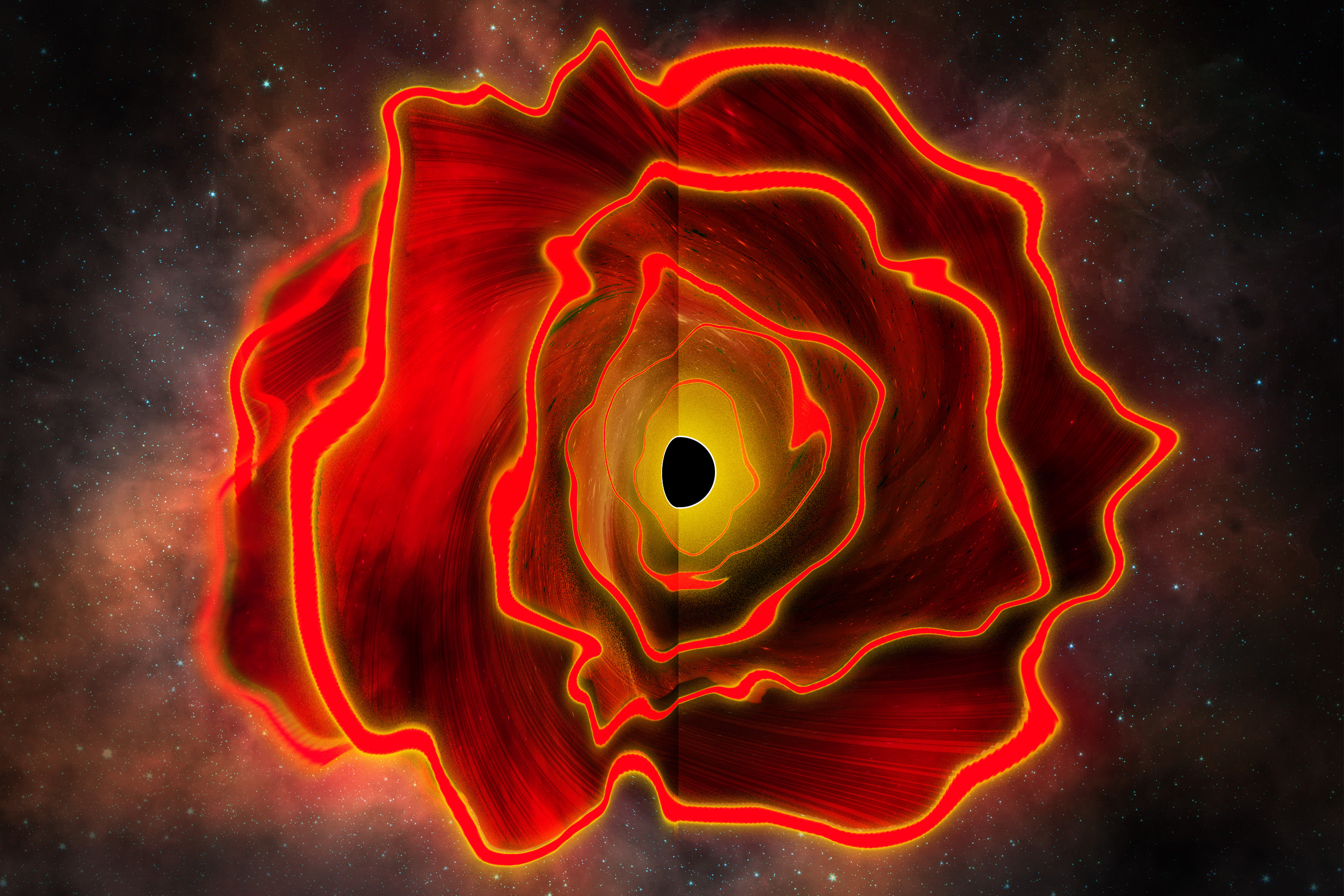
“Every little red dot is consistent with being a black hole star, embedded in a generic early galaxy,” Naidu stated. “What is special about MoM-BH*-1 is, the black hole star is essentially completely outshining its surrounding host galaxy, such that we’re seeing pure black hole star light.”
The research received support from NASA, the Space Telescope Science Institute, and the MIT Department of Physics. As scientists continue to analyze data from the James Webb Space Telescope, further studies of these enigmatic objects are expected to shed light on how supermassive black holes and early galaxies evolved together in the primordial universe.
Readers interested in following upcoming developments can track future publications in Nature or check updates from the Space Telescope Science Institute. What are your thoughts on this discovery? Share your perspective in the comments below.