
Ukraine has intensified a relentless drone strike campaign targeting the Kremlin-occupied region of Crimea, aiming to sever its logistical links to mainland Russia and nullify its strategic value as a military base, according to reporting by the Kyiv Post. Launched to isolate the peninsula through a comprehensive logistics lockdown, the ongoing aerial and maritime bombardment relies heavily on domestically manufactured strike aircraft and remote-controlled sea drones to hit high-value targets across a vast theater of operations.
Robert “Madyar” Brovdi, commander of Ukraine’s Unmanned Systems Forces (USF), announced that his troops initiated systematic attacks against Russian cargo trucks, fuel tankers, rail hubs, power grids, bridges, and automobile ferries supporting traffic to and from the Black Sea territory. The campaign, which marked its two-week milestone in July, forms part of a broader national strategy designed to compel Russia into peace negotiations by bringing continuous pressure on heavily defended supply lines and military assets in occupied southern regions, including Kherson and Zaporizhzhia.
Operations are conducted primarily at operational ranges spanning 50 to 300 kilometers from likely launch sites, utilizing an unprecedented volume of unmanned systems. According to published USF statements reported by the Kyiv Post, Ukrainian units launch at least 1,500 drones daily. Each unit functions essentially as a human-guided flying bomb capable of pinpoint strikes against vehicles and infrastructure.
Advanced Unmanned Arsenal and Multi-Agency Execution
The strike force relies on specialized aircraft tailored for distinct combat roles. The pusher-prop FP-2 drone serves as a primary workhorse carrying substantial explosive weight, while batwing Behemot drones—designed with a semi-stealth profile for low-altitude, undetected flight—execute selected operations. Pilots drawn from top USF strike units, alongside operators from Ukraine’s SBU national intelligence agency and the HUR military agency, coordinate the mid-range missions targeting Crimea, the Azov Sea, and the Black Sea.
Maritime operations employ remote-controlled sea drones packed with up to half a ton or more of explosives. Resembling racing motorboats in both appearance and speed, these surface vessels execute long-range strikes against larger targets such as tankers, oceangoing tugboats, and transport ferries.
Before launching the active interdiction phase, Ukrainian forces conducted preparatory suppression operations using long-range artillery and surface-to-surface missiles to degrade Russian air defense networks. USF counts, partially corroborated by regional social media accounts and partisan statements, indicate that these preliminary strikes damaged or knocked out critical radar installations and surface-to-air missile batteries protecting the peninsula.
Impact on Regional Defenses and Infrastructure
Heavy S-400 air defense sites sustained multiple direct hits by early July, while mobile Pantsir systems—engineered specifically to intercept incoming drones—were routinely located and struck within days of deployment. A representative operation occurred overnight between June 23 and 24, when a coordinated wave of USF and SBU drones targeted over 60 air defense assets across Crimea. Subsequent strike footage verified the destruction of a Pantsir-S1 system, an S-300 launcher, a ZU-23 gun system, and a Nebo-U radar station.
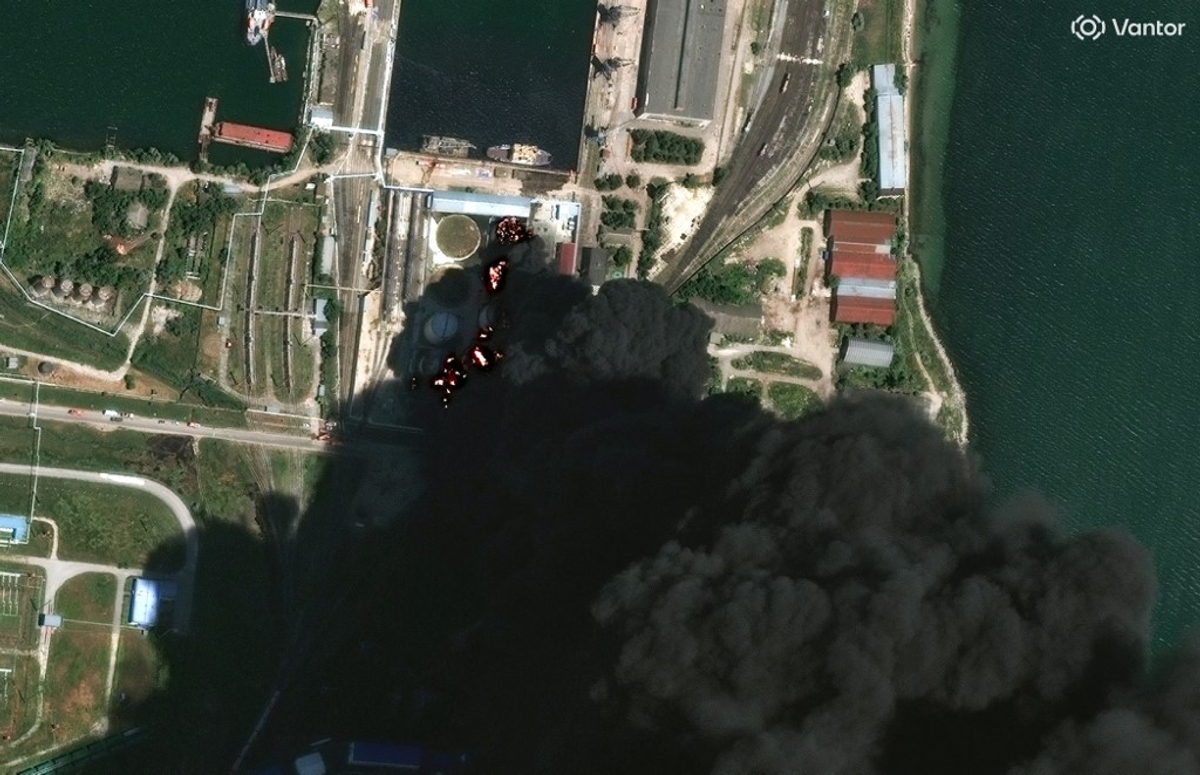
Local monitoring indicates that active Russian anti-aircraft fire has largely contracted to heavily fortified positions, such as the Novorossiysk naval port in Russia’s Krasnodar region and the Saki airfield near Sevastopol in southwestern Crimea. Across the wider operational zone—spanning land and sea areas roughly comparable to the combined sizes of Hungary and Slovakia—Ukrainian forces maintain persistent pressure on remaining logistical nodes.
Official updates regarding the campaign’s progression and tactical assessments are periodically released through military channels and defense communications managed by Ukraine’s Unmanned Systems Forces. Readers seeking further developments can follow institutional updates and official briefings provided through Ukrainian defense media platforms.
Worth a look