China and East Asia Command Global Fleet Assets
Released in August 2026, the institute's International Logistics Weekly highlights a heavy geographical bias in asset distribution, with Asian markets holding a commanding majority of the world's container fleet value.
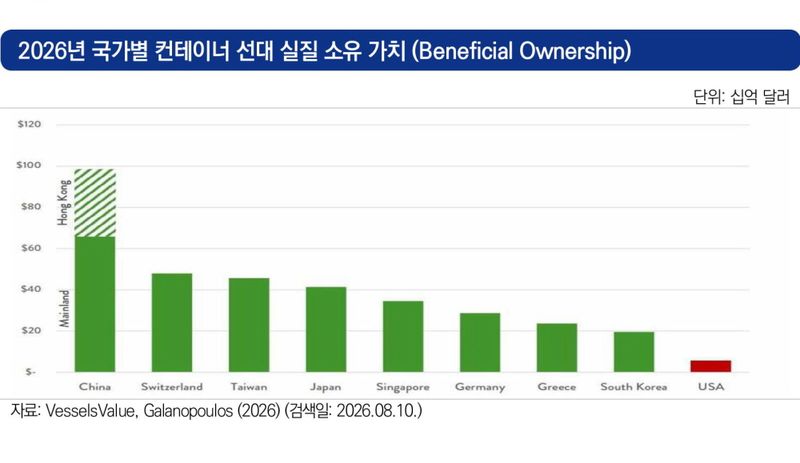
China leads the world in the practical ownership value of global container fleets as of the first half of 2026. Switzerland, Taiwan, Japan, and Singapore follow close behind in overall asset valuation. China alone accounts for roughly 30 percent of the total global container fleet value.
When expanded across the broader region, East Asian economies including China, Japan, Singapore, South Korea, and Taiwan collectively command about 70 percent of the world’s total container fleet asset value, underlining a distinct geographic center of gravity in maritime asset holding.
The Rise of Mega-Carriers and Alliances
Alongside national asset concentration, vessel capacity has gravitated rapidly toward a handful of dominant shipping lines. Data cited by the KMI show that the top 10 container shipping companies in the world expanded their combined slot capacity share from roughly 61 percent in the year 2000 to approximately 84 percent recently.
This carrier consolidation manifests primarily through operational pacts known as alliances, which allow mega-carriers to pool vessels and jointly manage primary trade routes.
Powerhouse Coalitions Control Trade Routes
Following significant industry restructuring, the global container market operates largely under three primary coalitions: Ocean Alliance, Gemini Corporation, and Premier Alliance. Together, these three powerhouse groups control approximately 83 percent of global container slot capacity.
Individual capacities within these cooperative blocs remain massive. The Ocean Alliance commands roughly 994여만 TEU of capacity, while Gemini Corporation operates approximately 710여만 TEU, and Premier Alliance manages about 390여만 TEU.
Regulators Weigh Competition Against Efficiency
While vessel sharing agreements and joint operations have long operated with regulatory tolerance to maximize fuel efficiency and schedule reliability, their sheer market footprint now triggers intense debate.
Balancing Operational Scale and Trade Policy
KMI researcher Ha Do-yeon analyzed the shifting landscape by noting that future container shipping markets must navigate a delicate equilibrium between operational efficiency achieved through mega-vessels and alliances versus the preservation of healthy market competition.
Furthermore, shifts in United States maritime competition policy could send ripple effects through global carrier operations and service network designs. Industry stakeholders must closely monitor evolving regulatory frameworks and trade policy adaptations as maritime authorities evaluate the long-term impacts of deep market consolidation.