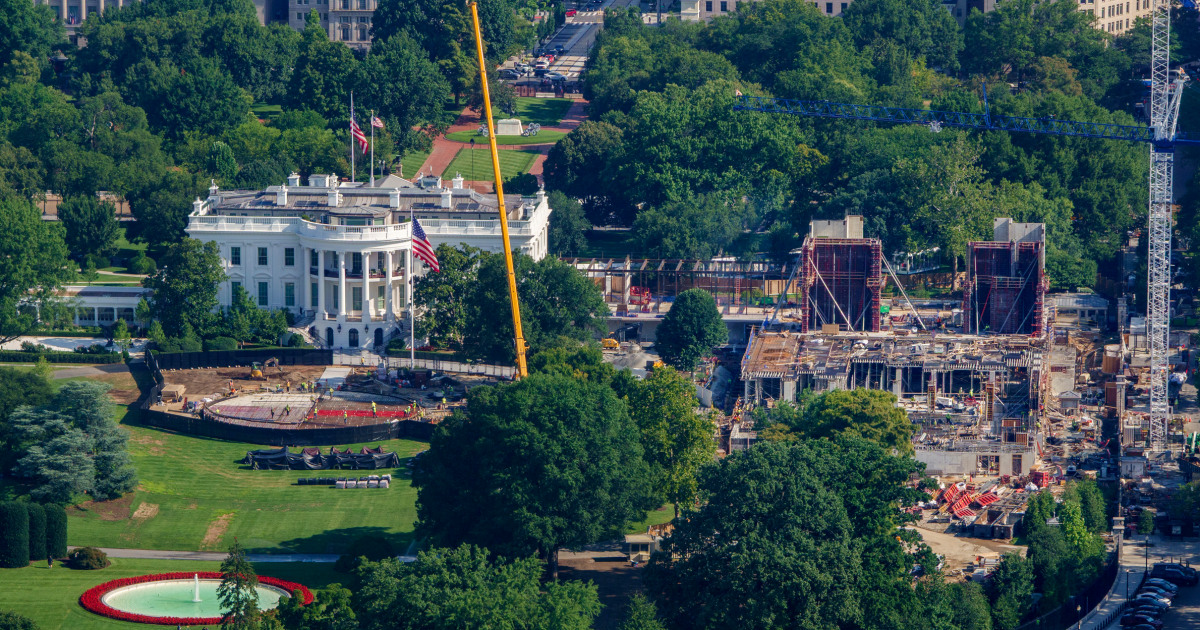
President Donald Trump’s administration has formally petitioned the U.S. Supreme Court to lift a temporary legal block and allow construction to resume on a $400 million White House ballroom project. The solicitor general filed the emergency application following a divided appellate ruling that halted the undertaking over congressional approval disputes.
The legal battle centers on a 90,000-square-foot ballroom complex currently occupying the former site of the White House East Wing, which was demolished in the fall. A three-judge panel of the U.S. Court of Appeals for the District of Columbia Circuit ruled 2-1 that the executive branch lacks unilateral authority to construct the facility because Congress has not approved the project.
In the emergency petition, government attorneys urged the justices to intervene before the appeals court mandate takes effect. The administration argues that maintaining an open construction site on the executive mansion grounds makes it harder to protect the White House and that the judicial branch is improperly interfering with executive branch facilities management.
Legal Arguments and National Security Claims
The Justice Department’s filing contends that halting work midway leaves the complex vulnerable. According to court filings submitted by the solicitor general, the project involves an integrated military complex with a secure ballroom space deemed vital for national security.
“This case involves an extraordinary and unlawful injunction that will halt the ongoing construction of the integrated military complex, including a totally secure ballroom space, at the East Wing of the White House, which is vitally required by national security,” the solicitor general wrote in the petition to the high court.
The appellate panel’s majority decision last week sided with historic preservationists, including the National Trust for Historic Preservation, who sued to stop construction of the ballroom. Government lawyers countered that preservation groups lack the legal standing to challenge executive branch property decisions, maintaining that the president holds unimpeded authority to renovate the White House.
Scope of Presidential Authority Debated in Court
During oral arguments before the D.C. Circuit in early June, Justice Department lawyer Yaakov Roth faced questions from the bench regarding the theoretical limits of executive control.
Confronted by the judges with a hypothetical case involving executive real estate oversight, Roth contended that authorities could demolish both the White House and the Statue of Liberty without descendants of enslaved builders of the White House or immigrants processed at Ellis Island possessing any legal right to file a lawsuit.
Meanwhile, lawmakers on Capitol Hill have expressed oversight concerns. Senate Democrats recently sought an audit into the ballroom project, citing a lack of transparency regarding taxpayer expenditures.
What Happens Next
The appeals court previously granted a brief two-week administrative stay to give the White House time to seek Supreme Court intervention before the injunction fully goes into effect on Aug. 21.
The administration’s top appellate lawyer requested that the high court issue a ruling on the stay application prior to the implementation of the lower court panel’s mandate.
Worth a look