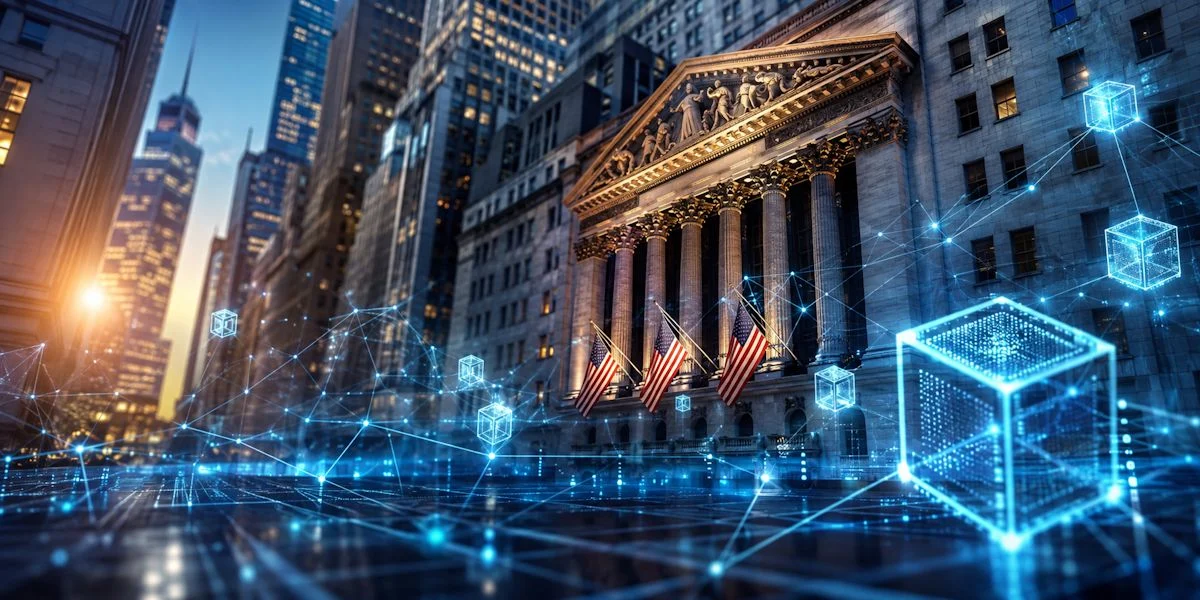
Wall Street Redesigns Its Financial Architecture
Wall Street is quietly redesigning its core financial architecture around blockchain technology, signaling a massive shift from experimental cryptocurrency projects to mainstream institutional adoption. According to a comprehensive report titled Tokenization 2030: Wall Street On-Chain released by the Citi Institute, traditional financial heavyweights are moving past preliminary trials to build operational market infrastructure directly on distributed ledgers. Citi estimates that the global market for tokenized financial assets could soar to 5,5 billones de dólares by the year 2030 under its central baseline scenario, with potential valuations ranging between 2,7 y 8,2 billones depending heavily on regulatory milestones and institutional momentum.
For financial institutions, this evolution represents a fundamental departure from the decade prior, when tokenization was primarily championed by crypto startups and isolated pilot projects with little connection to legacy capital markets. Today, the movement is spearheaded by some of the most critical institutions in the United States financial system. Operators such as the DTCC, which handles clearance and settlement for nearly all US stock transactions, alongside the NYSE and Nasdaq, are actively working to integrate tokenized assets directly into their core trading platforms.
Equities and Sovereign Debt Drive Growth
Unlike early predictions that pointed toward private equity or real estate as the primary beneficiaries of blockchain integration, Citi’s analysis indicates that publicly traded equities, public bonds, and United States Treasury debt will lead the adoption during this decade. By bringing these assets on-chain, market operators aim to drastically reduce settlement times and operational frictions.
Managing Transition and Technical Complexity
However, analysts at Citi caution that the industry will not experience a sudden, disruptive revolution. Instead, the firm outlines a prolonged transitional phase where traditional registers, private distributed networks, and public blockchains will coexist. This operational overlap will likely increase near-term technical complexity before structural efficiency gains materialize. Achieving widespread adoption will require significant advancements in cross-platform interoperability and the establishment of a harmonized regulatory framework.
The Crucial Role of Regulated Digital Money
Another core finding of the Citi report emphasizes that blockchain tokenization cannot scale effectively without regulated digital money. Early experiments stumbled largely because tokenized assets still relied on legacy banking rails for final settlement. The modern landscape, by contrast, is being shaped by the projected expansion of regulated stablecoins and tokenized commercial bank deposits, which can facilitate near-instantaneous delivery-versus-payment transactions. Citi projects that the stablecoin market could reach 1,9 billones de dólares by 2030, becoming the primary support for the development of blockchain-based financial markets.
The Rise of Structural Orchestrators
This technological upgrade carries profound implications for market structure, potentially consolidating power among entities capable of orchestrating multiple layers of the value chain. Citi introduces the term “Structural Orchestrators” to describe institutions that successfully integrate asset issuance, distribution, and settlement. While clearinghouses, custodians, asset managers, and commercial banks will remain essential, smart contracts and instantaneous settlement will automate many traditional administrative duties. The resulting ecosystem promises lower operational expenses, continuous trading availability, and innovative revenue streams tied to digital custody and automated collateral management.
As traditional financial giants systematically embed blockchain into the bedrock of global capital markets, the narrative surrounding distributed ledger technology has fundamentally shifted. Rather than attempting to construct an alternative financial system detached from traditional banking, Wall Street is modernizing its plumbing from the inside out.
Keep reading