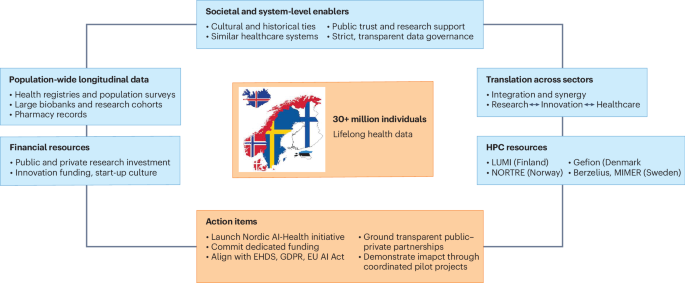
The Nordic AI-Health Initiative has outlined a comprehensive regional blueprint to connect large-scale longitudinal and multimodal health data sets across six countries, establishing a federated technical framework designed to enable secure, regulation-compliant access for medical research. As detailed in scientific literature published in August 2026, the proposed infrastructure seeks to overcome years of cross-border institutional and legal barriers by keeping sensitive patient data under national control while allowing approved computational models to move between secure environments.
Rather than functioning as a deployed clinical platform or a centralized database, the initiative serves as an infrastructure thesis for the Nordic and Baltic regions. According to independent analysis published by Remio, the proposal requires participating nations to harmonize governance, semantics, and validation procedures so that disparate national systems can operate effectively as a unified research network.
The timing of the initiative aligns closely with broader European regulatory shifts. The European Health Data Space, or EHDS, has entered an extended implementation period designed to set binding rules for cross-border health data access. Proponents of the Nordic initiative argue that countries in the region should organize their unusually detailed population data before broader European genomic, imaging, and computing infrastructures mature.
Connecting Data Without Moving It Across Borders
The technical architecture relies on federated learning to process sensitive medical information without transferring identifiable records across national borders. Instead of centralizing patient data, the system sends analytical instructions and model code directly to participating national environments. Each local site performs approved computations internally and returns only permitted results or aggregated model updates.
This approach addresses strict privacy requirements, though developers emphasize that federated learning does not entirely remove legal responsibilities or security risks. Model updates can leak information in some settings, meaning every participating environment must strictly enforce access controls, comprehensive logging, and rigorous output vetting. Approved analyses are designed to run exclusively within controlled trusted research environments.
The underlying data assets across Denmark, Estonia, Finland, Iceland, Norway, and Sweden include extensive longitudinal health records that track individuals across time. By combining these records with biobanks, genomic resources, and multimodal data sources such as medical images, laboratory results, and clinical registries, the initiative aims to develop and test biomedical foundation models.
Overcoming Institutional and Legal Fragmentation
While the Nordic region possesses extensive population data and sophisticated healthcare registries, researchers have historically struggled with structural fragmentation. The primary obstacle is not a lack of data assets, but rather the absence of shared operational authority, standardized semantics, and coordinated validation procedures across national boundaries.

The proposal reflects input from 22 authors affiliated with universities, hospitals, biobanks, and life-science organizations throughout the region. Their framework focuses heavily on the foundational data and computing layers required to build medical AI models capable of generalizing better than systems trained on single hospitals or narrow cohorts.
Public health authorities and institutional stakeholders are expected to review these governance frameworks as national and European data regulations continue to evolve. Readers seeking further updates on health data infrastructure developments can monitor official announcements from regional research institutions and European regulatory bodies.
What are your thoughts on federated health data infrastructure? Share your perspective in the comments below.