
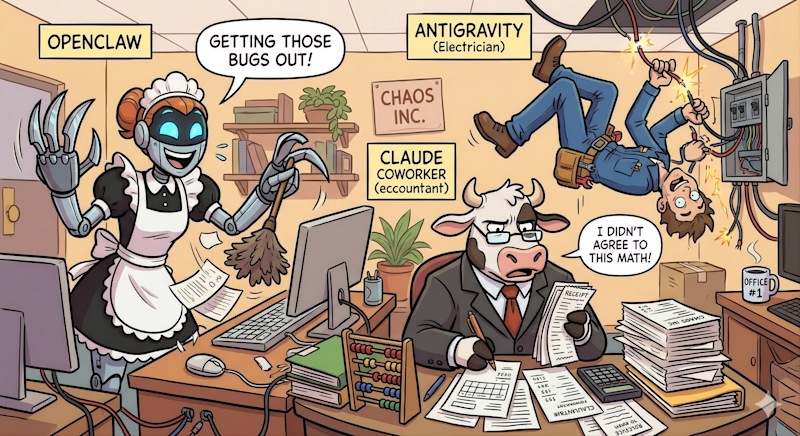
The era of agentic AI has arrived, shifting the conversation from simple chatbots that answer questions to autonomous agents capable of executing complex workflows. This transition marks a significant leap from the early days of generative AI, moving toward a reality where software doesn’t just suggest text but actively manages files, triages emails, and handles professional domain tasks.
However, this rapid deployment of AI agents has introduced a new layer of volatility. As tools like Claude Cowork and OpenClaw gain traction, the industry is grappling with the “chaos” of granting deep system access to autonomous models. For users and enterprises, the promise of reduced cognitive load is now balanced against the risks of data leaks and unauthorized system modifications.
The current landscape is defined by a clash between open-source flexibility and the controlled ecosystems of tech giants. While open-source projects allow for rapid innovation, the lack of a central governing authority creates security concerns. Conversely, proprietary agents offer more guardrails but are increasingly moving toward restrictive monetization models.
A prime example of this tension is the recent shift in how Anthropic manages its ecosystem. As of 3 p.m. ET on April 4, 2026, Anthropic stopped offering free access to Claude through third-party tools like OpenClaw according to Engadget. Boris Cherny, Anthropic’s creator and head of Claude Code, stated on X that subscriptions no longer cover the usage patterns of these third-party tools due to engineering constraints and the demand to prioritize capacity for direct customers and API users.
Comparing the New Wave of Autonomous Agents
The current market is seeing a divergence in how AI agents are applied, ranging from general-purpose “maids” to specialized professional consultants. Understanding these distinctions is critical for users deciding which tools to integrate into their local machines.

OpenClaw, an open-source AI assistant, is designed to automate personal workflows. It is capable of managing belongings—such as files and data—to perform tasks like inbox triaging, sending emails, and organizing calendars. Because it is deployed on local machines with deep system access, it operates with a high degree of autonomy, effectively acting as a digital assistant with “the keys to the house.”
In contrast, Anthropic has introduced Claude Cowork. This desktop agent is designed to touch files directly and provides domain-specific knowledge for industries such as legal and finance. Cowork can automate professional tasks, including contract reviews and NDA triage. The introduction of such specialized capabilities has reportedly caused volatility in legal-tech and software-as-a-service (SaaS) stocks, a phenomenon referred to as the “SaaSpocalypse.”
Beyond general and professional agents, We find highly specialized tools like Google’s Antigravity. This coding agent includes an integrated development environment (IDE) that streamlines the process from a prompt to a production-ready application. Antigravity allows users to interactively create entire projects and modify specific details, functioning similarly to a junior developer who can build, test, and fix issues within a narrow scope.
The Risks of Deep System Access
The utility of an AI agent is directly proportional to the power it is granted. However, increasing an agent’s authority increases the risk of misuse. When an agent has the ability to modify system files or execute code, a single incorrect prompt or “hallucination” can lead to significant damage.
In a coding environment, an agent might inject incorrect code or create hidden flaws that are not immediately evident. In a professional context, a tool like Cowork could potentially miss critical tax-saving opportunities or, conversely, include illegal write-offs if not properly supervised. Because OpenClaw is open-source, it lacks a central governing authority to enforce safety standards, which complicates the security landscape for those deploying it on local hardware.
To mitigate these risks, the industry is emphasizing “responsible AI” principles. These include accountability, transparency, reproducibility, security, and privacy. Experts suggest that logging every step an agent takes and requiring human confirmation for critical actions are essential guardrails to prevent autonomous agents from making random or unaccounted-for decisions.
The Path Toward a Controlled Ecosystem
As agents begin to interact with diverse systems, the need for a shared “language” or ontology becomes paramount. A domain-specific ontology can define a “code of conduct” for agents, ensuring that events can be tracked, monitored, and accounted for across different platforms.
When combined with a shared trust and distributed identity framework, these systems can enable agents to perform useful work without compromising security. The ultimate goal is to offload the “cognitive load” of mundane tasks—such as scheduling and data organization—allowing the human workforce to focus on high-value, creative, and strategic tasks.
Summary of Agent Capabilities
| Agent | Primary Focus | Key Capabilities | Access Level |
|---|---|---|---|
| OpenClaw | Personal Workflow | Inbox triaging, calendar management | Deep Local System Access |
| Claude Cowork | Professional Domains | Contract review, NDA triage, finance | File-level access / Domain-specific |
| Antigravity | Software Development | App creation, testing, integration | IDE / Project-specific |
For users of OpenClaw who still wish to utilize Anthropic’s models, the new reality requires a financial commitment. Users must now purchase a usage bundle—which are currently discounted—or provide a Claude API key to maintain functionality as detailed by Engadget. Alternatively, users are switching to other AI integrations such as xAI, Perplexity, or DeepSeek.
The transition to agentic AI is an ongoing process. As these tools evolve, the focus will likely shift from mere capability to the robustness of the guardrails surrounding them. The industry continues to monitor how these autonomous systems impact job security and the broader software economy.
The next major checkpoint for users will be the rollout of further usage bundle options and potential API updates from Anthropic as they continue to optimize capacity for their first-party products.
Do you use AI agents for your daily workflow? Share your experiences and the guardrails you use in the comments below.