
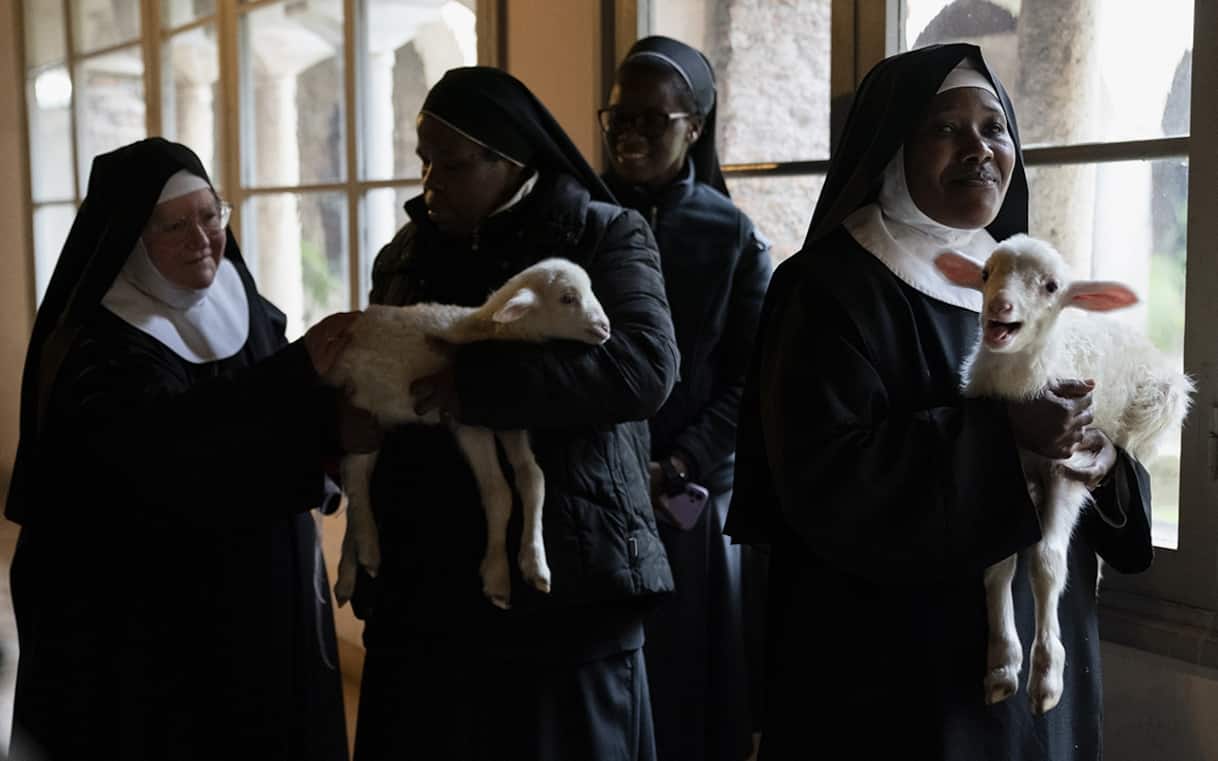
In the heart of Rome, where centuries-old traditions intersect with the quiet rhythms of cloistered life, a new cinematic work is capturing international attention. Agnus Dei (Lamb of God), the directorial debut of Massimiliano Camaiti, is a contemplative documentary that transforms a millenary Catholic rite into a poignant meditation on motherhood, faith, and human fragility.
The film follows a unique tradition at the Monastery of Santa Cecilia in Trastevere. Every January, two newborn lambs are blessed and entrusted to the care of the cloistered nuns. These animals are not merely symbols; their wool is used to weave the pallium, the sacred vestment worn by the Pope on June 29 during the Solemnity of Saints Peter, and Paul. Through a lens of discretion and silence, Camaiti captures the profound emotional bond that forms between the nuns and the lambs they nurture with maternal tenderness.
After a successful run on the international festival circuit, including a debut at the 82nd Venice International Film Festival in the Biennale College Cinema section, the documentary is set to reach a wider audience. Distributed by Kinèa Distribuzioni and produced by Cinemaundici in collaboration with Rai Cinema, Agnus Dei will arrive in Italian cinemas on April 20, 2026.
A Sacred Tradition Amidst Global Change
The narrative of Agnus Dei is anchored in the juxtaposition of the timeless and the ephemeral. While the daily activities of the Monastery of Santa Cecilia remain unchanged across centuries, the film intersects this stability with the sudden arrival of history. During the Holy Year 2025, as the ritual of caring for the lambs unfolded, the world was struck by the news of the Pope’s illness and subsequent passing.

Director Massimiliano Camaiti describes the project as a revelation, born from a chance encounter while walking past the Basilica of Santa Cecilia in Trastevere. He sought to document the journey of the lambs from their birth to the completion of the ritual that transforms their wool into a papal vestment. According to the director’s statement, the news of Pope Francis’s death caused only a brief halt in the monastery’s activities; after a few hours of commotion, the nuns returned to their unchanging routine, illustrating a level of spiritual resilience and continuity that defines the cloistered experience.
The film is characterized by its “cinema of the real” approach, avoiding loud declarations in favor of minimal gestures—the act of feeding, nursing, and protecting. This focus shifts the documentary from a purely religious record to a study of the universal human need for relationship and the unexpected form of motherhood found within the monastery walls.
Critical Acclaim and Festival Recognition
Before its theatrical release, Agnus Dei garnered significant praise from critics and industry peers. The film’s ability to let silence tell the story has earned it several prestigious accolades. Notably, it was awarded the Premio Michel Mitrani at FIPADOC in Biarritz and was named the best documentary of the year by the Documentaristi Italiani.
The production reflects a high level of technical craftsmanship, with cinematography by Ilya Sapeha and editing by Benni Atria. The sonic landscape is shaped by Husk and Media Fenix, while visual effects were handled by Ermanno Di Nicola. With a running time of 73 minutes, the film maintains a pace that mirrors the “different rhythm” of the monastery, inviting the viewer into a secret universe that operates outside the frantic speed of modern urban life.
Key Production Details
| Category | Detail |
|---|---|
| Director | Massimiliano Camaiti |
| Production Company | Cinemaundici (Giovanna Nicolai, Olivia Musini) |
| Collaborator | Rai Cinema |
| Distributor | Kinèa Distribuzioni |
| Primary Cast | The Benedictine Nuns of the Monastery of Santa Cecilia in Trastevere |
| Running Time | 73 Minutes |
The Significance of the Pallium Ritual
To understand the emotional weight of Agnus Dei, one must understand the significance of the pallium. This white wool band, decorated with six black crosses, is a symbol of jurisdictional authority and the bond between the Pope and metropolitan archbishops. The fact that the wool comes from lambs raised by cloistered nuns in the heart of Rome adds a layer of spiritual intimacy to a high-ranking ecclesiastical garment.
The documentary highlights how this ritual bridges the gap between the terrestrial and the divine. The nuns’ care for the lambs is presented not just as a duty, but as a vocation of tenderness. By focusing on the “fragility” of the newborn animals and the “silence” of the nuns, Camaiti creates a mirror for the viewer’s own reflections on faith and caretaking.
The film’s presence in the Biennale College Cinema highlights its artistic merit, positioning it as a work that transcends simple reportage to develop into a piece of contemplative art.
As the film prepares for its wide release on April 20, it stands as a testament to the power of unhurried cinema—works that do not demand attention through noise, but earn it through authenticity and emotional depth.
The next major milestone for the film is its official theatrical opening in Italy on April 20, 2026. We invite our readers to share their thoughts on the intersection of faith and art in the comments below.