
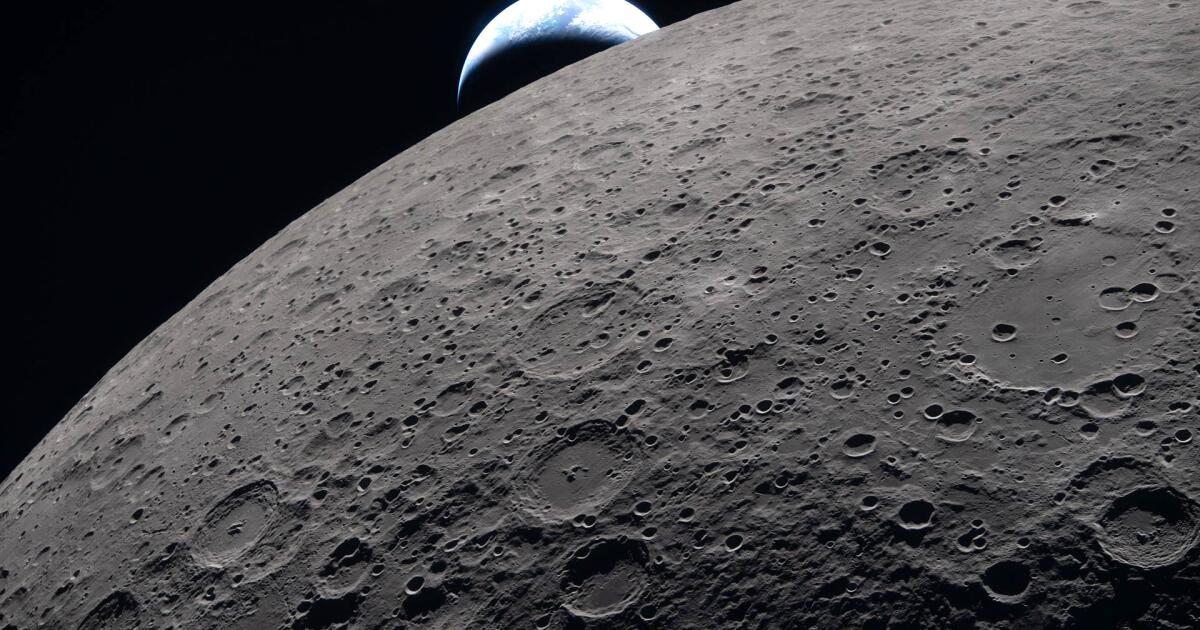
For a brief window of time during their journey, four astronauts experienced a level of isolation that few humans in history have ever known. As they drifted past the far side of the moon, the crew of the Artemis II mission entered a zone of absolute silence, severed from all communication with Earth.
This period of profound solitude was a central part of the 10-day lunar flyby mission, which launched on April 1, 2026. The mission marks NASA’s first crewed flight of the Artemis program and the first time humans have ventured beyond low Earth orbit since the Apollo 17 mission in 1972 Artemis II Wikipedia.
The crew—composed of Reid Wiseman, Victor Glover, Christina Koch, and Jeremy Hansen—piloted the Orion spacecraft, launched by the Space Launch System (SLS) rocket. Their journey was designed not only to test deep space systems but to pave the way for future lunar surface landings and eventual missions to Mars NASA Artemis II Mission Page.
The Silence of the Far Side
The most striking psychological and technical challenge of the mission occurred as the Orion spacecraft traveled around the moon. When the spacecraft moved behind the lunar body, the moon itself acted as a physical shield, blocking all direct radio signals between the astronauts and the Deep Space Network on Earth.

During this transit, the crew described the experience of drifting past the far side of the moon, unable to communicate with mission control. This gap in connectivity creates a unique state of solitude, as the astronauts are physically shielded from the only other known source of human life in the universe.
Mission Parameters and Technical Milestones
The Artemis II mission was a complex demonstration of human deep space capabilities. The spacecraft used for the mission, Orion CM-003 Integrity, was developed by Lockheed Martin, with the European Service Module (ESM-2) manufactured by Airbus Artemis II Wikipedia.
Key technical data from the flight includes:
- Launch Date: April 1, 2026, at 22:35:12 UTC Artemis II Wikipedia.
- Closest Approach: The spacecraft reached its closest point to the moon on April 6, 2026, at approximately 23:00 UTC, at a distance of 4,067 miles (6,545 km) Artemis II Wikipedia.
- Total Distance: The planned travel distance for the mission was 695,081 miles (1,118,624 km) Artemis II Wikipedia.
- Mission Duration: Planned for 10 days, with a recovery date of April 11, 2026 Artemis II Wikipedia.
The Role of the Space Launch System (SLS)
The mission relied on the SLS, NASA’s new heavy-lift rocket, to propel the Orion spacecraft out of Earth’s orbit. This rocket is essential for sending crews to the moon and serves as a critical stepping stone for the long-term goal of sending humans to Mars NASA Artemis II Mission Page.
The Human Impact of Deep Space Exploration
Beyond the telemetry and orbital mechanics, Artemis II served as a test of human endurance and psychological resilience. The transition from the constant chatter of mission control to the absolute silence of the lunar far side highlights the vulnerability and bravery inherent in deep space exploration.
The crew size of four allowed for a balanced operational environment during the 10-day mission, ensuring that critical systems could be monitored while the team navigated the challenges of a crewed lunar flyby. The mission’s success in demonstrating these capabilities is vital for the upcoming Artemis III mission, which intends to return humans to the lunar surface.
| Detail | Information |
|---|---|
| Crew Members | Reid Wiseman, Victor Glover, Christina Koch, Jeremy Hansen |
| Launch Site | Kennedy Space Center, LC-39B |
| Spacecraft | Orion CM-003 Integrity |
| Recovery Vessel | USS John P. Murtha (planned) |
As the mission concludes, the focus shifts toward the recovery of the crew in the Pacific Ocean. The data gathered during this flight, including the experiences of the crew during their period of isolation, will inform the safety protocols and communication strategies for all future human missions to the Moon, and beyond.
The next confirmed milestone for the program is the transition toward Artemis III, which will aim for a crewed lunar landing.
We invite our readers to share their thoughts on the future of lunar exploration in the comments below.