
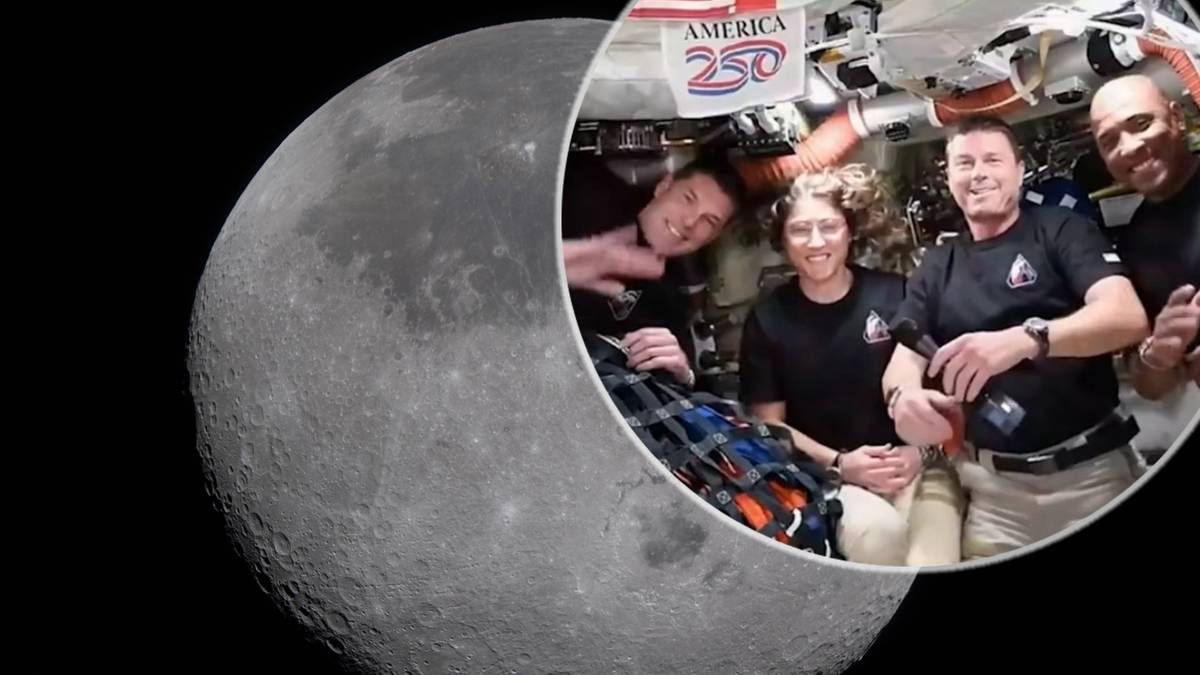
The boundaries of human exploration have been pushed further than ever before. The crew of the Artemis II mission has officially set a new record for the farthest distance humans have traveled from Earth, marking a historic milestone in deep space exploration.
Launching in the early hours of April 2, 2026, the four-person crew aboard the Orion spacecraft embarked on a 10-day lunar loop designed to test critical systems in deep space and carry humans to the most distant point from our home planet. As of April 6, 2026, the mission has successfully orbited the Moon and the crew is now making their return journey to Earth after experiencing views described as science-fiction.
The mission, comprising astronauts Christina Koch, Reid Wiseman, Victor Glover, and Jeremy Hansen, represents the first time in half a century that humans have ventured toward the Moon. By successfully navigating the complexities of a lunar flyby, NASA has not only validated the Orion spacecraft’s capabilities but has also expanded the reach of human presence in the solar system.
Breaking the Lunar Distance Record
The primary achievement of the Artemis II mission is the establishment of a new human distance record. According to NASA, the crew reached a maximum distance of 406,778 km from Earth , surpassing the previous record of 400,171 km. This leap, while measured in thousands of kilometers, is a significant psychological and technical victory for the Artemis program.
Jeremy Hansen expressed his admiration for the views encountered during the voyage, encouraging future generations to continue pushing these boundaries and breaking records. The record-breaking distance was a key objective of the mission, proving that the Orion capsule and its life-support systems can sustain a crew at the furthest reaches of current human capability.
Navigating the Far Side and the Radio Silence
One of the most harrowing and scientifically valuable portions of the mission occurred as the crew passed over the far side of the Moon. During this transit, the crew experienced a total loss of radio communication with the flight control center in Houston for approximately 40 minutes while flying closest to the lunar surface.
At the peak of this encounter, the Orion spacecraft flew approximately 6,500 km above the lunar surface , the closest approach of the entire mission. During this period of radio silence, the crew witnessed the rare phenomena of Earthrise and Earthset, viewing the home planet from a perspective hidden from all terrestrial observers.
The astronauts spent a total of six hours studying the unilluminated hemisphere of the Moon, capturing detailed photographs and observing phenomena that are invisible from Earth . This phase of the mission provided critical data on the lunar far side while testing the crew’s ability to operate independently of ground control.
The Human Element of Deep Space
Beyond the technical metrics, Artemis II has been defined by moments of profound human connection. The crew carried a recording from the late Captain Jim Lovell of Apollo 13, bridging the gap between the pioneers of the 1960s and the explorers of the 2020s . This gesture underscored the continuity of lunar exploration and the enduring legacy of the Apollo era.
The emotional weight of the mission was evident when communication was restored after the far-side blackout. Mission specialist Christina Koch described the feeling of reconnecting with mission control, stating, “Wonderful to hear Earth again,” and adding, “Always choose Earth, always choose each other” .
Key Mission Statistics
| Metric | Detail |
|---|---|
| Maximum Distance from Earth | 406,778 km |
| Closest Approach to Moon | ~6,500 km |
| Far Side Radio Silence | ~40 minutes |
| Far Side Observation Time | 6 hours |
| Mission Duration | 10-day loop |
Return to Earth and Future Implications
As of April 7, 2026, the Orion spacecraft is on its return trajectory. The successful completion of the loop—including the record-breaking distance and the far-side transit—serves as the final validation for the systems required for future lunar landings. The mission has demonstrated that the Orion capsule can safely transport a crew to the farthest reaches of the Earth-Moon system and bring them back safely.
The data gathered during the six hours of far-side observation and the performance of the ship’s systems in deep space will be analyzed to refine the parameters for subsequent Artemis missions, which aim to return humans to the lunar surface.
The next confirmed checkpoint for the mission is the atmospheric reentry and splashdown of the Orion capsule as it concludes its journey back to Earth.
Do you suppose the Artemis missions are the first step toward Mars, or should we focus on a permanent lunar base first? Share your thoughts in the comments below.