
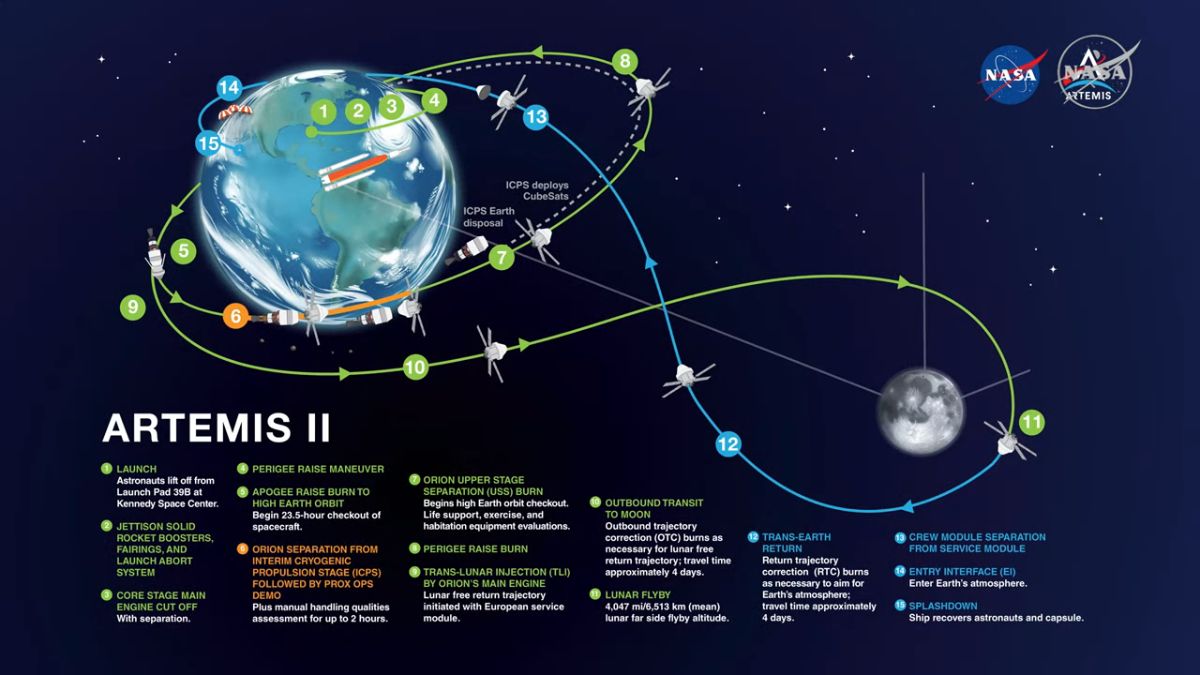
Humanity has reached a new milestone in deep-space exploration as the Artemis II lunar flyby has officially pushed astronauts further from Earth than any humans in history. The mission, a critical step in NASA’s effort to return humans to the lunar surface, has transitioned from its initial transit phase to a historic encounter with the moon, marking a significant leap in our capability to navigate and communicate across the void of space.
The crew of Artemis II is currently executing a complex trajectory that swings them around the moon, providing a rare, close-up perspective of the lunar surface and the mysterious far side. This mission is not merely about distance; it is a rigorous test of the Orion spacecraft’s systems and the crew’s ability to operate in the most extreme environments known to modern exploration.
Beyond the physical journey, the mission is pioneering new ways of sharing the experience with the world. For the first time, NASA is utilizing a high-bandwidth laser communications system to beam 4K video from the vicinity of the moon back to Earth, transforming how the global public perceives and interacts with deep-space missions Scientific American.
Breaking Distance Records and the Lunar Flyby
The Artemis II mission has officially set a new record for the farthest distance humans have traveled from Earth ABC News. This achievement is a testament to the precision of the trajectory calculations and the performance of the spacecraft’s propulsion systems. As the crew continues their lunar flyby, they are experiencing the unique gravitational dynamics of the Earth-Moon system.
During the mission’s progression, the crew has engaged in essential operational tests. On Flight Day 5, the astronauts conducted demonstrations of their suits and prepared the spacecraft for the critical flyby phase NASA (.gov). These suit checks are vital for ensuring safety and functionality should the crew need to perform tasks in a pressurized environment during later stages of the Artemis program.
The “swing around” the moon is a carefully choreographed maneuver. By using the moon’s gravity to slingshot the spacecraft back toward Earth, NASA can test the Orion capsule’s heat shield and reentry capabilities even as providing the crew with unprecedented views of the lunar landscape. This flyby serves as a dress rehearsal for future missions that will involve landing on the lunar surface.
Technological Frontiers: 4K Laser Communications
One of the most significant technical achievements of the Artemis II mission is the implementation of a laser communications system. Traditional radio frequency communications, while reliable, have limited bandwidth that often results in compressed, lower-resolution imagery when transmitting from deep space. The new laser system allows NASA to beam 4K video directly from the moon Scientific American.
This leap in communication technology is critical for several reasons:
- Enhanced Telemetry: High-resolution video allows ground control to monitor the spacecraft and crew with far greater precision.
- Public Engagement: Beaming high-definition footage in real-time (or near real-time) brings the experience of space exploration to a global audience in a way that was impossible during the Apollo era.
- Future Infrastructure: This system lays the groundwork for the communication networks required for a permanent lunar base or future missions to Mars.
The Challenge of the Lunar Far Side
As the crew maneuvers around the moon, they encounter one of the most challenging aspects of lunar navigation: the loss of direct line-of-sight communication with Earth. When the spacecraft passes behind the moon, the lunar mass blocks the signals between the Orion capsule and the Deep Space Network on Earth.
This period of “radio silence” is a planned part of the mission, testing the crew’s autonomy and the spacecraft’s automated systems. The experience of seeing the far side of the moon—a region never visible from Earth—provides unique scientific and psychological insights for the astronauts, as they witness a landscape characterized by a lack of the large “maria” (dark basaltic plains) common on the near side.
Key Mission Milestones
| Phase | Key Achievement | Verification/Detail |
|---|---|---|
| Transit | Farthest distance traveled by humans | New record set ABC News |
| Flight Day 5 | Suit and flyby preparations | Crew demos and readiness NASA (.gov) |
| Communications | 4K Video Transmission | Laser comms system active Scientific American |
The mission continues to move toward its final phases, with the crew preparing for the return journey. The next confirmed checkpoint for the mission is the reentry and splashdown phase, where NASA will evaluate the performance of the Orion spacecraft’s heat shield after its high-speed return from the moon.
Do you think high-definition video from space changes how we perceive exploration? Share your thoughts in the comments below and share this update with your network.