
The dawn of the Artemis era has brought not only historic milestones in lunar exploration but similarly a recent challenge in the digital age: the rise of hyper-realistic AI-generated misinformation. As NASA’s Artemis II mission recently returned the first crewed flight to the vicinity of the Moon since 1972, the public’s fascination with the lunar far side has been exploited by creators using artificial intelligence to fabricate “discoveries.”
Among the most prominent examples is a widely circulated image claiming to show the “Eastern Basin” of the Moon. While the image captured the imagination of social media users, fact-checkers and space experts have confirmed that the visual was created using AI, not captured by the crew of the Orion spacecraft. This incident highlights the growing tension between genuine scientific achievement and the seamless nature of modern synthetic media.
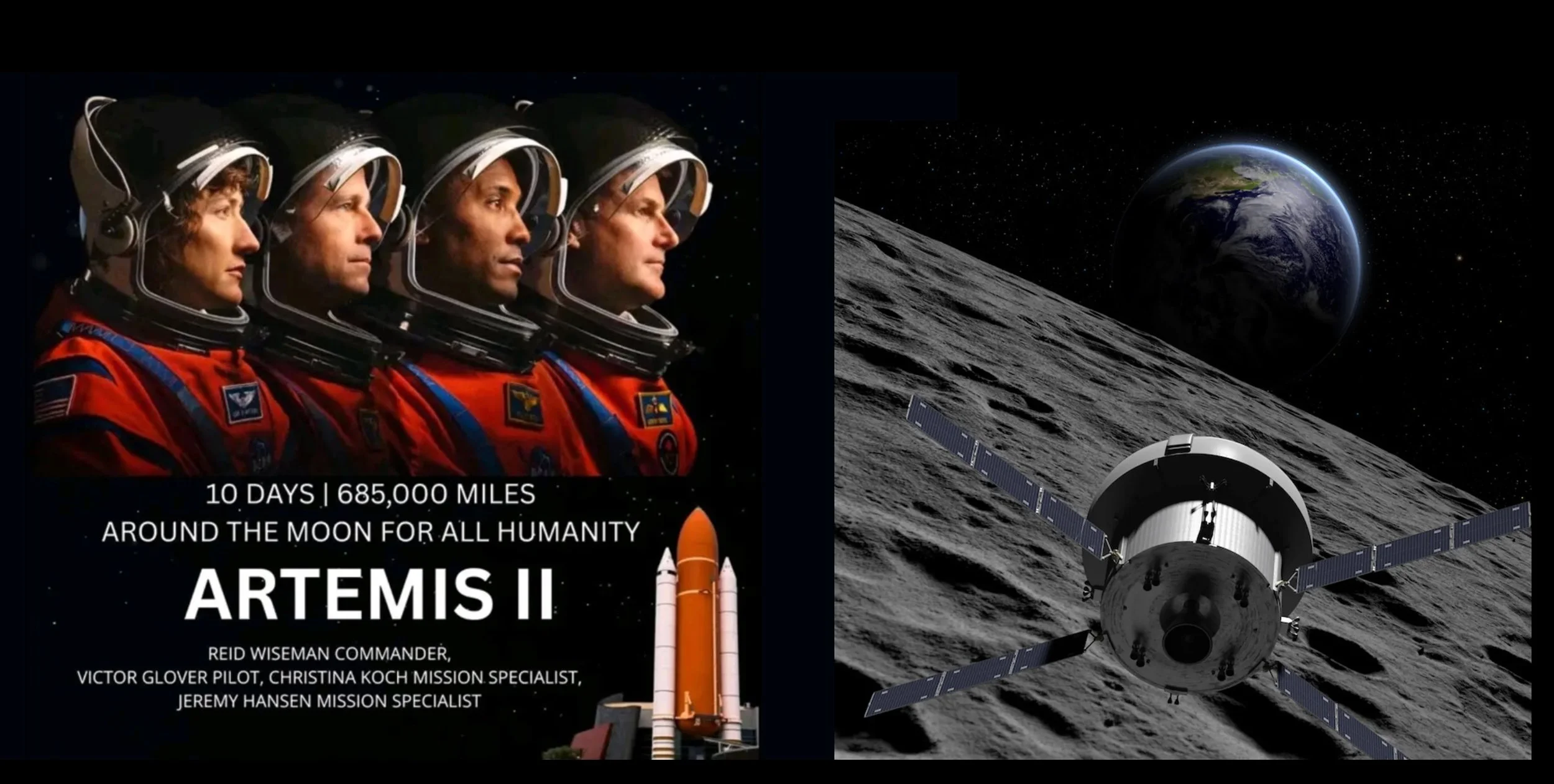
The Artemis II mission, which launched on April 1, 2026, was designed as a ten-day lunar flyby to test the capabilities of the Orion spacecraft and the Space Launch System (SLS) rocket via Wikipedia. With a crew consisting of astronauts Reid Wiseman, Victor Glover, Christina Koch, and Jeremy Hansen, the mission successfully navigated a trajectory that took them over the lunar far side on April 6, 2026 via NASA.
The genuine images released by NASA on April 7, 2026, are breathtaking, featuring a rare in-space solar eclipse and views of the heavily cratered terrain of the eastern edge of the Moon. Still, the “Eastern Basin” AI hoax serves as a cautionary tale for a global audience eager for news from the deep space frontier, reminding us that not every stunning visual shared on social media is a product of a camera lens.
The Anatomy of the “Eastern Basin” AI Hoax
The fake image in question purported to show a specific geological feature—the “Eastern Basin”—with a level of detail and coloration that exceeded the typical grayscale appearance of the lunar surface. The image gained traction on platforms like X and Facebook, often accompanied by claims that the Artemis II crew had discovered something “unexplained” or “hidden” on the far side of the Moon.
From a technical perspective, AI-generated images often struggle with consistent geometry and specific astronomical accuracy. In this case, the “Eastern Basin” image lacked the specific telemetry and lighting consistency found in the official NASA gallery. The real photographs taken during the crew’s seven-hour pass over the lunar far side on April 6, 2026, show the Moon’s surface as a stark, cratered landscape, though some images capture the “terminator”—the boundary between the day and night sides of the Moon via NASA.
The spread of this AI-generated content is not an isolated event. The Artemis II mission has been a magnet for various theories, including claims about “strange colors” on the lunar surface. Scientific explanations for these visual anomalies usually involve lighting conditions, camera sensor responses, or the specific way the Sun illuminates the lunar regolith during a flyby, rather than the discovery of exotic materials or extraterrestrial structures.
Verifying the Real Artemis II Imagery
To distinguish between official mission data and AI fabrications, it is essential to rely on verified repositories. NASA’s official gallery for the Artemis II lunar flyby provides the gold standard for what the crew actually saw. For instance, image art002e009283 explicitly shows the “heavily cratered terrain of the eastern edge” of the Moon, which is a real geological observation, not a synthetic creation via NASA.
The crew’s experience was documented through a series of high-resolution captures. On April 6, 2026, the crew photographed a “faint view of a crescent Earth above the horizon” and an “Earthset” at 6:41 p.m. EDT via NASA. These images are tied to specific timestamps and mission phases, providing a layer of provenance that AI-generated images cannot replicate.
the mission’s trajectory was tracked in real-time. According to mission data, the Orion spacecraft reached a closest approach to the Moon of approximately 6,545 kilometers (or 4,067 miles) on April 6, 2026, at 23:00 UTC via Wikipedia. Any image claiming to show a level of detail that would require a much lower altitude or a different orbital position can be immediately flagged as suspicious.
Key Mission Details at a Glance
| Detail | Verified Information |
|---|---|
| Launch Date | April 1, 2026, 22:35:12 UTC via Wikipedia |
| Crew Members | Reid Wiseman, Victor Glover, Christina Koch, Jeremy Hansen via Wikipedia |
| Closest Lunar Approach | April 6, 2026 (~6,545 km) via Wikipedia |
| Planned Duration | 10 days via Wikipedia |
| Spacecraft | Orion CM-003 Integrity / ESM-2 via Wikipedia |
Why AI Misinformation Targets Space Missions
Space exploration triggers a unique blend of awe and mystery, making it a fertile ground for “discovery” hoaxes. The lunar far side, in particular, has long been a subject of conspiracy theories and science fiction, which makes the public more susceptible to believing in “hidden” basins or anomalous structures. When an AI tool can generate a visually convincing landscape of a cratered surface, the line between a scientific photograph and a digital hallucination blurs.

For the crew of Artemis II, the mission was about testing the systems that will eventually take humans back to the lunar surface for Artemis III. The psychological impact of these hoaxes is minimal for the astronauts, but for the general public, it can lead to a “truth decay” where genuine scientific breakthroughs are viewed with the same skepticism as AI fabrications.
The Orion spacecraft’s journey was a complex feat of orbital mechanics. The crew spent seven hours passing over the lunar far side, a region that is never visible from Earth and thus remains one of the most mysterious places in our solar system via NASA. The fact that humans have returned to this vicinity for the first time in over five decades is the real story, far outweighing any synthetic “basin” created by a prompt-based AI.
How to Spot Synthetic Space Imagery
As a technology journalist, I have seen how generative AI has evolved from producing “uncanny valley” images to nearly indistinguishable fakes. When evaluating space imagery, there are several red flags to look for:
- Lack of Metadata: Official NASA images come with specific identifiers (e.g., “art002e015231”) and detailed captions explaining the time and context of the shot via NASA.
- Impossible Lighting: AI often struggles with the physics of a single light source (the Sun) in a vacuum. Look for multiple shadows or light sources that don’t align with the position of the Sun.
- Over-Saturation: While the Moon can have varied mineral compositions, AI-generated “discoveries” often feature neon or overly vibrant colors designed to trigger a viral response.
- Generic Sources: Be wary of images shared by accounts that do not link directly to an official government agency or a recognized scientific institution.
The Artemis II mission is a bridge to the future of human exploration. By maintaining a rigorous standard of verification and relying on sources like the NASA gallery and the JPL Horizons data used by mission trackers, we can ensure that the wonder of space exploration is based on truth rather than algorithms via Artemis Dashboard.
The mission is currently reaching its conclusion, with the crew’s splashdown scheduled for April 10, 2026, at 17:00 UTC via Artemis Dashboard, with recovery planned by the USS John P. Murtha via Wikipedia. The final official update will follow the safe recovery of the crew and the subsequent analysis of the data collected during the flyby.
What are your thoughts on the intersection of AI and scientific exploration? Do you suppose we require more robust “watermarking” for official space imagery? Let us know in the comments below.