
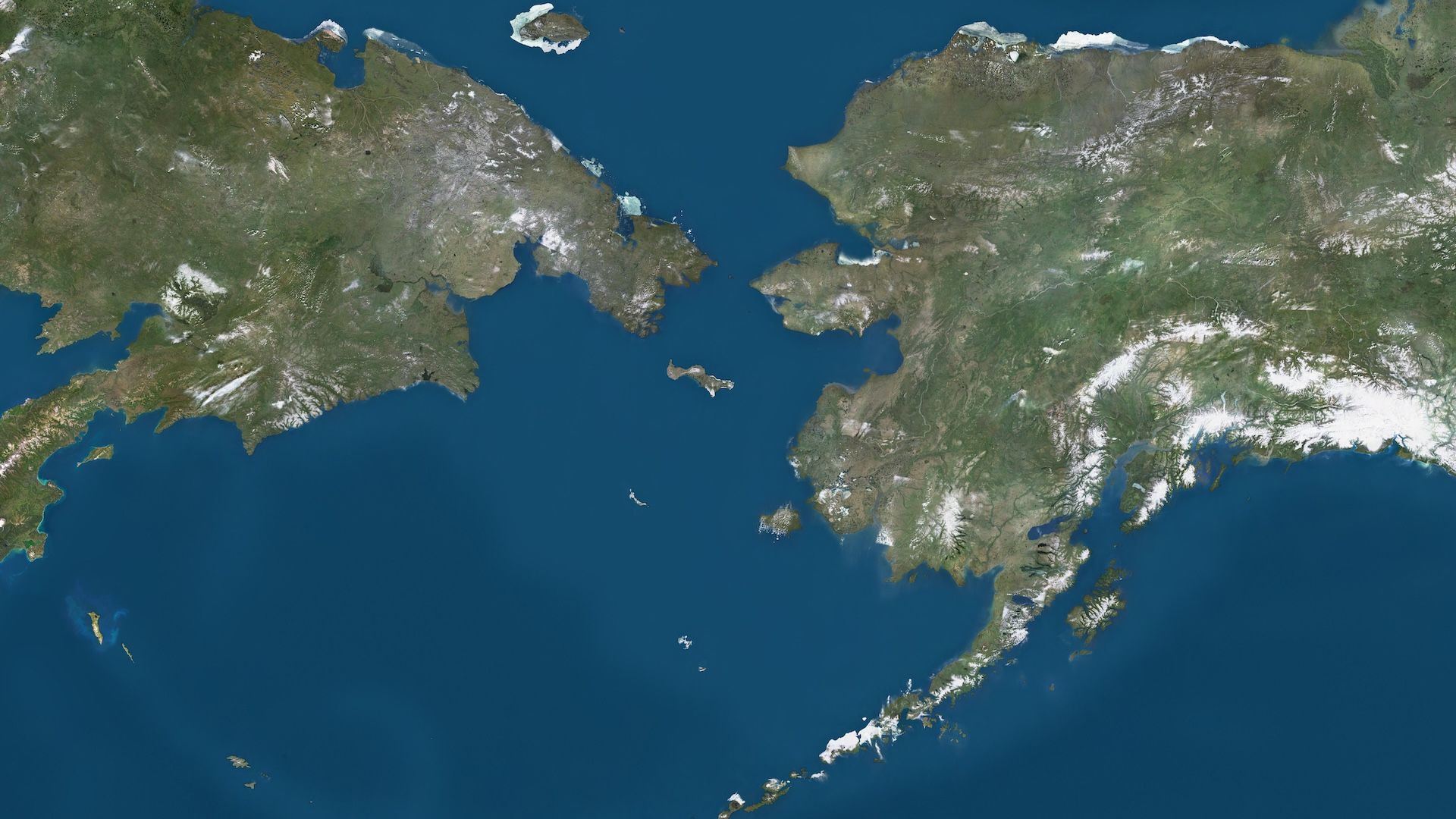
Rethinking the First Americans: New Evidence Shifts Timeline of Bering Land Bridge Access
For decades, the story of the first Americans has centered around a migration across the bering Land Bridge – a now-submerged stretch of land connecting Asia and North America during the last Ice Age. But a growing body of evidence is challenging the conventional timeline, suggesting this crucial pathway wasn’t reliably open until much later than previously believed. This shift has profound implications for understanding who those first Americans were.
Recent research, detailed in a 2023 paper and bolstered by subsequent findings, points to a later opening of the Bering Strait.This means the window for migration into the Americas may have coincided with the presence of fully modern humans, possibly excluding our extinct relatives like Neanderthals and Denisovans.Let’s explore the evidence and what it means for our understanding of early American history.
The Traditional View & Emerging Challenges
The long-held theory posits that the Bering Land Bridge, also known as Beringia, was intermittently passable for tens of thousands of years, allowing waves of migration. However, new data from ocean sediment cores is rewriting that narrative.
Here’s what’s changing:
* Ocean Nutrient Shifts: Analysis reveals Pacific Ocean nutrients began appearing in the Arctic Ocean around 24,000 to 19,000 years ago. this strongly suggests the Bering Strait opened during this period,allowing for ocean water exchange.
* A later Opening: This timing is substantially later than the previously accepted timeframe, potentially meaning the land bridge wasn’t consistently traversable until closer to the Last Glacial Maximum (LGM), roughly 26,500 to 19,000 years ago.
* Fossil Evidence Discrepancies: Fossil records of animals like mammoths, bison, lions, and bears in both Eurasia and the Americas, dating back as far as 46,000 years ago, present a puzzle. Computer models based on these fossil locations suggest the land bridge was closed during the period the 2023 paper indicated it was open. This discrepancy highlights the complexity of reconstructing past environments.
“You have two fully different data sets telling the same story,” explains Dr. kenae Farmer, a researcher involved in the sediment core analysis. This convergence of evidence is compelling scientists to re-evaluate the timing of the first American migrations.
What Does This Mean for Human Migration?
The revised timeline has a direct impact on the question of who first populated the Americas. If the Bering Land Bridge wasn’t reliably open until later, it narrows the possibilities.
* Modern Humans as the Likely Pioneers: A later opening supports the idea that Homo sapiens – fully modern humans – were the first to make the journey.
* Excluding Earlier Hominids: Ian Buvit, an independent archaeologist, notes that Neanderthals and Denisovans, who inhabited parts of Siberia, were likely extinct or nearing extinction in northeastern Asia by the time the Bering Strait opened. ”Neanderthals and Denisovans…were already extinct, or on the verge of extinction, throughout northeastern Asia by this time.”
* The Role of Seafaring: Even with a later opening, the possibility remains that ancient humans utilized boats to reach the Americas. The seafaring skills demonstrated by the ancestors of the modern Inuit demonstrate this capability.
As Buvit points out, “Any human migration into the Americas before 40,000 to 35,000 years ago would have required watercraft and the ability to navigate open ocean.” This skill,as far as we certainly know,was uniquely possessed by anatomically modern humans.
beyond the Land Bridge: A More Nuanced Picture
The story of the first Americans is becoming increasingly complex. while the Bering Land Bridge remains a central piece of the puzzle, it’s clear that the picture is far more nuanced than previously thought.
Here’s what we’re learning:
* Multiple Migration Routes: The possibility of coastal migration routes, utilizing boats, adds another layer of complexity.
* ongoing Research: Scientists continue to refine the timeline and explore alternative scenarios through ongoing research, including genetic studies and archaeological excavations.
* A Dynamic Environment: the environment surrounding the Bering Strait was





![Nigeria Mosque Blast: Deaths & Latest Updates | [Year]](https://i0.wp.com/s.france24.com/media/display/edad9848-e0fb-11f0-aa07-005056bf30b7/w%3A1280/p%3A16x9/AP25077805366921.jpg?resize=150%2C100&ssl=1 "Nigeria Mosque Blast: Deaths & Latest Updates | [Year]")


