
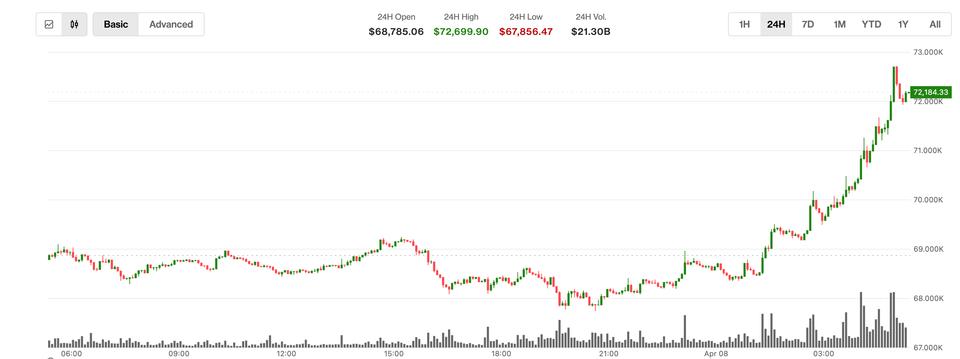
Bitcoin surged past the $72,000 threshold on Tuesday evening, triggered by a sudden shift in geopolitical tensions as President Donald Trump announced a temporary ceasefire with Iran. The move sparked an immediate market repricing, driving the largest cryptocurrency higher and signaling a renewed appetite for risk assets among global investors.
The Bitcoin price surge after US-Iran ceasefire news saw the digital asset jump nearly 5%, trading around $72,174 at the time of the rally. This upward momentum extended across the broader digital asset landscape, with the total cryptocurrency market capitalization climbing from approximately $2.3 trillion to about $2.43 trillion according to market data reported by NewsBTC.
The de-escalation in the Middle East too had an immediate impact on traditional energy markets, where oil prices tumbled following the announcement. For investors, the ceasefire represents a temporary removal of the “war premium” that had been weighing on global markets, allowing capital to flow back into volatile assets like Bitcoin.
The Terms of the Ceasefire and Geopolitical Drivers
President Trump stated that the United States has agreed to suspend military strikes on Iran for a period of two weeks. However, this suspension is not unconditional; it is contingent upon Tehran’s commitment to the “COMPLETE, IMMEDIATE, and SAFE OPENING of the Strait of Hormuz,” as detailed in the President’s announcement. The Strait of Hormuz remains one of the world’s most critical maritime chokepoints for global oil shipments, making its accessibility a primary concern for global economic stability.
The diplomatic pivot followed high-level conversations with Pakistan’s leadership. President Trump noted that the decision to hold off on military action came after discussions with Pakistan’s Prime Minister Shehbaz Sharif and Field Marshal Asim Munir, who both requested the suspension of strikes.
Market analysts noted that while the geopolitical news was the primary catalyst, the rally was further bolstered by technical drivers. Data from the social media platform X, specifically from DeFi Tracer, indicated that major exchanges and market-makers executed large buy orders immediately following the ceasefire announcement, accelerating the price break above $72,000.
Iran’s $7.8 Billion Crypto Shadow Economy
The intersection of Bitcoin and Iranian geopolitics extends far beyond simple market speculation. Iran has spent years constructing a sophisticated, multibillion-dollar parallel economy designed specifically to bypass the U.S. Dollar and evade international sanctions. This infrastructure is heavily driven by the Islamic Revolutionary Guard Corps (IRGC).
According to blockchain analytics firm Chainalysis, Iran’s crypto ecosystem reached a valuation of $7.78 billion in 2025, exhibiting growth that outpaced the previous year as reported by CoinDesk. To put this figure in perspective, the size of this shadow economy is comparable to the entire GDP of nations such as Liechtenstein or the Maldives.
The Iranian government’s strategy relies on two primary pillars: state-sponsored Bitcoin mining and the use of stablecoins. Since legalizing crypto mining in 2019, the regime has allowed licensed operators to utilize subsidized electricity. In exchange, these operators sell the mined Bitcoin (BTC) to the central bank, which then uses the assets to pay for imports and settle international trade outside the traditional dollar-based banking system.
While the state uses these tools for strategic trade, ordinary Iranian citizens have utilized the crypto ecosystem as a financial lifeline. During periods of domestic unrest, protests, and severe economic crises, digital assets have provided a means of preserving wealth and accessing funds when traditional banking channels are restricted.
The Vulnerability of Mining Infrastructure
Despite its scale, Iran’s crypto-economic engine is fragile. The energy-intensive nature of Bitcoin mining makes it heavily dependent on the national power grid. Recent military strikes have threatened this infrastructure, highlighting a critical vulnerability: if the power grid is compromised, the financial channel used to bypass sanctions is effectively severed.

Estimates suggest that Iran controls between 2% and 5% of the global Bitcoin mining power, though much of this activity is conducted away from public view to avoid international scrutiny per CoinDesk reports.
Market Analysis: Risk Assets and Geopolitical De-escalation
From an economic perspective, the reaction of Bitcoin to the US-Iran ceasefire is a textbook example of how “risk-on” assets behave during geopolitical volatility. When the threat of a wide-scale conflict in the Middle East increases, investors typically flee to “safe havens” like gold or the U.S. Dollar.
Conversely, a ceasefire—even a temporary one—reduces the perceived risk of global supply chain disruptions (particularly regarding oil) and systemic financial shocks. This shift encourages investors to move capital back into higher-yield, higher-volatility assets. The jump in Bitcoin’s price to $72,174 reflects a broader market belief that the immediate threat of escalation has subsided.
The role of stablecoins in this ecosystem also cannot be overlooked. For a regime like Iran’s, stablecoins provide the stability of a pegged asset while maintaining the censorship-resistance of blockchain technology, allowing for faster and more discreet international settlements than Bitcoin, which remains subject to high price volatility.
| Indicator | Pre-Ceasefire Status | Post-Ceasefire Movement |
|---|---|---|
| Bitcoin (BTC) Price | Approx. $68,000 | Surged to $72,174 |
| Crypto Market Cap | $2.3 Trillion | $2.43 Trillion |
| Oil Prices | Elevated (War Premium) | Tumbled/Decreased |
| Investor Sentiment | Risk-Averse | Risk-On |
What Happens Next?
The stability of the current market rally depends heavily on the adherence to the ceasefire terms. The primary focal point for the next 14 days will be the Strait of Hormuz. If Tehran fails to ensure the “complete, immediate, and safe opening” of the waterway, the conditions for the ceasefire will be violated, potentially leading to a swift reversal of the current gains in the crypto and equity markets.
the continued viability of Iran’s $7.8 billion crypto economy will remain under scrutiny. As the IRGC continues to integrate Bitcoin mining into its national security and trade strategy, the digital asset’s role as a tool for sanctioned states will likely continue to influence its volatility and global perception.
The next confirmed checkpoint is the conclusion of the two-week ceasefire period, at which point the U.S. Administration will evaluate whether to extend the suspension of strikes or resume military action based on the status of the Strait of Hormuz.
We invite our readers to share their thoughts on the intersection of cryptocurrency and geopolitics in the comments section below.