
Wireless Brain-Computer Interface Achieves Unprecedented Control and Opens New Frontiers in Neuroscience
Researchers at Northwestern university have unveiled a groundbreaking wireless brain-computer interface (BCI) capable of delivering complex, patterned light stimulation to the brain with unprecedented precision and minimal invasiveness. This advancement, detailed in a recent study, represents a significant leap forward in optogenetics and holds immense promise for both basic neuroscience research and future therapeutic applications in humans.
For decades, scientists have sought ways to directly interface with the brain to understand its intricate workings and potentially treat neurological disorders. Traditional methods, like optogenetics – using light to control neurons – have been hampered by the need for bulky external hardware and restrictive fiber optic cables. This new system overcomes these limitations, offering a fully implantable, wirelessly powered, and programmable solution.
A Paradigm Shift in Brain Stimulation
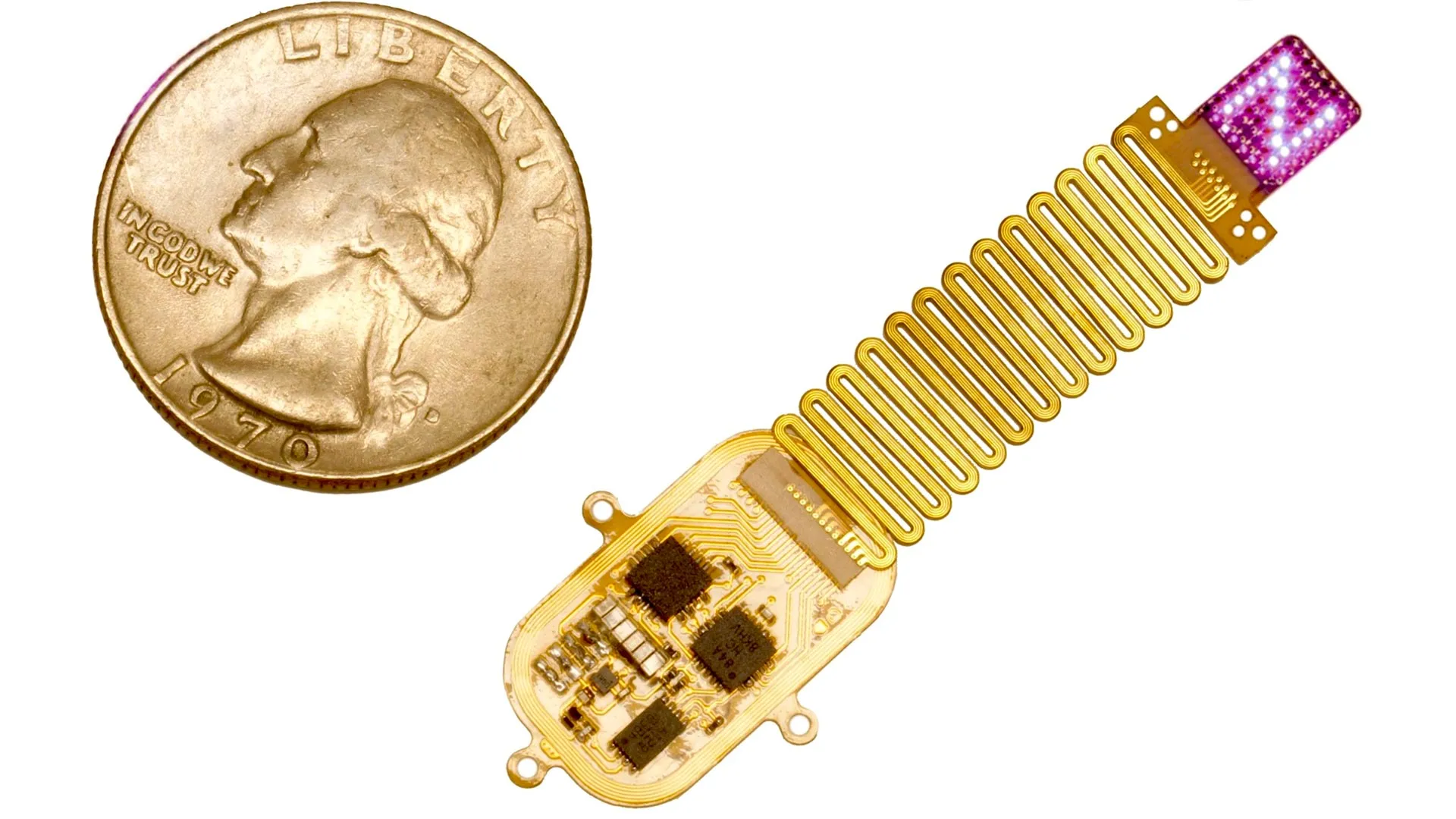
The device consists of a soft, conformable array of micro-LEDs, each smaller than a human hair, coupled with a wirelessly powered control module. This allows researchers to program and deliver light stimulation in real-time, directly to the brain’s cortex, without disrupting natural animal behavior. Unlike previous iterations, this system utilizes up to 64 independently controllable micro-LEDs, enabling the creation of complex stimulation patterns that mimic the distributed activity naturally occurring during sensory experiences.
“The brain doesn’t operate on single neuron activation; it’s about coordinated activity across networks,” explains mingzheng Wu, postdoctoral researcher and first author of the study. “Our array allows us to recreate these patterns, offering a far more biologically relevant approach to brain stimulation.”
This builds upon the team’s earlier success in 2021, when they developed the first fully implantable, wireless optogenetic device using a single micro-LED.While that initial breakthrough demonstrated the feasibility of wireless brain control, the new array substantially expands the possibilities for complex neural interaction.
Minimally Invasive Design & Effective Transcranial Stimulation
A key innovation lies in the device’s design. Measuring roughly the size of a postage stamp and thinner than a credit card, it doesn’t require invasive brain penetration. Rather, the flexible array gently conforms to the skull’s surface, delivering red light – which effectively penetrates tissue – to activate neurons beneath.
“Red light has excellent tissue penetration properties,” notes Professor Yevgeniy Kozorovitskiy, Irving M. Klotz Professor of Neurobiology at Northwestern. “This allows us to activate neurons through the skull, minimizing the invasiveness of the procedure.”
Demonstrating Artificial Perception in Mice
To validate the system, researchers worked with mice genetically engineered to have light-responsive neurons in their cortex. Through a carefully designed training paradigm, the mice learned to associate specific patterns of light stimulation with a reward.The implant delivered coded light patterns across four cortical regions, effectively “tapping a message” directly into the brain.
The mice consistently navigated to the correct reward port when the target pattern was detected, demonstrating their ability to interpret the artificial stimulation as meaningful facts. This behavioral response confirms the brain’s capacity to learn and respond to these synthetic signals.
Looking Ahead: Expanding Capabilities and Therapeutic Potential
The team is now focused on refining the system,exploring more complex stimulation patterns,and determining the brain’s capacity to learn and differentiate a wider range of signals. Future iterations may incorporate:
* Increased LED Density: More LEDs with smaller spacing for even finer-grained control.
* Larger Arrays: Expanding the coverage area to stimulate broader cortical regions.
* Wavelength Optimization: Utilizing different wavelengths of light for deeper tissue penetration.
The implications of this technology are far-reaching. Beyond its immediate value for basic neuroscience research, this wireless BCI holds significant potential for addressing a range of human health challenges, including:
* Restoring Sensory Function: Potentially bypassing damaged neural pathways to restore vision, hearing, or other senses.
* Treating Neurological Disorders: Developing targeted therapies for conditions like Parkinson’s disease, epilepsy, and depression.
* Advanced Prosthetics Control: Creating more intuitive and responsive prosthetic limbs.
This research, led by Professors John A. Rogers (materials science and engineering, biomedical engineering, neurological surgery) and Yevgeniy Kozorovitskiy, and supported by a diverse range of funding sources, marks a pivotal moment in the field of brain-computer interfaces. By offering a minimally invasive, highly programmable, and wirelessly powered solution, this technology is paving the way for a deeper understanding of the brain and the advancement of innovative therapies for neurological conditions.
Sources:
* Northwestern University News: [https://news.northwestern.edu/news/2024/01/patterned-wireless-transcranial-optogenetics-generates-artificial-perception/](https://news.northwestern.edu/news/2024/01/patterned





