The Erosion of Democratic Norms: Lessons from Brazil and a Warning for the United States
The recent legal challenges faced by former Brazilian President Jair Bolsonaro, and the surprisingly vocal support he’s receiving from former U.S. President Donald Trump, highlight a disturbing trend: the deliberate undermining of democratic institutions by leaders unwilling to accept electoral defeat. This isn’t simply a South American issue; it’s a global threat to the principles of accountability and the rule of law, and the United States is increasingly lagging behind in defending them.
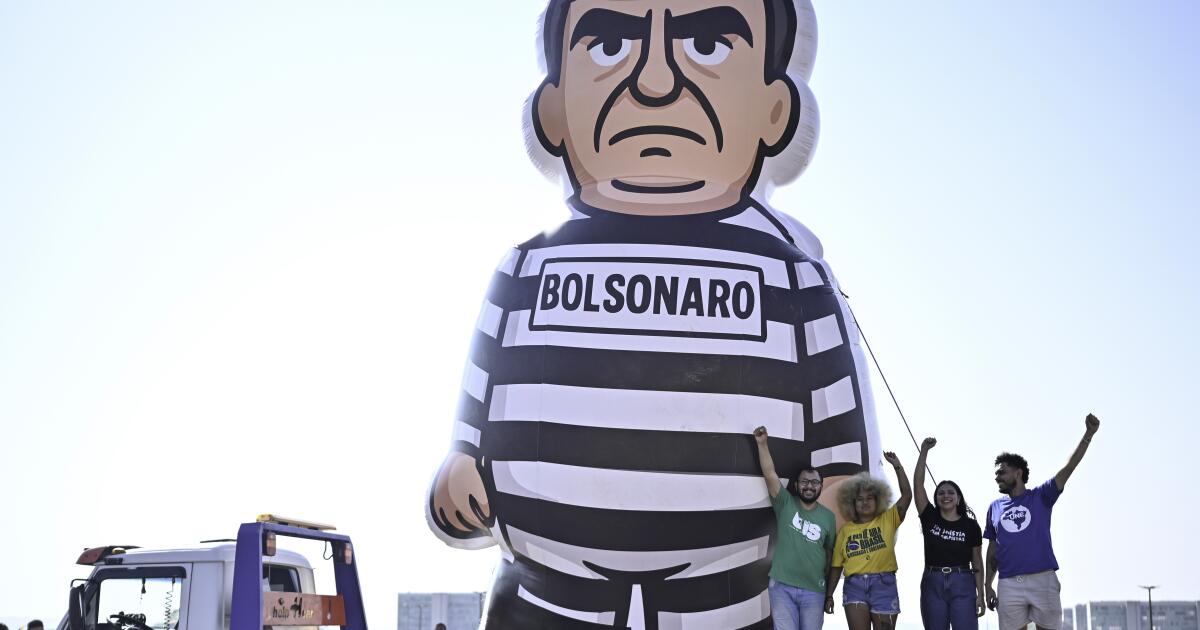
Bolsonaro’s history is marked by a risky disregard for democratic norms. Even before his 2018 election, he openly romanticized Brazil’s past military dictatorship, infamously stating that the country would only improve “on the day that we break out in civil war here and do the job that the military regime didn’t do: killing 30,000.” This chilling rhetoric foreshadowed his attempts to cling to power after losing the 2022 presidential election to Luiz Inácio Lula da Silva (Lula).
The parallels with the aftermath of the 2020 U.S. election are stark.Fueled by unsubstantiated claims of electoral fraud,both Trump and bolsonaro incited their supporters to violence. On January 6th, 2021, a mob stormed the U.S. Capitol. Just days later, on January 8th, 2023, Bolsonaro’s followers attacked government buildings in Brasília, mirroring the insurrection in Washington. These coordinated attempts to subvert democratic processes are not coincidences; they represent a shared playbook of authoritarian tactics.
Bolsonaro’s legal troubles stem directly from his role in these post-election events. He is now facing investigations into his conduct, spearheaded by Chief Justice Alexandre de Moraes, a figure Trump has derisively labeled as conducting a “witch hunt” on behalf of the Lula government. This characterization is misleading.While Lula and de Moraes are not political allies – Lula leads a social-democratic party while de moraes is associated with the center-right – the prosecution of Bolsonaro is rooted in a commitment to upholding the rule of law, a commitment that was demonstrably lacking during Bolsonaro’s own presidency.
To understand the situation, consider this: during Bolsonaro’s term, brazil’s Attorney General, appointed by Bolsonaro himself, was perceived as insufficiently zealous in pursuing legal accountability. De Moraes stepped into this void,acting with a level of independence and resolve that would be remarkable - and arguably necessary – in any functioning democracy. Imagine, for a moment, if Chief Justice John Roberts in the United States felt compelled to proactively encourage legal action against a president perceived to be flouting the law due to a lack of vigor from the Justice Department. This is the equivalent of the situation unfolding in brazil.
What’s especially striking is the contrast between the Brazilian experience and the current state of affairs in the United States. Many Americans might rightly view Brazil’s decisive action against Bolsonaro with a degree of envy. Here is a nation that held a leader accountable for attempting to undermine its democratic institutions, a leader who lost an election and then actively sought to overturn the results through violence and disinformation.
This accountability is basic to a healthy democracy.Political scientists distinguish between “vertical accountability” – voters holding incumbents accountable through elections – and “horizontal accountability” – checks and balances between coequal branches of government. Leaders like Bolsonaro attempt to dismantle both,seeking to remain in power nonetheless of electoral outcomes and weakening autonomous institutions like courts,agencies,and a free press. Brazil, ultimately, demonstrated a commitment to both forms of accountability, holding Bolsonaro responsible through the ballot box and the judicial system.
Trump’s intervention in bolsonaro’s case, including threats of tariffs against Brazil, is deeply concerning. It not only undermines Brazil’s sovereignty but also reveals a disturbing pattern of shielding allies from legal consequences. Furthermore, the justification for these tariff threats – purportedly to protect U.S. manufacturers or correct trade imbalances – rings hollow when used as a tool to interfere in a foreign legal process. Such actions erode the credibility of U.S. trade policy and demonstrate a willingness to prioritize political loyalty over economic principles.
The United States, once a beacon of democratic governance, is increasingly losing its luster. The absence of strong internal checks on presidential power – advisors willing to challenge unwise instincts – is a critical deficiency. A prudent advisor might have cautioned Trump against threatening Brazil with tariffs, pointing out the potential for exacerbating inflation (particularly in key consumer goods like coffee and orange juice) and the hypocrisy of invoking trade concerns as a pretext for political intervention.
Brazil, despite its