
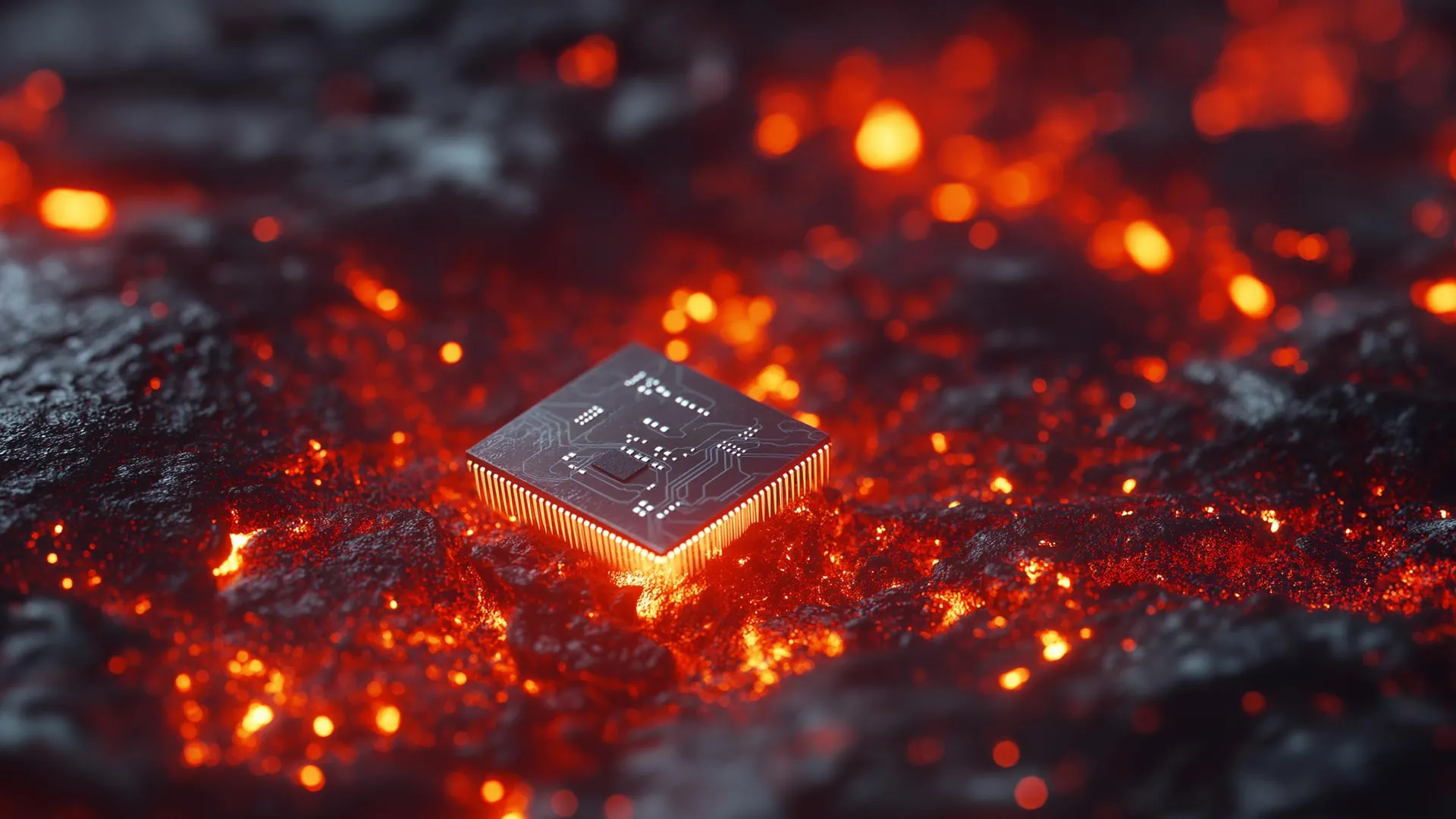
The electronics powering our smartphones, automobiles, and the vast network of satellites orbiting Earth all share a fundamental, critical vulnerability: heat. For decades, engineers have contended with a rigid thermal ceiling; once a standard microchip is pushed past approximately 200 degrees Celsius, it begins to fail. This limitation has long served as one of the most stubborn barriers in hardware engineering, restricting where One can send our technology and how we can build the next generation of computing.
However, a research team at the University of Southern California (USC) may have just shattered that wall. In a breakthrough that challenges the established limits of materials science, scientists have developed a memory chip that survives 700°C, operating reliably at temperatures hotter than molten lava. This achievement represents a massive leap forward from previous thermal limits, offering a glimpse into a future where electronics can thrive in the most extreme environments imaginable.
The findings, published on March 26, 2026, in the journal Science, detail the creation of a specialized electronic memory device that showed no signs of failure even at the upper limits of the researchers’ testing equipment. Led by Joshua Yang, the Arthur B. Freeman Chair Professor at the Ming Hsieh Department of Electrical and Computer Engineering of the USC Viterbi School of Engineering and the USC School of Advanced Computing, the team has demonstrated a device that functions far beyond any previous benchmark in its class.
Overcoming the Thermal Ceiling
To understand the scale of this achievement, one must look at the current state of semiconductor technology. Most modern chips rely on materials that degrade or lose their electrical properties when exposed to intense heat. When a chip exceeds its thermal threshold, the atomic structure can shift, and the electrical pathways that store and move data collapse. This is why high-performance computers require massive cooling systems and why space probes require complex thermal shielding.

The USC device, however, remained stable at 700 degrees Celsius. According to the researchers, this temperature was not necessarily the absolute limit of the chip itself, but rather the limit of the equipment used to test it. As reported by Scientific Inquirer, the device showed no signs of reaching its breaking point during these trials.
“You may call it a revolution,” Professor Yang stated regarding the discovery. “It is the best high-temperature memory ever demonstrated.”
The Anatomy of a Memristor: The “Tiny Sandwich”
The device is not a traditional transistor-based chip but a memristor—a nanoscale component capable of both storing information and performing computing operations. This dual functionality makes memristors highly attractive for the development of neuromorphic computing, which aims to mimic the architecture of the human brain.
The secret to the device’s heat resistance lies in its material composition. Jian Zhao, the first author of the study, constructed the memristor using a specific “sandwich” of ultra-durable materials designed to withstand extreme thermal stress:
- Top Layer: Tungsten, chosen because it possesses the highest melting point of any element.
- Middle Layer: A thin filling of hafnium oxide ceramic.
- Bottom Layer: Graphene, a single layer of carbon atoms known for its extraordinary strength and conductivity.
By combining these materials, the team created a structure that prevents the typical heat-induced failure seen in standard silicon-based electronics. The result is a robust memory device that maintains its integrity and functionality in environments that would instantly incinerate conventional hardware, as noted by TechSpot.
Implications for AI and Space Exploration
The ability to maintain memory and computing power at 700°C opens the door to applications that were previously considered science fiction. One of the most immediate beneficiaries is the field of space exploration. Current probes and satellites must carry heavy cooling apparatuses to survive the heat of planetary atmospheres or the proximity of stars. A chip that can operate at lava-like temperatures would allow for leaner, more durable probes capable of exploring volcanic worlds or diving deeper into hostile planetary environments.
Beyond space, this technology could fundamentally alter the trajectory of artificial intelligence. AI hardware, particularly the chips used for training large language models, generates immense amounts of heat. While the USC memristor is designed for extreme external heat, the underlying materials science could lead to more efficient, heat-tolerant AI processors that can operate at higher speeds without the risk of thermal throttling or failure.
According to TechXplore, the potential for these devices to combine memory and processing in a single nanoscale component could reduce the energy required to move data between a CPU and RAM, further enhancing AI efficiency.
Key Technical Takeaways
| Feature | Detail |
|---|---|
| Operating Temperature | Up to 700°C (tested limit) |
| Component Type | Memristor (Memory + Computing) |
| Materials Used | Tungsten, Hafnium Oxide, Graphene |
| Lead Researcher | Professor Joshua Yang (USC) |
| Publication Date | March 26, 2026 (Science journal) |
As the industry looks toward the next frontier of computing, the work coming out of the USC Viterbi School of Engineering suggests that the “thermal wall” is no longer an impassable barrier. By rethinking the materials that create up the heart of our machines, researchers are paving the way for electronics that are as resilient as the environments they are designed to explore.
With the study now published in Science, the next phase of development will likely focus on scaling these memristors into larger arrays to create fully functional high-temperature memory modules. Further updates on the integration of this technology into commercial or governmental space missions are expected as the research progresses.
Do you feel heat-resistant chips will accelerate our exploration of the solar system, or will they primarily impact AI hardware? Share your thoughts in the comments below.