
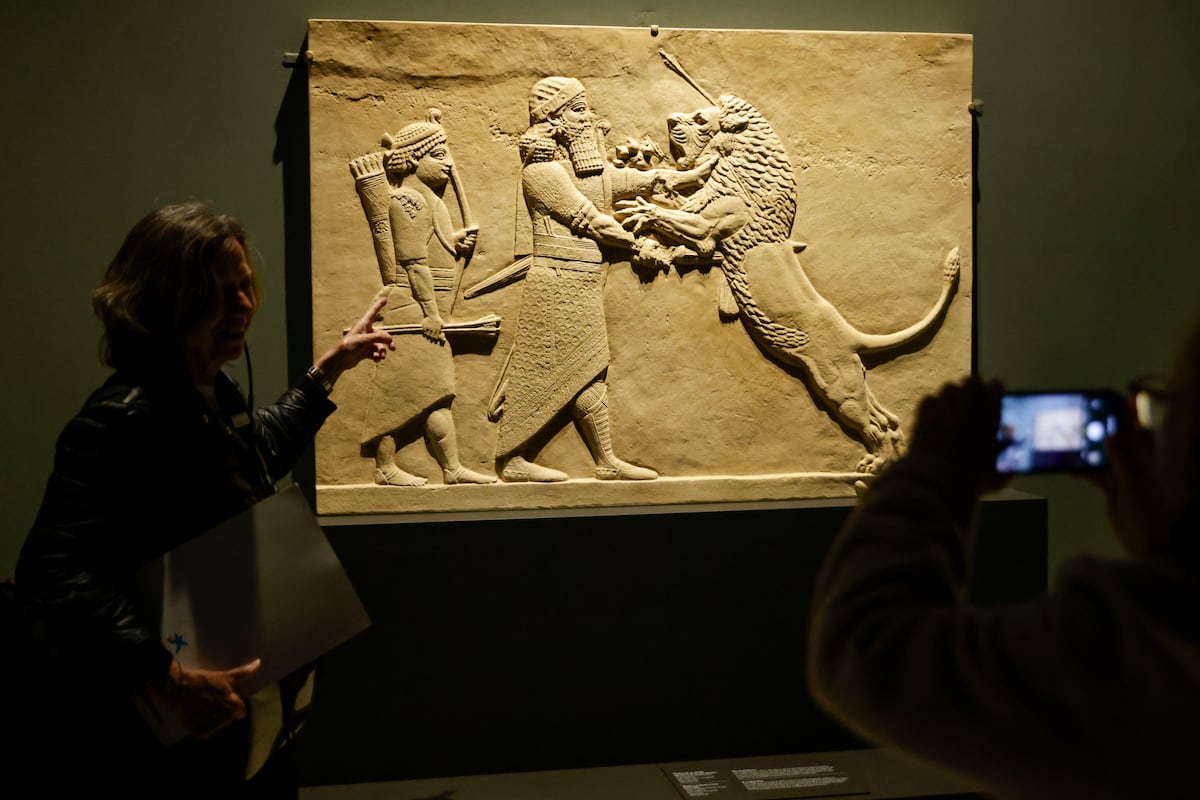
The ancient world’s most formidable intersection of power and knowledge has arrived in Spain. Madrid is currently playing host to a monumental exploration of one of history’s most complex figures with the exhibition “Soy Asurbanipal, rey del mundo, rey de Asiria” (I am Ashurbanipal, King of the World, King of Assyria). Opening at CaixaForum Madrid, the showcase offers a rare glimpse into the life of the last great sovereign of the Assyrian Empire, a man who balanced extreme military violence with an insatiable passion for literacy and archiving.
This ambitious exhibition is the result of a strategic partnership between Fundación “la Caixa” and the British Museum. It brings together 158 objects from the British Museum’s collection, transporting visitors back to the 7th century B.C. To witness the scale of an empire that once dominated the Near East through both the sword and the stylus.
Ashurbanipal, who governed from 669 to approximately 631 B.C., presided over a vast territory that encompassed all of Mesopotamia, stretching from the Mediterranean coast in the west to the mountains of Iran in the east. Described by the exhibition’s curator, Sebastien Rey, as “probably the most powerful man on the planet” at the time, Ashurbanipal’s legacy is defined by his dual identity as a ruthless conqueror and a scholarly curator.
For those interested in the intersection of art, history, and power, this exhibition provides a critical gaze at how knowledge was used to configure memory and culture. The display is curated by Sebastien Rey, who leads the Department of Ancient Mesopotamia in the Near East at the British Museum, and is hosted by Isabel Fuentes, the director of CaixaForum Madrid.
The Scholar King and the Library of Nineveh
Unlike many of his predecessors, Ashurbanipal placed a profound emphasis on the accumulation of knowledge. He established a legendary library in Nineveh—located in modern-day Mosul, Iraq—where he collected thousands of clay tablets written in cuneiform script. This effort created what is often considered the first universal library in history, aiming to centralize the wisdom of the known world under one roof.

The survival of these records is a paradox of history. Even as the city of Nineveh eventually fell, the very fire that destroyed the city served to preserve its knowledge. Sebastien Rey explains that the clay tablets were broken and scattered during the city’s destruction, but they were effectively “baked” and hardened by the heat of the fires, ensuring their preservation for future archaeologists to uncover.
The exhibition highlights this legacy by showcasing the recovered pieces that illustrate the king’s intellectual ambitions. By gathering texts from across Mesopotamia, Ashurbanipal ensured that the cultural and religious heritage of the region would survive, even as the political structures of the Assyrian Empire crumbled.
A Realm of Power and Violence
While his intellectual pursuits were groundbreaking, Ashurbanipal’s reign was equally characterized by the brutal efficiency of the Assyrian military machine. The exhibition does not shy away from the “violent personality” of the king, presenting a narrative where the pursuit of culture existed alongside the exercise of absolute, often terrifying, power.
The visual storytelling of the exhibition utilizes impressive artifacts, such as a gypsum wall bas-relief dating from 645-640 B.C. Found in the North Palace of Nineveh. This specific piece depicts the gods Sebitti, with all figures shown with their right hand raised, holding an axe—a stark reminder of the martial strength that backed the king’s scholarly endeavors.
The scale of his dominion was immense. From the plains of the Tigris and Euphrates to the shores of the Mediterranean, the Assyrian Empire under Ashurbanipal represented the pinnacle of Mesopotamian imperial reach. This duality—the library and the axe—defines the exhibit’s exploration of the sovereign’s life and the lasting impact of his reign on human civilization.
The Strategic Partnership Between CaixaForum and the British Museum
The arrival of “Soy Asurbanipal” in Madrid is part of a long-term strategic alliance between the British Museum and Fundación “la Caixa.” According to Isabel Fuentes, director of CaixaForum Madrid, this partnership has been instrumental in bringing civilizations and cultures that are often underrepresented in Spanish public institutions to a wider audience.
Since 2015, this collaboration has resulted in a total of ten exhibitions. These projects have spanned a diverse range of human history, including perspectives on Egyptian pharaohs and mummies, the Middle Ages in Europe, Ancient Greece, the transition from the Assyrians to Alexander the Great, and more contemporary themes such as “The American Dream” (from pop art to the present), feminine power in art, and “Voices of the Pacific.”
The current exhibition serves as a reflection on the power of knowledge in shaping cultural memory. However, the presentation is framed by a sobering reality. Both Isabel Fuentes and the director of the British Museum, Nicholas Cullinan, have acknowledged the “convulsive situation” currently affecting the region where these artifacts originated, adding a layer of contemporary urgency to the study of these ancient Mesopotamian ruins.
Key Exhibition Details
| Detail | Information |
|---|---|
| Venue | CaixaForum Madrid |
| Objects on Display | 158 items from the British Museum |
| Curator | Sébastien Rey (British Museum) |
| Closing Date | October 4, 2026 |
| Historical Focus | Ashurbanipal (669 – c. 631 B.C.) |
The exhibition remains open for public visitation until October 4, 2026, offering a comprehensive journey through the 7th century B.C. And the complex legacy of the man who sought to own all the knowledge of his world.
For those planning to visit, information regarding programming and ticket purchases is available through the official CaixaForum Madrid channels.
We invite our readers to share their thoughts on the intersection of power and knowledge in the comments below. Which ancient civilization do you believe has the most influential legacy on our modern world?