
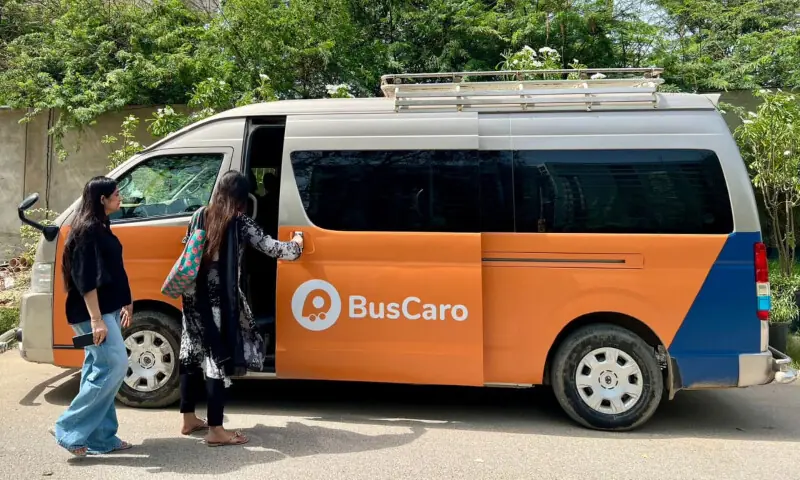
BusCaro: how a Pragmatic Approach to Shared Commuting is Succeeding Where Others Failed in Pakistan
The recent wave of startup failures in emerging markets, notably in the ride-hailing and mass transit space, has been a stark lesson in the perils of prioritizing hyper-growth over enduring economics. Companies like Airlift and Swvl, once lauded as potential unicorns, buckled under the weight of soaring fuel prices, economic downturns, and a shift in investor sentiment. But amidst the wreckage, a Pakistani startup, BusCaro, is charting a different course – and showing promising signs of success.
So, what’s BusCaro doing differently? The answer lies in a fundamental shift in strategy: focusing on profitability from day one, and building a business model anchored in real-world needs, not venture capital hype.
The Pitfalls of Subsidized growth
The business models of Airlift and Swvl were predicated on aggressive expansion fueled by substantial subsidies.They aimed to capture market share by offering deeply discounted rides, betting that scale would eventually deliver profitability. However, this strategy proved unsustainable when external conditions changed. the dramatic increase in petroleum prices,coupled with a global economic slowdown and a tightening of venture capital funding,exposed the fragility of these heavily subsidized operations. Investors, once eager to fund “growth at all costs,” began demanding a clear path to profitability.
BusCaro, however, sidestepped this trap. From its inception, the company prioritized positive unit economics – meaning each ride generates more revenue then it costs to provide. This isn’t a theoretical concept; it’s a core principle that dictates every aspect of their operation. While fares are adjusted to reflect fuel price fluctuations, a shared commute with BusCaro consistently remains a more affordable option than a private vehicle.
The Power of Aggregation: B2B & B2B2C
The key to BusCaro’s unit economics lies in its innovative approach to customer acquisition and service delivery. Unlike its predecessors, BusCaro hasn’t relied on expensive marketing campaigns or per-seat fare subsidies. rather, it’s built a robust network through two key verticals: Business-to-Business (B2B) and Business-to-Business-to-Consumer (B2B2C).
* B2B Partnerships: BusCaro collaborates directly with institutions, offering shared commuting as an employee benefit. This can take the form of employers subsidizing a portion of the commute cost, or BusCaro providing a convenient and cost-effective transportation solution when sufficient employee demand exists.
* B2B2C Facilitation: BusCaro partners with entities like housing societies and co-working spaces to aggregate commuters at designated pick-up points. This dramatically reduces customer acquisition costs and fosters a sense of community, contributing to positive unit economics.
Currently, B2B accounts for approximately 60% of BusCaro’s revenue, with B2B2C contributing the remaining 40%, including traffic generated through its consumer-facing app. This diversified approach provides a stable revenue base and reduces reliance on individual customer acquisition.
Tapping into Untapped Needs: The School Commute
Beyond its core B2B and B2B2C offerings, BusCaro has identified and is capitalizing on a significant gap in the market: safe and reliable school commutes. For many parents in Pakistan, the decline of conventional school van services has created a logistical nightmare. BusCaro’s app addresses this pain point by providing real-time ride tracking, with manual check-in/check-out features for minors, offering peace of mind to parents and schools alike. Founder Ms. Shahzad believes this niche has substantial growth potential, not only within Pakistan but also across the Gulf Cooperation Council (GCC) region, particularly for working mothers.
Challenges Remain: The Path to Profitability
Despite its promising trajectory,BusCaro isn’t yet profitable. The company currently experiences a monthly burn rate of around $15,000, resulting in an EBITDA of -2.8% – largely attributable to ongoing technology investments.The high interest rates in Pakistan (currently 36% as noted by Ms. Shahzad) further exacerbate the financial burden, making debt financing a costly proposition. This was a critical factor in the downfall of previous ventures in the space.
Though, demand considerably outstrips supply. Ms. Shahzad reports a pipeline 5-6 times larger than their current capacity. The underlying logic is compelling: shared commuting, outside of often overcrowded and unreliable public transport, will always be the most economical way to move people.To achieve profitability, BusCaro




