
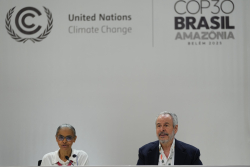
## Navigating COP30: A Deep Dive into Global Climate Negotiations
The global effort to address climate change reached a significant milestone this November as nearly 200 nations gathered in Brazil for the 30th Conference of the Parties (COP30). This landmark event, originating from the 1992 United Nations Framework Convention on climate Change (UNFCCC), represents three decades of international dialog. while the sheer longevity of the COP process – reaching its 30th iteration since the inaugural meeting in Berlin in 1995 – is noteworthy, the true measure of its success lies in tangible outcomes, a point increasingly scrutinized by observers. This article provides an in-depth analysis of COP30,its past context,key discussions,and future implications,offering a comprehensive understanding of this crucial arena for international climate action.
### The Evolution of COP: From Berlin to Brazil
The Conference of the Parties isn’t merely a yearly meeting; it’s the supreme decision-making body of the UNFCCC. initially conceived as a forum for assessing the implementation of the Convention, the COP’s role has expanded dramatically over the years. The early COPs focused on establishing the framework for international cooperation, defining common but differentiated responsibilities, and initiating data collection and reporting.
Significant milestones include the 1997 Kyoto Protocol, which established legally binding emission reduction targets for developed countries, and the 2015 Paris Agreement, a landmark accord aiming to limit global warming to well below 2, preferably to 1.5 degrees Celsius, compared to pre-industrial levels. Though, the path hasn’t been without obstacles. The withdrawal of the United States from the Kyoto Protocol and, later, from the Paris Agreement under the Trump management, highlighted the political fragility of international climate commitments.Recent data from the Intergovernmental Panel on Climate Change (IPCC) Sixth Assessment Report (released in 2023) underscores the urgency of the situation, stating that limiting warming to 1.5°C requires “rapid and far-reaching and sustained” reductions in greenhouse gas emissions. This context heavily influenced the discussions at COP30.
“The choices and actions we take now will have consequences for decades to come.”
### COP30: Key Discussions and Outcomes
COP30 in Brazil centered around several critical themes. A primary focus was the operationalization of the Loss and Damage Fund, established at COP27 in Sharm el-Sheikh, Egypt. This fund aims to provide financial assistance to vulnerable developing countries already experiencing the devastating impacts of climate change, such as extreme weather events and sea-level rise. Negotiations surrounding the fund’s structure,funding sources,and disbursement mechanisms proved especially challenging.
Another key area of discussion revolved around the Global Stocktake, a process mandated by the Paris Agreement to assess collective progress towards achieving its goals. The initial Global Stocktake, completed at COP28 in Dubai, revealed a significant gap between current emission reduction efforts and the 1.5°C target. COP30 aimed to translate this assessment into more enterprising national commitments, known as Nationally Determined Contributions (NDCs).
Furthermore, discussions extended to financing climate adaptation and mitigation efforts in developing countries. Developed nations reaffirmed their commitment to mobilize $100 billion per year in climate finance, a pledge initially made in 2009 but consistently falling short. The debate intensified regarding the need for innovative financing mechanisms, including carbon markets and private sector investment.
### The Role of Non-State Actors: A Growing Influence
While the COP process is fundamentally intergovernmental, the influence of non-state actors – including businesses, civil society organizations, and subnational governments - has grown considerably in recent years. These actors often bring innovative solutions, ambitious commitments, and a sense of urgency that can complement governmental efforts.
For example, the “America’s Pledge”


