
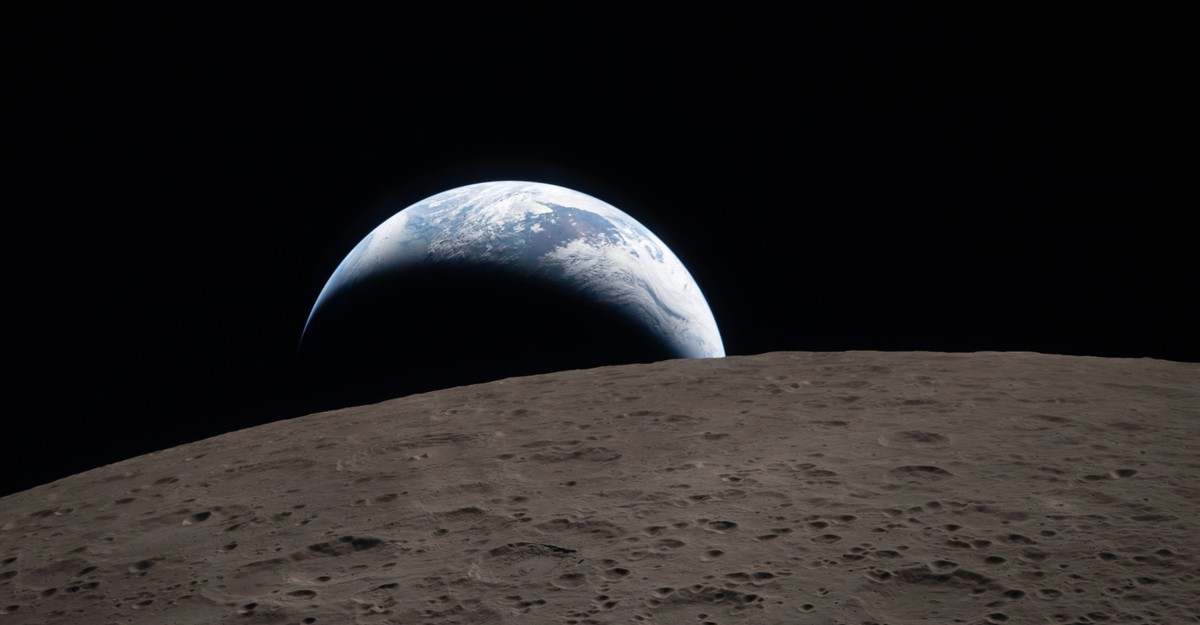
The contrast between the silent expanse of the lunar orbit and the volatile noise of terrestrial politics has never been more jarring. As the Artemis II mission makes its return to Earth following a slingshot orbit around the moon, the world is witnessing a profound psychological phenomenon known as the overview effect. This cognitive shift, experienced by astronauts viewing the planet from a distance, fosters a sense of global unity and an acute awareness of Earth’s fragility.
However, this vision of a borderless world exists in sharp tension with the current geopolitical climate. While mission pilot Victor Glover described the view from space as a reminder that “Homo sapiens is all of us,” the digital sphere is dominated by threats of civilizational destruction. The juxtaposition suggests a widening gap between the perspective of those who see the world as a single, fragile entity and those who view it as a chessboard for domination.
For global markets and economic policy, this tension is not merely philosophical. The stability of critical transit points, such as the Strait of Hormuz, remains a primary concern for international trade. When leadership rhetoric shifts toward the potential obliteration of entire civilizations, the “overview effect” becomes more than a psychological curiosity—it becomes a missing piece of the strategic puzzle.
Understanding the Overview Effect and the Artemis II Perspective
The “overview effect” is a term coined in the 1980s by author Frank White to describe the euphoria and cognitive shift reported by astronauts. This experience typically involves a realization that national boundaries are invisible from space and that the planet is a tiny, vulnerable oasis in a vast vacuum. The overview effect consistently produces a sense of connection to all humans, regardless of origin or appearance.
This sentiment was echoed in real time by the crew of the Artemis II mission. As the astronauts navigated their return from the moon, Victor Glover emphasized the unifying nature of the orbital perspective, stating, “Trust us, you look amazing, you look gorgeous… And from up here, you similarly look like one thing. Homo sapiens is all of us. No matter where you’re from or what you look like, we’re all one people.”
This perspective stands in direct opposition to the rhetoric of division. While the astronauts see a singular human race, the political discourse on Earth often emphasizes the survival of the strongest and the legitimacy of violence as a tool for domination. This cognitive dissonance creates a “whiplash effect,” where the triumph of scientific exploration is immediately countered by the threat of geopolitical collapse.
Geopolitical Volatility and the Strait of Hormuz
The fragility of the planet, so evident to the Artemis II crew, is currently being tested by aggressive posturing in the Middle East. In a recent message on Truth Social, Donald Trump issued a stark ultimatum regarding Iran and the Strait of Hormuz. He threatened that if Iran did not open the strait by an 8 p.m. Eastern deadline, “a whole civilization will die tonight, never to be brought back again.”
The Strait of Hormuz is one of the world’s most strategically important chokepoints, essential for the transit of global oil supplies. Threats of this magnitude—which some critics describe as sounding like genocide—project a vision of the world defined by ballistic force and civilizational battle. Trump characterized the moment as “one of the most important moments in the long and complex history of the World,” yet his framing focuses on destruction rather than the collective survival emphasized by the astronauts.
From an economic standpoint, such volatility introduces extreme risk into global energy markets. The distance provided by space exploration allows for a view of the planet as a shared home, but the “dirt of civilizational battle” remains the primary lens for those exercising terrestrial power.
The Economics of Exploration vs. Earthly Poverty
The pursuit of the stars has always been shadowed by the realities of poverty on Earth. The tension between the cost of space exploration and the needs of the marginalized is a long-standing critique of the space race. On the day of the Apollo 11 launch in 1969, civil-rights leader Ralph Abernathy led a protest at NASA, highlighting a stark disparity: it cost $12 a day to feed an astronaut, while a starving child could be fed for $8.
This critique was further articulated in the 1970 song “Whitey on the Moon” by Gil Scott-Heron. Through a blend of poetry and percussion, Scott-Heron contrasted the triumphalism of the moon landing with the systemic poverty and medical neglect facing Black Americans. The song serves as a reminder that while some humans are exploring the cosmos, others cannot afford basic doctor bills.
In the modern era, the role of private billionaires—such as Elon Musk and Jeff Bezos—has shifted the dynamics of space exploration. While these figures provide the infrastructure for orbital travel, critics argue that their focus remains on the destination rather than the people left behind. There is a risk that the perspective gained in zero gravity could be used to dismiss earthly problems as insignificant, rather than to inspire a more compassionate approach to solving them.
The Perspective of Scale: From the Atomic to the Galactic
The feeling of insignificance that accompanies the overview effect was captured for a wider audience in the 1977 IBM short film Powers of Ten. The film uses a zooming technique to move from a couple picnicking in Chicago outward by a factor of 10 every ten seconds, eventually encompassing the entire universe before reversing the process to zoom into the molecular and atomic levels.
This exercise in scale demonstrates that from a certain perspective, human conflicts are virtually invisible. The “grandiose reasons” presented for inflicting damage on others—such as the threats directed at Iran—grow absurd when viewed against the vastness of the Milky Way. The ruins of war, whether in Gaza or Tehran, are invisible from outer space, which can either lead to a dangerous erasure of conscience or a realization that the destruction of any part of the planet is a form of self-destruction.
This sense of scale is a necessary corrective to the oversized egos of political leadership. If the overview effect can diminish the perceived importance of nationalistic squabbles, it suggests that the ruination sought through violence is, in reality, a threat to the entire species. From a superterrestrial height, the civilization being threatened is indistinguishable from the one doing the threatening.
Conclusion: The Choice Between Unity and Obliteration
The convergence of the Artemis II mission and the current geopolitical threats represents a crossroads for humanity. One path leads toward the “overview effect”—a recognition of our shared identity as Homo sapiens and a commitment to protecting our fragile home. The other path leads toward the “ballistic missile” approach, where domination is achieved through the threat of total annihilation.
The question remains whether the leaders of the world can cultivate the perspective of the astronaut without actually leaving the atmosphere. The ability to see the planet as one people is not just a poetic sentiment; it is a strategic necessity for the survival of a globalized economy and a shared environment.
The world now awaits the final resolution of the deadline set for the Strait of Hormuz. The outcome will determine whether we continue to move toward the unity envisioned by Victor Glover or succumb to the cycle of destruction described in the Truth Social threats.
World Today Journal will continue to monitor the Artemis II return and the geopolitical status of the Strait of Hormuz. We invite our readers to share their perspectives on the balance between space exploration and earthly responsibility in the comments below.