
The intersection of architecture and public health is often invisible until it fails. For individuals living with disabilities or recovering from significant trauma, the physical environment can either be a barrier to recovery or a catalyst for healing. When housing is designed solely for utility, it often risks feeling institutional, inadvertently reinforcing the marginalization of the people it is meant to serve. Although, a shift toward trauma-informed universal design in supportive housing is redefining how we approach the fundamental human right to a dignified home.
In the heart of New York City’s Lower East Side, a new residential project serves as a critical case study in this evolution. Freedom Village, a 65,000-square-foot residence providing permanent supportive housing, seeks to empower its community through a deliberate focus on dignity, autonomy, and inclusion. By blending healthcare-inspired best practices with residential warmth, the project challenges the traditional aesthetics of supportive living.
As a physician and journalist, I have seen how the “clinical” perceive of many support facilities can trigger anxiety or a sense of helplessness in patients. The philosophy behind Freedom Village suggests that the built environment can directly impact long-term well-being. By prioritizing the psychological needs of the resident alongside their physical requirements, the project moves beyond simple accessibility to create a space that is truly human-centered.
A Foundation of Purpose: Barrier Free Living and JCJ Architecture
The development of Freedom Village is the result of a collaboration between JCJ Architecture and Barrier Free Living (BFL), a nationally recognized organization. BFL has served as a pillar of the Lower East Side community for more than 45 years, focusing on supporting individuals with disabilities and ensuring they live lives free from bias and abuse.

To realize this vision, BFL engaged James E. LaPosta, Jr. Of JCJ Architecture to create a facility that balanced a unique architectural presence with highly accessible interiors. The resulting program is comprehensive, featuring a mix of 74 studio, one-, two-, and three-bedroom apartments. Beyond the living quarters, the facility includes administrative offices, community support spaces, a rear garden, and an elevated outdoor recreation area, ensuring that residents have access to both private sanctuary and social connection.
Beyond Compliance: The Mechanics of Universal Design
While many buildings claim accessibility by meeting the minimum legal standards of the Americans with Disabilities Act (ADA), universal design aims higher. The goal is to create an environment that is intuitively usable by everyone, regardless of their age, size, or ability, without the need for specialized adaptations that might make a resident feel “different.”
At Freedom Village, this approach manifests in several precise, thoughtful details:
- Intuitive Wayfinding: A specific color palette was used throughout the building to signify entrances and signage. These shades were selected to remain recognizable for individuals who cannot see in color, reducing the stress of navigation.
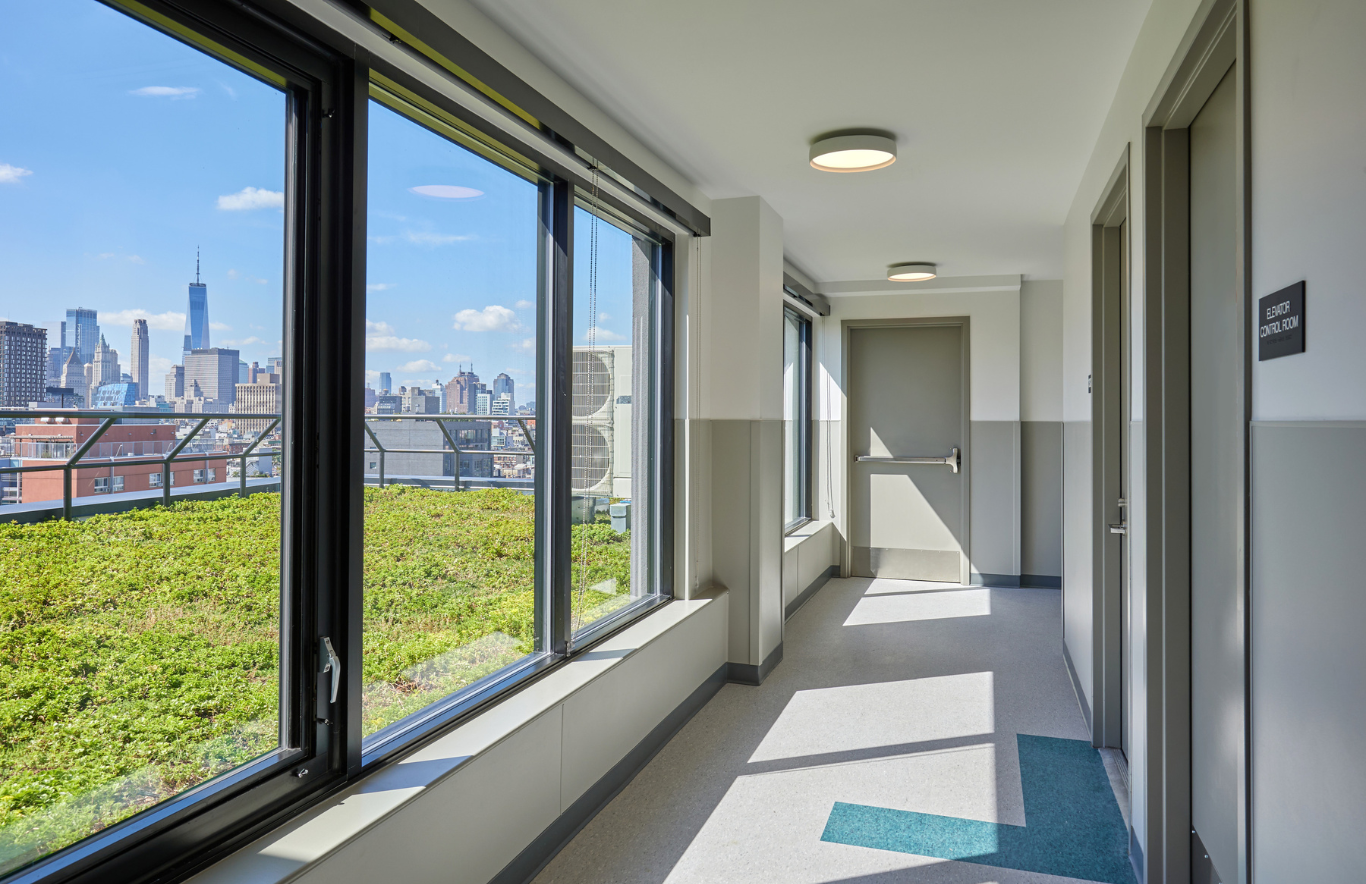
- Uninterrupted Circulation: Every hallway in the facility has been widened to allow wheelchair traffic to move in both directions simultaneously, preventing bottlenecks and promoting independence.
- Adaptive Residential Units: Kitchenettes and bathrooms are equipped for various abilities. This includes strategically selected counter heights and cabinets that are reachable for those in wheelchairs.
- Integrated Safety: To protect residents, stoves are equipped with automatic shut-off mechanisms that activate once a certain temperature is reached.
- Sensory Alerts: For residents with hearing impairments, select units feature flashing light devices that alert them when someone is knocking at the door.
- Inclusive Security: Door peepholes are installed at two different heights to accommodate both standing residents and those using mobility devices, while floor tiles that transition in color indicate the entrance to each unit.

The Psychology of Space: Trauma-Informed Design
While universal design addresses physical access, trauma-informed design addresses emotional and psychological safety. Many residents in permanent supportive housing have histories of trauma, which can make certain environmental cues—such as cramped hallways, dim lighting, or a lack of control over one’s surroundings—feel threatening.
The design team at JCJ Architecture focused on creating a “delicate balance” between security and aspiration. To avoid an institutional atmosphere, the project integrated warmth, color, and visual interest. However, safety remained paramount; clear sightlines were maintained throughout the building to ensure a sense of security for both residents and staff.
A critical component of this wellness strategy is the integration of nature and light. Freedom Village features two landscaped terraces, located on the second and ninth floors, which offer expansive views of the New York City skyline. These outdoor spaces are not merely aesthetic; they are actively programmed for recreation, social events, and therapy. This recognizes a fundamental tenet of public health: that access to nature and natural light is inextricably linked to mental well-being and physical recovery.
Key Elements of Trauma-Informed Housing
| Feature | Institutional Approach | Trauma-Informed Approach (Freedom Village) |
|---|---|---|
| Aesthetics | Sterile, neutral, utilitarian | Warmth, color, and visual interest |
| Security | Restrictive, closed-off | Clear sightlines and controlled outdoor access |
| Nature | Limited or indoor-only | Landscaped terraces for therapy and recreation |
| Navigation | Standard signage | Color-coded wayfinding for diverse visual needs |
Why Design Matters for Public Health
The implications of projects like Freedom Village extend beyond a single building in the Lower East Side. When we reshape supportive housing to prioritize dignity, we are essentially treating the environment as a part of the medical intervention. For a person with a disability, the ability to navigate their own home without assistance is not just a convenience—it is a restoration of autonomy.
the integration of universal and trauma-informed principles reduces the cognitive load on residents. When a building is intuitive and feels safe, residents can redirect their mental energy away from survival and navigation and toward recovery and community integration. This is where architecture becomes a tool for social impact.
By demonstrating that supportive housing can be both functional and uplifting, Freedom Village sets a new standard. It proves that we do not have to sacrifice aesthetics for accessibility, nor security for warmth. Instead, these elements can work in tandem to foster a sense of pride and belonging for those who have historically been pushed to the margins of urban design.
As urban centers continue to evolve, the adoption of these principles will be essential in addressing the complex needs of individuals and families living with disabilities. The focus must remain on creating spaces that do not just house people, but actually support their journey toward a more dignified and independent life.
For those interested in the ongoing evolution of accessible urban planning, the project serves as a living example of how intentional design choices can reshape the experience of supportive living. We encourage readers to share their thoughts on how inclusive design can be further integrated into public health infrastructure in the comments below.