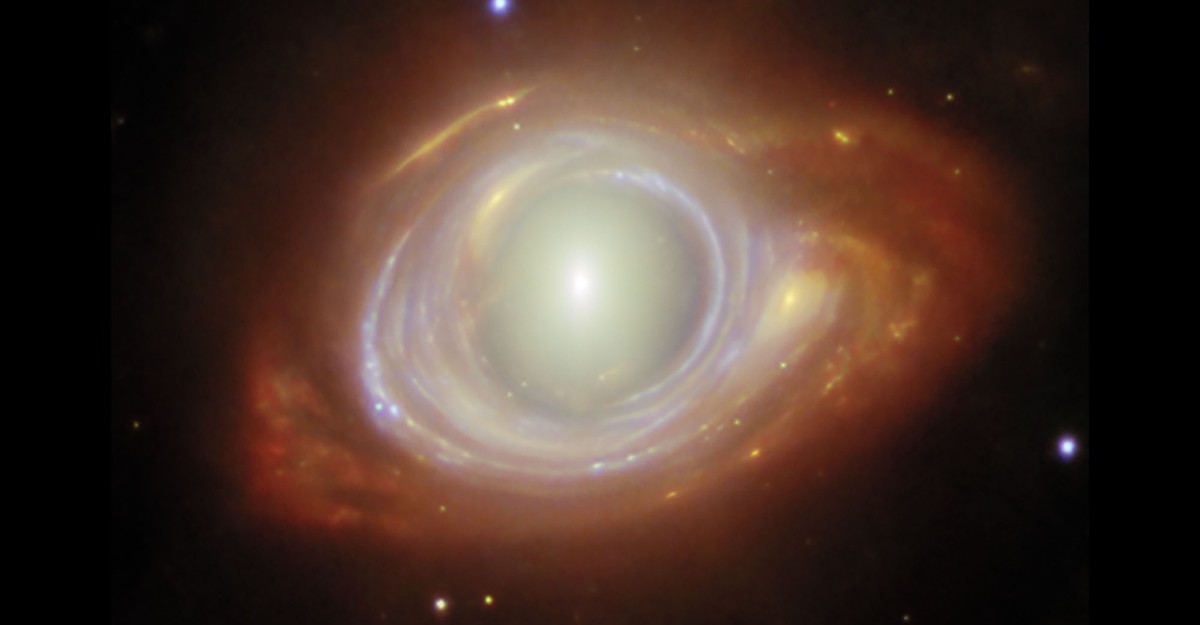
The Astonishing Einstein Ring: A Deep Dive into Gravitational Lensing
Have you ever wondered how gravity can bend light? The universe holds amazing secrets, and one of the most visually stunning confirmations of Einstein’s theory of general relativity is the Einstein Ring. This phenomenon, captured beautifully by the James Webb Space Telescope (JWST) as part of The Atlantic’s 2025 Space Telescope Advent Calendar, isn’t just a pretty picture; it’s a powerful tool for understanding the cosmos. This article will explore the science behind Einstein rings, their significance in astrophysics, and what recent observations are revealing about the distant universe.
What is gravitational Lensing?
At its core, gravitational lensing occurs when the gravity of a massive object, like a galaxy or cluster of galaxies, bends and magnifies the light from a more distant object behind it. Think of it like looking through a warped piece of glass – the image is distorted. Albert Einstein predicted this effect in 1912 as a consequence of his theory of general relativity, stating that gravity isn’t just a force, but a curvature of spacetime.
Did You Know? The first confirmed gravitational lens was observed in 1979, a double quasar named Q0957+561.This revelation provided strong evidence supporting Einstein’s predictions.
Decoding the Einstein Ring: A perfect Alignment
An Einstein Ring is a special case of gravitational lensing. It happens when the source, the lens, and the observer (us on Earth) are perfectly aligned. This creates a ring-like distortion of the source galaxy’s light around the lensing galaxy. The image from the 2025 Advent Calendar showcases this perfectly, revealing a warped spiral galaxy distorted by the gravity of a closer galaxy cluster, SMACSJ0028.2-7537.
Why are Einstein Rings Crucial for Astronomers?
These aren’t just beatiful cosmic spectacles. Einstein Rings are invaluable tools for astronomers. Here’s how:
* Magnification: They magnify the light from distant galaxies, allowing us to study objects that would or else be too faint to observe.
* Mass Mapping: The degree of distortion reveals the mass distribution of the lensing galaxy, including dark matter, which doesn’t emit light but exerts gravitational pull.
* Redshift Measurement: Analyzing the distorted light helps determine the redshift of the background galaxy, providing insights into its distance and the expansion of the universe.
* Studying Early Galaxies: They allow us to peer back in time and study galaxies as they existed billions of years ago, closer to the universe’s birth.
pro Tip: The completeness of an Einstein Ring is rare. More frequently enough, astronomers observe partial Einstein Rings, or arcs, due to slight misalignments. These are still incredibly useful for analysis.
Recent Discoveries & the James Webb Space Telescope
the JWST is revolutionizing our understanding of gravitational lensing. Its infrared capabilities allow it to see through dust and gas, revealing previously hidden details in einstein Rings. Recent research (published in Nature Astronomy in November 2024) utilizing JWST data has identified several new, highly magnified galaxies at redshifts exceeding 10, offering unprecedented views of the early universe. These observations are challenging existing cosmological models and providing new insights into galaxy formation.
Here’s a quick comparison of how different telescopes contribute to studying Einstein Rings:
| Telescope | Wavelength | Key Capabilities for Einstein Ring Study |
|---|---|---|
| Hubble Space Telescope | Visible & Ultraviolet | Initial detection of many lensing systems; high-resolution imaging. |
| James Webb Space Telescope | Infrared | Penetrates dust; observes highly redshifted galaxies; detailed mass mapping. |


![Water Bills Rise: Regulator Costs Soar Despite Abolition Plans | [Year] Update](https://i0.wp.com/i.dailymail.co.uk/1s/2025/12/17/12/102834251-15392061-Southern_Water_had_already_been_allowed_a_53_rise_to_average_bil-a-1_1765973558050.jpg?resize=330%2C220&ssl=1 "Water Bills Rise: Regulator Costs Soar Despite Abolition Plans | [Year] Update")