
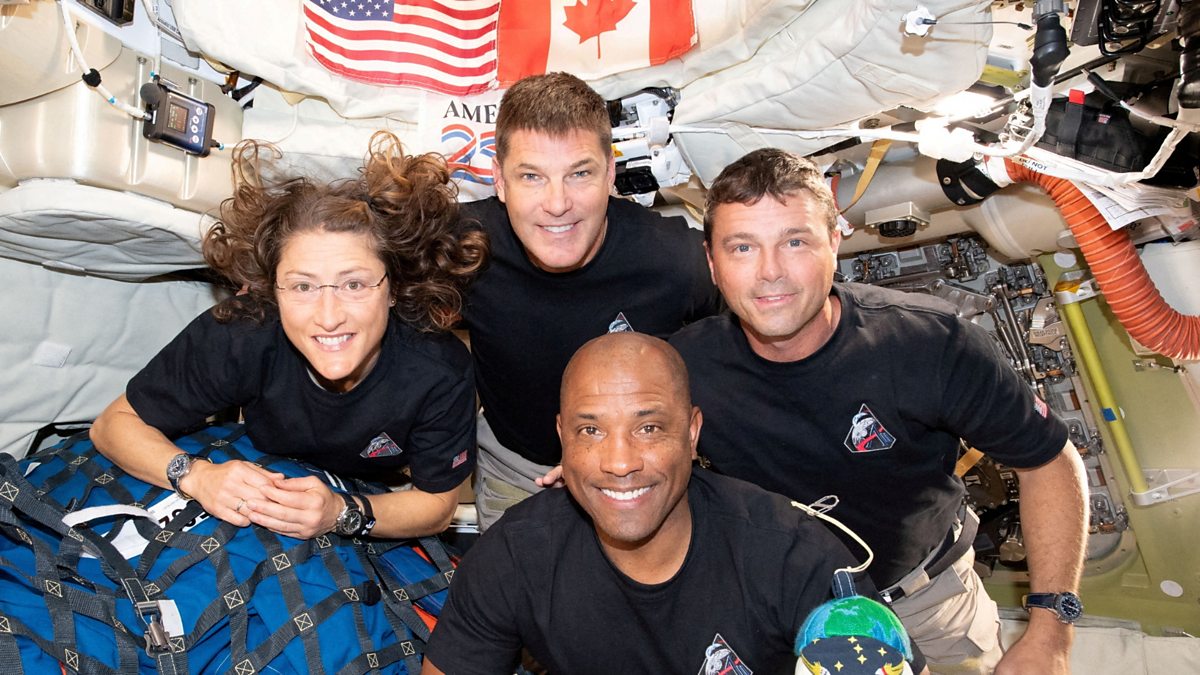
For the residents of Ingersoll, Ontario, the distance between a quiet Canadian town and the lunar frontier has suddenly shrunk. The community, home to approximately 15,000 people, is currently celebrating one of its own as the Jeremy Hansen Artemis II mission makes history, marking a pivotal moment in international space exploration.
Jeremy Hansen, a mission specialist and Colonel in the Royal Canadian Air Force, is not merely a passenger on this voyage; he is a trailblazer. As a key member of the Artemis II crew, Hansen has grow the first non-American to travel beyond low Earth orbit (LEO) and the first non-American to journey into the vicinity of the Moon. His trajectory from a farm near Ailsa Craig and a high school education in Ingersoll to the depths of space serves as a powerful narrative of human ambition and international cooperation.
The Artemis II mission represents the first crewed flight test of NASA’s foundational deep space capabilities, specifically the Space Launch System (SLS) rocket and the Orion spacecraft. By sending a crew around the Moon, NASA and its partners aim to verify that all spacecraft systems operate as designed in the actual environment of deep space, effectively paving the way for future long-term science and exploration on the lunar surface via NASA.
From Ontario Farmland to the Lunar Vicinity
The journey for Colonel Jeremy Hansen began far from the vacuum of space. Born on January 27, 1976, in London, Ontario, Hansen was raised on a farm near Ailsa Craig before moving to Ingersoll for his high school years via Wikipedia. His early interest in aviation was sparked at age 12 when he joined the 614 Royal Canadian Air Cadet Squadron.

Hansen’s professional ascent was rooted in military discipline and technical excellence. He served as a captain in the Royal Canadian Air Force, where he piloted the CF-18 fighter jet at CFB Cold Lake, Alberta. This rigorous background in high-performance aviation provided the foundation for his selection by the Canadian Space Agency (CSA) during the 2009 astronaut recruitment process.
Now holding the rank of Colonel, Hansen brings a blend of military precision and scientific curiosity to the Artemis II mission. His presence on the crew underscores the collaborative nature of modern space exploration, moving beyond the era of single-nation dominance to a model of global partnership.
The Artemis II Crew and Mission Objectives
The Artemis II mission is a meticulously planned operation designed to test the limits of human endurance and spacecraft reliability. The crew consists of four highly experienced astronauts, each filling a critical role in the mission’s success:
- Commander Reid Wiseman: Leading the mission and overseeing the overall operations of the Orion spacecraft.
- Pilot Victor Glover: Responsible for the flight systems and navigation.
- Mission Specialist Christina Hammock Koch: A NASA astronaut contributing extensive experience in long-duration spaceflight.
- Mission Specialist Jeremy Hansen: Representing the Canadian Space Agency and providing critical operational support.
The primary goal of this flight is to confirm that the Orion spacecraft can safely support a human crew during a lunar flyby. Here’s a prerequisite for the subsequent Artemis missions, which intend to land humans on the lunar surface for the first time in over half a century. By verifying these capabilities, the mission establishes the necessary infrastructure for sustained lunar living and a permanent moon base via CBC News.
Breaking Records in Deep Space
The Jeremy Hansen Artemis II mission has already rewritten the record books. By leaving low Earth orbit, Hansen has broken the distance record from Earth alongside his crewmates, venturing further into the cosmos than any human since the Apollo era. This achievement is particularly significant for Canada, marking the first time a Canadian citizen has headed toward the Moon.
The mission reached a critical milestone on April 2, 2026, when the crew executed the translunar ignition. After approximately 25 hours in Earth’s orbit, and following confirmation that all Orion critical systems were functioning correctly, the capsule bolted out of orbit to begin its journey toward the Moon, located nearly 400,000 kilometres away via CBC News.
Beyond the technical achievements, the mission has provided moments of profound human connection. On April 7, 2026, while in transit, Hansen announced the naming of the crater Carroll, named in honour of Carroll Taylor Wiseman, the wife of Commander Reid Wiseman via Wikipedia.
Artemis II Mission Timeline and Milestones
| Date | Event | Significance |
|---|---|---|
| August 8, 2023 | Crew Presentation | The crew was officially presented at the Neil Armstrong Operations and Checkout Building. |
| April 2, 2026 | Translunar Ignition | The Orion capsule left Earth’s orbit to head toward the Moon. |
| April 7, 2026 | Crater Naming | Jeremy Hansen announced the naming of crater Carroll. |
| April 2026 | Lunar Vicinity | Hansen becomes the first non-American to travel beyond LEO. |
What Which means for the Future of Exploration
The success of the Artemis II mission is not just a victory for the four individuals aboard the Orion spacecraft; it is a validation of the Space Launch System (SLS) as a viable vehicle for deep space exploration. The ability to send humans beyond the protective shield of Earth’s magnetic field and into the radiation-heavy environment of deep space is a critical step toward the eventual goal of human missions to Mars.
For the global community, the inclusion of the Canadian Space Agency highlights the importance of the Artemis Accords and the spirit of international cooperation. It demonstrates that the exploration of the Moon is a shared human endeavor, where expertise from different nations converges to push the boundaries of what is possible.
The mission’s focus on “verifying today’s capabilities” ensures that when the first boots touch the lunar dust in the coming years, the safety and reliability of the systems will have been proven under the most rigorous conditions. This methodical approach minimizes risk while maximizing the scientific yield of future lunar surface missions.
As of the current mission status, the crew has spent a total of 9 days, 1 hour, and 32 minutes in space, continuing to provide data that will be analyzed for years to come via Wikipedia.
The next confirmed checkpoint for the mission involves the completion of the lunar flyby and the subsequent reentry sequence, which will return the crew safely to Earth. Official updates on the splashdown and post-mission debriefs will be provided by NASA and the Canadian Space Agency.
We invite our readers to share their thoughts on this historic milestone. Do you believe international partnerships are the key to reaching Mars? Let us know in the comments below.