
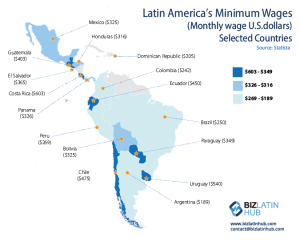
The landscape of labor compensation in Latin America has undergone significant shifts as nations struggle to balance worker purchasing power against persistent inflationary pressures. In 2026, a small group of countries has managed to distance itself from the regional average, establishing a high-tier bracket where the highest minimum wage in Latin America exceeds the $600 monthly threshold.
Leading this group are Costa Rica, Uruguay, and Panama, the only three nations in the region where the legal minimum monthly remuneration surpasses $600 USD. These countries have leveraged tripartite agreements—negotiations between government, employers, and labor unions—to sustain these levels. Even as much of the region faces volatile economic conditions, these three nations have created a “buffer” that protects the most vulnerable workers from the sharpest effects of inflation.
Meanwhile, other major economies like Colombia are making aggressive strides to climb the rankings. In a move that has drawn regional attention, Colombia recently implemented a substantial salary increase, resulting in a total monthly income for workers that reaches $2,000,000 COP when combining the base salary and transportation allowances according to reports from April 2026.
This shift highlights a growing divide in the continent: a “productivity elite” of nations that can sustain higher legal floors, and a larger group of emerging economies where the cost of the basic food basket often grows faster than the official salary adjustments.
The Elite Tier: Costa Rica, Uruguay, and Panama
At the top of the regional hierarchy, Costa Rica maintains its position as the leader in legal remunerations for unskilled work. According to data from the International Labour Organization (ILO), Costa Rica leads the ranking with an average monthly minimum wage of $751 USD as of 2026. This figure is significantly higher than the Latin American average and reflects a stable economic framework that has seen modest adjustments, such as a 1.63% increase depending on the sector since 2025.

Uruguay follows in the second position, with a monthly minimum income of approximately $648 USD per recent analysis. Uruguay’s success in maintaining a high wage floor is attributed to gradual adjustments agreed upon through sustained tripartite negotiations, ensuring that wage growth remains aligned with macroeconomic stability.
Panama rounds out the top three, with an average minimum wage orbiting $637 USD in 2026. However, unlike the more uniform structures in Costa Rica or Uruguay, Panama’s figures can vary depending on the specific sector of economic activity, reflecting a more fragmented labor market.
| Country | Approximate Monthly Minimum (USD) | Key Driver |
|---|---|---|
| Costa Rica | $751 | Sector-based adjustments / ILO data |
| Uruguay | $648 | Tripartite agreements |
| Panama | $637 | Sector-specific variations |
Colombia’s Ascent and the $2 Million COP Milestone
Colombia has emerged as a significant mover in the 2026 regional rankings. The government has implemented a sharp increase in the Salario Mínimo Legal Mensual Vigente (SMLMV), which is now set at $1,750,905 COP as of April 2026. When this base salary is combined with the transportation allowance (auxilio de transporte) of $249,095 COP, the total monthly income for workers reaches exactly $2,000,000 COP.
In dollar terms, this total remuneration is equivalent to approximately $539 USD at current rates. While this does not yet break the $600 USD barrier maintained by the top three nations, it places Colombia firmly in a second tier of competitiveness alongside Chile (USD 597) and Mexico (which ranges between USD 533 and USD 641 depending on the specific zone) per regional market analysis.
The impact of this increase is substantial. For a Colombian worker, the daily pay now sits at $58,363 COP according to April 2026 data. This represents a significant effort to protect the purchasing power of the population against inflationary dynamics that have pressured emerging economies throughout the last cycle. The overall increase for the year was reported at 23.7% per reported figures, one of the highest growth rates in the region.
The Regional Gap and Economic Implications
Despite these increases, the “wage gap” across Latin America remains pronounced. The disparity is most evident when comparing the top tier to countries like Peru, where the minimum income does not exceed $400 USD according to 2026 analysis. This gap is not merely a matter of currency, but a reflection of differing levels of productivity and cost of living across borders.
The International Labour Organization (ILO) notes that minimum wage increases over the last decade have varied wildly. While Uruguay and Costa Rica saw increases between 6% and 10%, and Brazil and Chile around 18%, countries like Colombia, Mexico, and the Dominican Republic have seen much more aggressive jumps, ranging between 24% and 30% according to ILO data cited in April 2026.
Economists suggest that while raising the nominal minimum wage is a political and social necessity to combat inflation, the “real” purchasing power remains the primary challenge. In many of these economies, the cost of the basic food basket is rising at a pace that threatens to neutralize the benefits of these legal increases.
Key Takeaways for the 2026 Labor Market
- The $600 Club: Only Costa Rica, Uruguay, and Panama have minimum wages exceeding $600 USD per month.
- Costa Rica’s Lead: With an average of $751 USD, Costa Rica remains the highest paying nation for unskilled labor in the region.
- Colombia’s Milestone: The combination of SMLV and transport allowance has brought Colombian worker income to a round $2,000,000 COP ($539 USD).
- Aggressive Adjustments: Colombia, Mexico, and the Dominican Republic lead the region in percentage increases over the last decade (24-30%).
- Persistent Inequality: A sharp divide remains between the “elite” group and nations like Peru, where wages stay below $400 USD.
As governments continue to calibrate their labor policies, the focus for 2026 will remain on whether these nominal increases can translate into a genuine improvement in quality of life or if they will be absorbed by the rising cost of living. Workers and employers alike are now looking toward the next round of quarterly economic reviews to see how these adjustments affect national productivity.
World Today Journal encourages readers to share their perspectives on regional wage gaps in the comments below.