Unveiling N11: A Stellar Nursery in the Large Magellanic Cloud - A Deep Dive into Star Formation
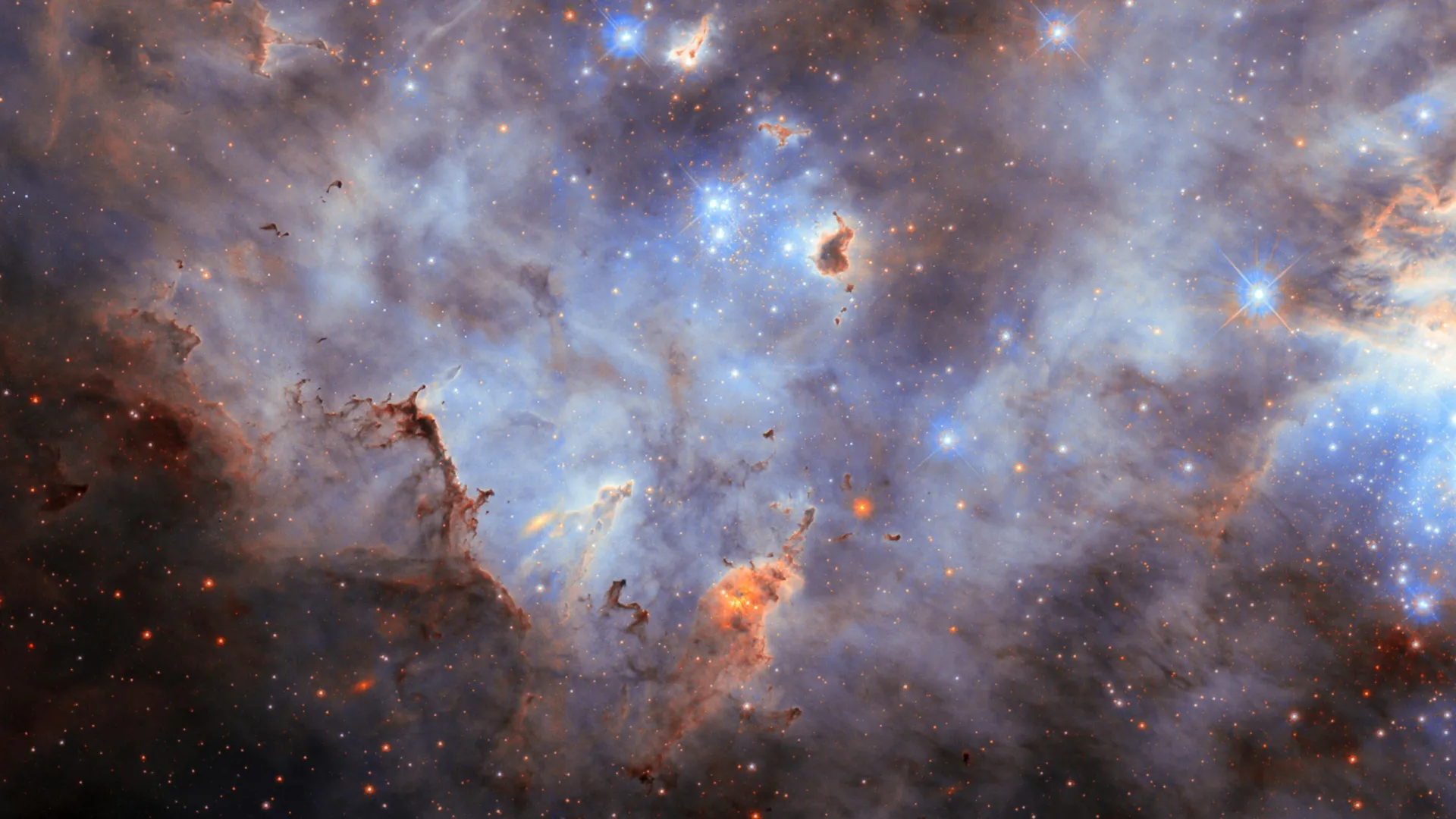
The cosmos continually births new stars, and few places showcase this process as dramatically as the N11 star-forming region within the Large Magellanic Cloud (LMC). this breathtaking image, captured by the NASA/ESA hubble Space Telescope, isn’t just a pretty picture; it’s a window into the fundamental processes of star formation, offering astronomers invaluable data about the lifecycle of stars and the evolution of galaxies. This article will delve into the intricacies of N11, exploring its location, composition, the past observations that shaped our understanding, and the future implications of studying such stellar nurseries.We’ll examine the role of cosmic dust, the impact of ultraviolet radiation, and the significance of long-term observational studies.
Understanding the Large Magellanic Cloud: A Galactic Neighbor
The large Magellanic Cloud, a dwarf galaxy approximately 160,000 light-years from Earth in the constellations Dorado and Mensa, is a fascinating object in its own right. With a mass estimated to be 10-20% that of our Milky Way,it’s the largest of the dozens of smaller galaxies gravitationally bound to our own. Its proximity makes it an ideal laboratory for studying galactic evolution and the processes occurring within galaxies similar to those that existed in the early universe.
The LMC is rich in interstellar gas and dust, the raw materials for new stars. These materials coalesce within massive stellar nurseries, and N11 is one of the most prominent examples.Understanding the conditions within these nurseries – temperature, density, chemical composition - is crucial to understanding how stars are born.
N11: A Hub of Intense Starbirth
N11, the second-largest star-forming region in the LMC (after the renowned Tarantula Nebula), is a chaotic yet beautiful landscape of glowing gas, dark dust clouds, and brilliant young stars.The image from Hubble reveals the dynamic interplay between these components. Bright, newly formed stars emit intense ultraviolet (UV) radiation, which sculpts the surrounding gas and dust, creating intricate structures and triggering further star formation.
the region is characterized by a complex network of filaments, bubbles, and cavities, all carved out by the energetic output of massive stars. These stars, substantially larger and hotter than our Sun, have short lifespans, ending their lives in spectacular supernova explosions that further enrich the surrounding interstellar medium with heavy elements.This cycle of star birth,life,and death is fundamental to the evolution of galaxies.
A Two-Decade Perspective: Hubble’s legacy observations
What makes the Hubble image of N11 particularly valuable is that it combines observations taken roughly 20 years apart. The initial observations, conducted in 2002-2003 using the Advanced Camera for Surveys (ACS), were groundbreaking at the time. Astronomers embarked on an enterprising project: to catalog every star within the young N11 cluster with masses ranging from 10% to 100 times the mass of our Sun. This thorough census provided unprecedented insights into the initial mass function (IMF) – the distribution of stellar masses within a star cluster - and the processes that govern star formation.
The subsequent observations, made with the Wide Field Camera 3 (WFC3), focused on the dusty clouds permeating the cluster. WFC3’s capabilities allowed astronomers to penetrate these dust clouds, revealing previously hidden details and providing a new perspective on the role of cosmic dust in star formation. Dust isn’t just a passive bystander; it plays a crucial role in shielding gas from radiation,promoting gravitational collapse,and ultimately,the formation of new stars.
| Camera | Observation Period | Primary Focus |
|---|

![NWSL Power Rankings: Lavelle & Shaw Fuel Gotham FC’s Surge | Week [Date]](https://i0.wp.com/sportshub.cbsistatic.com/i/r/2025/09/11/44216803-3e72-4b23-99d5-865b8526d099/thumbnail/1200x675/bc698df8788b30222918e30717c87316/power-rankings-soccer-nwsl-template-1-6.png?resize=150%2C150&ssl=1 "NWSL Power Rankings: Lavelle & Shaw Fuel Gotham FC’s Surge | Week [Date]")