
The International Monetary Fund (IMF) is preparing to deploy a massive financial lifeline to stabilize the world’s most fragile economies, with expectations that IMF financial assistance Middle East war support could reach up to $50 billion. The announcement comes as the global economy grapples with the systemic shocks of a conflict that has disrupted energy markets, snarled international trade and threatened the food security of millions.
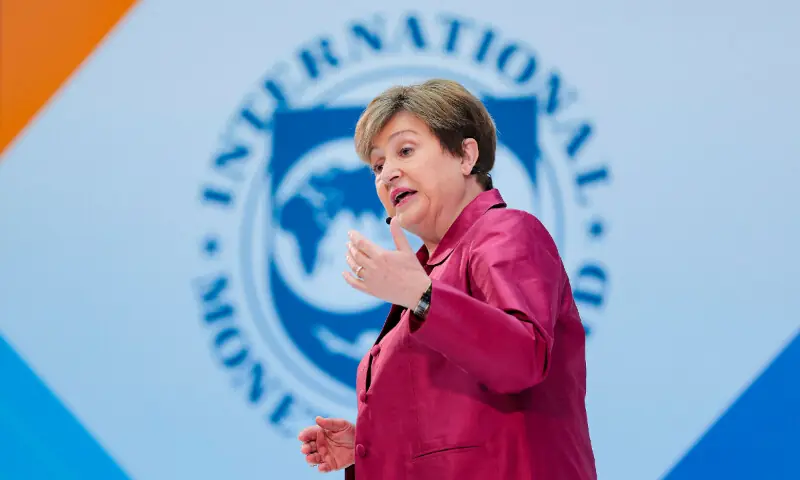
Speaking on Thursday at the annual Spring Meetings in Washington, IMF Managing Director Kristalina Georgieva warned that the economic fallout will be far-reaching and enduring. Georgieva indicated that near-term demand for balance-of-payments support is expected to rise to between $20 billion and $50 billion, noting that the lower end of that spectrum would likely prevail if the current fragile ceasefire remains intact.
The crisis, sparked by the US-Israeli war on Iran launched on February 28, has created a volatile economic environment. The conflict has seen Tehran virtually block the Strait of Hormuz, a move that sent oil prices surging and triggered a ripple effect across global supply chains. As a senior economist, I view this not merely as a regional dip but as a structural shock that threatens to rewrite growth trajectories for the coming years.
The ‘Scarring Effect’ and Global Growth Forecasts
One of the most concerning aspects of the current crisis is what the IMF describes as “scarring effects.” Even in the most optimistic scenarios, Georgieva noted that the combination of infrastructure damage, supply disruptions, and a precipitous loss of market confidence means the global economy will not simply return to its previous state. “Even in a best case, there will be no neat and clean return to the status quo ante,” she stated.
The IMF has signaled that it will pare its global growth forecast for 2026 to account for these disruptions. The impact is described as “asymmetric,” meaning that while some nations may weather the storm, low-income energy importers with limited fiscal space are being hit disproportionately hard. Georgieva specifically highlighted the plight of Pacific Island nations, which sit at the end of long, vulnerable supply chains and face acute uncertainty regarding fuel deliveries.
The regional toll is even more stark. According to data from the World Bank, Middle East economic growth—excluding Iran—is expected to slow to just 1.8 percent in 2026, a sharp decline from 4 percent the previous year. This represents a downgrade of 2.4 percentage points compared to pre-war projections. The World Bank characterized the economic toll on the region as “serious and immediate,” following retaliatory Iranian strikes across the Gulf and Israeli attacks in Lebanon.
the IMF’s research into the economic costs of conflict suggests a grim pattern: output in countries where active fighting occurs typically drops by 3 percent at the outset and continues to decline for several years. This suggests that the recovery process for the Middle East will be a marathon, not a sprint.
Food Insecurity and Supply Chain Fractures
Beyond the balance sheets of national treasuries, the war is manifesting as a humanitarian crisis. The IMF expects that food insecurity, driven by transport bottlenecks and supply chain disruptions, will affect at least 45 million people. The crisis is compounded by a severely disrupted fertilizer supply chain, which threatens agricultural productivity in low-income countries.
In a joint statement following a meeting in Washington between the heads of the IMF, the World Bank, and the World Food Programme (WFP), officials warned that “sharp increases in oil, gas, and fertiliser prices, together with transport bottlenecks, will inevitably lead to rising food prices and food insecurity.” This intersection of energy volatility and agricultural failure creates a precarious situation for the world’s most vulnerable populations, who are seeing external assistance decline just as the necessitate for it peaks.
Inflationary Pressures and Debt Risks
The global markets are now bracing for an upward revision of headline inflation. The dual shocks of surging oil prices and broken supply chains are expected to push costs higher for consumers worldwide. This inflationary pressure arrives at a time when many governments are already struggling with high debt levels.
The IMF is set to release its annual Fiscal Monitor report, which is expected to flag the risks associated with rising government debt. As countries attempt to tackle repeated economic shocks, the cost of borrowing and the necessity of emergency spending are pushing fiscal deficits to dangerous levels.
Key Economic Impacts at a Glance
| Metric | Projected Impact / Figure | Context |
|---|---|---|
| IMF Emergency Support | $20 billion – $50 billion | Balance-of-payments support for vulnerable nations |
| Regional Growth (Excl. Iran) | 1.8% (2026) | Down from 4% in the previous year |
| Food Insecurity | 45 million people | Due to transport and supply chain disruptions |
| Initial Output Drop | 3% | Typical decline in countries where fighting occurs |
Institutional Coordination and the Path Forward
To manage these overlapping crises, the IMF and World Bank have established a coordination group specifically focused on the energy market impacts of the war. This body is designed to synchronize the response of global financial institutions to prevent a total collapse of energy security in low-income regions. A top-level meeting of this coordination group is scheduled for Monday.
The immediate future of the region remains precarious. While a fragile ceasefire appeared to hold on Thursday, Tehran and Washington have continued to trade accusations of ceasefire violations. The global community is now looking toward Saturday, when talks aimed at establishing a more durable peace are slated to seize place.
As we monitor these developments, the focus remains on whether diplomatic efforts can stabilize the Strait of Hormuz and restore the flow of critical commodities. Without a durable peace, the “scarring” Georgieva warns of may become a permanent feature of the global economic landscape.
The next key checkpoint will be the peace talks scheduled for Saturday, followed by the IMF and World Bank energy coordination meeting on Monday.
What are your thoughts on the IMF’s proposed aid package? Do you believe $50 billion is sufficient to cushion the global shock? Share your analysis in the comments below.