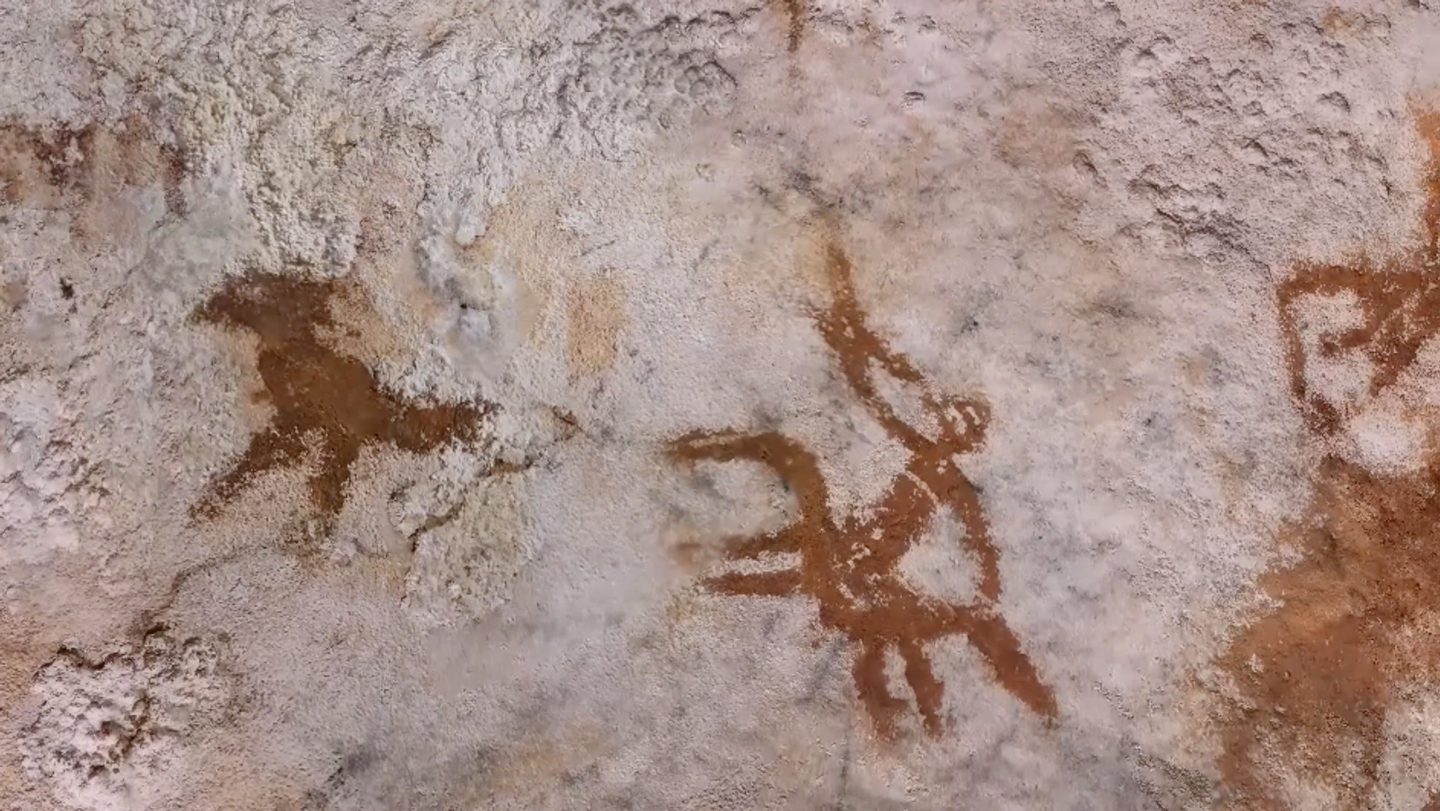
A stencil made on a cave wall about 67,800 years ago is the oldest rock art ever discovered.
“This image of a hand was created by someone placing their hand against the wall and then spraying a mouthful of paint around it,” says archaeologist adam Brumm. The stencil is among hundreds of later paintings of animals and other designs daubed in ochre and charcoal on cave walls on Muna Island, near the large Indonesian island of Sulawesi, Brumm and colleagues report january 21 in Nature.
“These people making the very earliest art on Sulawesi were part of the same broad population of modern humans who went on to colonize Australia by 65,000 years ago,” says Brumm, of Griffith University in brisbane, Australia.The find, the team says, supports a theory that early Homo sapiens were present at that time on Sulawesi as the species island-hopped in dugout canoes to the ancient continent of Sahul, which once connected New Guinea and Australia.
Until now, the earliest cave art was thought to have been made by Neandertals in Europe about 65,000 years ago.
In 2019, Brumm was part of a team that discovered a 44,000-year-old cave painting on Sulawesi that may be the earliest depiction of a story. In 2021, his team found the earliest known cave painting depicting an animal: a 45,0000-year-old pig. He says the newfound hand stencil, which can barely be seen amid the encrustation of minerals and later paintings, shows the dawn of an artistic tradition that subsequently developed on Sulawesi over tens of thousands of years.
For the new study, the researchers dated 11 cave paintings on several satellite islands in the southeast of Sulawesi by analyzing uranium isotopes in the thin layers of mostly calcium carbonate that formed over them for millennia in the humid limestone caves. That work gave the team a precise timeline for the prehistoric paintings and led them to identify the hand stencil in Metanduno Cave on Muna Island as the oldest of all.
the stencil appears to have been made by slightly rotating the hand as it was painted, so that the fingers appeared narrowed or clawlike — a motif repeated in cave paintings on muna and elsewhere in Sulawesi until about 20,000 years ago.
The ancient image may indicate a difference in the artistic capacity of Neandertals and early modern humans. Last year,hand stencils made by neandertals more than 66,000 years ago were discovered in a cave in Spain.While those stencils are some of the most sophisticated art neandertals ever made, early H. sapiens began with hand stencils and went on to create wonders like the Chauvet Cave in France, which is filled with hundreds of intricate cave paintings made between 37,000 and 32,000 years ago.
It’s not yet clear how the find impacts the old idea that Neandertals were not capable of abstract art and were only copying H. sapiens.“It’s an interesting possibility,” Brumm says. “The problem is that we don’t have evidence for modern humans creating that sort of cave art [in Europe] that Neandertals could have copied at such an early point.”
Some experts welcome the discovery as further evidence that early H. sapiens were island-hopping through this region at that time. “These people were crossing water channels by boat or raft,” says archaeologist Helen Farr of the University of Southampton in England,who has studied prehistoric seafaring to Sahul.
But others are cautious. Anthropologist James O’Connell of the University of utah in Salt Lake City suggests the earliest rock art on Sulawesi could have been made by an earlier human group than the H. sapiens that migrated to Sahul. And he rejects the idea that travel between islands was possible only in boats. Rather, he says, it might potentially be that they had swum or drifted there on debris, as other large mammals had.“The authors’ inferences about purposeful marine voyaging capacities are overdrawn.”