
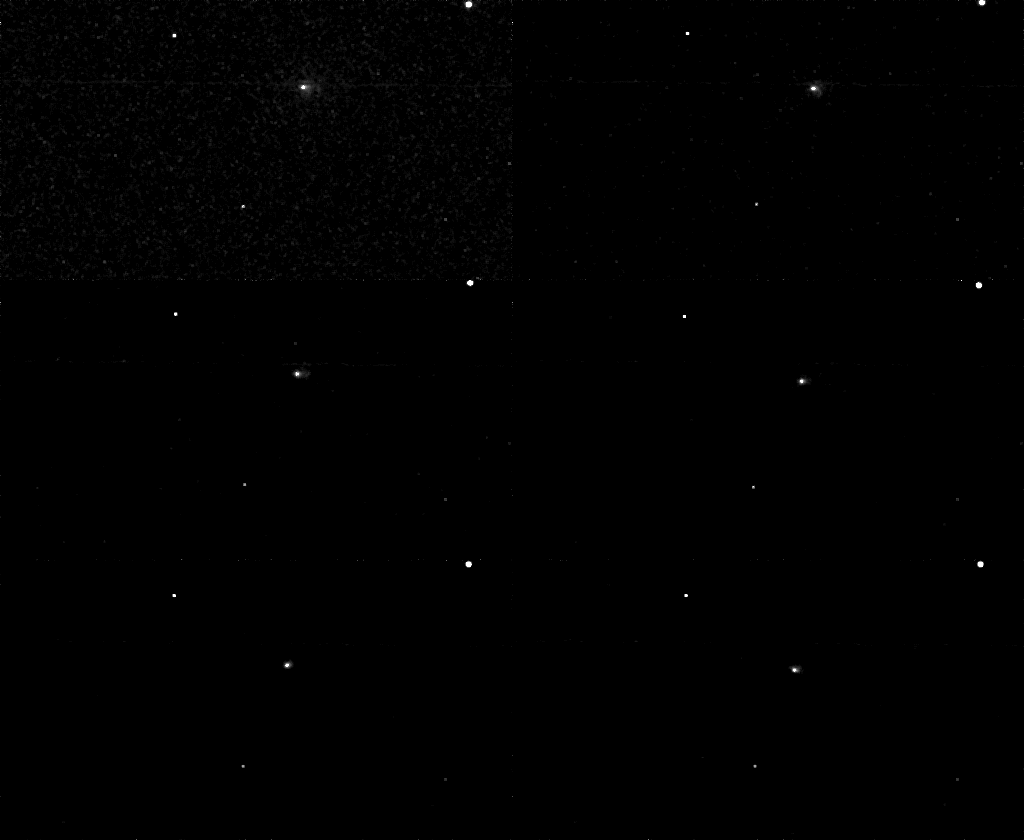
A Visitor From Beyond: Interstellar comet 3I/ATLAS Graces Our Solar System
For the first time, astronomers have observed an interstellar comet – a celestial traveler originating from outside our solar system – with remarkable clarity. Comet 3I/ATLAS, a truly ancient wanderer, is currently making its closest approach to the sun, offering a rare glimpse into the building blocks of other star systems.
This isn’t the first time we’ve detected objects from beyond. Previously, scientists confirmed two interstellar visitors: ‘Oumuamua and 2I/Borisov. However, 3I/ATLAS stands out as the largest of these confirmed interstellar objects, estimated to be between 3 and 7 miles wide.
What Makes 3I/ATLAS Special?
Several factors contribute to the excitement surrounding this comet:
* Size: Its considerably larger than the previously discovered interstellar objects.
* Age: Its trajectory suggests it has been journeying through the galaxy for billions of years, potentially predating our sun.
* Composition: Studying this comet could reveal clues about the composition of planetary systems around other stars.
Currently, 3I/ATLAS is positioned on the far side of the sun, making it temporarily invisible to Earth-based observers. Though, you’ll be able to spot it again with ground-based telescopes starting in early December.
A Martian Sighting?
Interestingly, a potential image of the comet may have been captured by NASA’s Perseverance rover on Mars. A bright streak in a raw image taken on October 4th has sparked speculation that it could be 3I/ATLAS. While no official confirmation has been released due to the recent U.S. government shutdown, the possibility is intriguing.
It’s important to remember that even with advanced technology, observing these distant objects is challenging. Though, the data we are gathering is incredibly valuable.
What’s Next for 3I/ATLAS?
The comet’s journey isn’t over yet. In March 2026, 3I/ATLAS will have a close encounter with Jupiter, experiencing a gravitational nudge that will alter its course. Ultimately, it will continue its voyage, eventually leaving our solar system forever.
This interstellar visitor provides a unique possibility to study material from another star system. As astronomers continue to observe 3I/ATLAS, you can expect to learn more about its composition, origin, and the conditions in the distant reaches of our galaxy. It’s a reminder that our solar system is just one small part of a vast and fascinating universe.





