
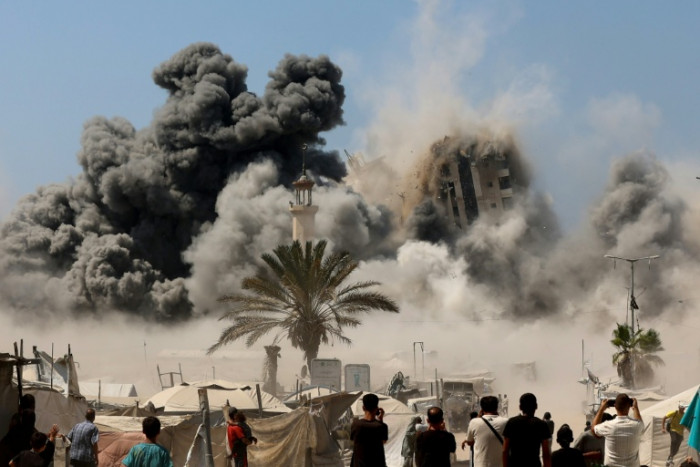
Israel’s military is urging residents of Gaza City to relocate to teh Al-Mawasi humanitarian zone, as operations intensify in the region.This call for evacuation comes amid escalating conflict and growing concerns for civilian safety.
The push to Al-Mawasi: A Humanitarian Zone Under Scrutiny
A military spokesperson, Avichay Adraee, recently communicated via social media, encouraging people to take this chance to move early to the (Al-Mawasi) humanitarian zone and join the thousands of people who have already gone there.
The Israeli army has emphasized the availability of essential resources within Al-Mawasi,including field hospitals,potable water pipelines,and desalination facilities. Furthermore, they state a continuous supply of food, tents, medicines, and crucial medical equipment is being maintained.
Relief operations are reportedly ongoing, facilitated in collaboration with the United Nations and various international organizations, even as ground operations expand. However, the designation of Al-Mawasi as a safe zone
has been met with skepticism, as the area has experienced repeated strikes, with israel citing the presence of Hamas fighters operating amongst civilians.
Did You Know? According to a recent report by the UN Office for the Coordination of Humanitarian Affairs (OCHA) in July 2024, the number of internally displaced persons (IDPs) in Gaza has surpassed 2.1 million, representing over 80% of the population.
Recent conversations with Gaza City residents reveal a deep sense of uncertainty and resignation. Many feel that relocation offers little advancement in their safety. Abdel Nasser Mushtaha,a resident of the Zeitoun neighborhood,currently sheltering in the Rimal area,expressed this sentiment,stating,Some say we should evacuate,others say we should stay. But everywhere in Gaza there are bombings and deaths.
His daughter, Samia Mushtaha, echoed this despair, noting that Wherever we go, death pursues us, whether by bombing or hunger.
She specifically highlighted that Al-Mawasi, despite its designation, has witnessed some of the most devastating bombings in the past year and a half.
Navigating the Complexities of Safe Zones
The concept of safe zones
in conflict areas is increasingly complex. While intended to protect civilians, their effectiveness hinges on consistent adherence to international humanitarian law and a genuine commitment to safeguarding non-combatants. I’ve found that the designation alone isn’t enough; continuous monitoring and accountability are essential to ensure these zones remain truly safe.
Here’s a quick comparison of the stated provisions in al-Mawasi versus the realities reported by residents:
| Feature | Reported Availability | Resident Experience |
|---|---|---|
| Field Hospitals | Yes | Limited access, overwhelmed |
| Water Supply | Pipelines & Desalination | Inconsistent, frequently enough insufficient |
| Food & Medicine | Continuous Supply | Severe shortages, uneven distribution |
| safety from Bombing | Designated Safe Zone | Repeated strikes reported |
Hostage Negotiations and the Path to Ceasefire
This call for evacuation coincides with intensified Israeli operations around Gaza City, despite mounting international pressure for a ceasefire. Hamas previously agreed to a proposal for a temporary cessation of hostilities and a phased release of hostages. Though, Israel is demanding the immediate release of all hostages, the complete disarmament of Hamas, and the relinquishing of control over Gaza.
Recent discussions at the White House indicate ongoing U.S. involvement in negotiations with Hamas regarding the captives held in Gaza. President Donald Trump stated, We’re in very deep negotiation with Hamas.
He also expressed concern over reports that some hostages may have died, stating, There could be some (hostages) that have recently died, is what I’m hearing. I hope that’s wrong, but you have over 30 bodies in this negotiation.
It’s important to remember that militants initially took 251 hostages during the October 2023 Hamas attack on Israel. The Israeli military currently estimates that 47 hostages remain in Gaza, with 25 presumed deceased.Trump emphasized a firm stance,stating,we said let them all out right now,let them all out,and much better things will happen for them. But if you don’t let them all out, it’s going to be a tough situation, it’s going to be nasty.
Pro Tip: When evaluating details from conflict zones,always cross-reference reports from multiple sources,including international organizations,news agencies,and on-the-ground accounts.
The Humanitarian Crisis Deepens
The UN estimates that nearly one million people remain in and around Gaza City, where a famine has been declared. A looming disaster
is predicted if the current assault continues. Israel anticipates that the offensive will displace another million people southward.
The scale of displacement is staggering, with the vast majority of Gaza’s population – over two million people – having been displaced at least once during the conflict. The situation is further complicated by restrictions on media access and difficulties in verifying information from affected areas.
The initial Hamas attack on Israel in 2023 resulted in the deaths of 1,219 people, according to official figures. In response, Israel’s military offensive has led to the deaths of at least 64,300 Palestinians, the majority of whom are civilians, according to the health ministry in Hamas-run Gaza, which the United Nations considers a reliable source.
Understanding the Long-Term Implications
The current situation in Gaza highlights the urgent need for a lasting resolution to the conflict. Addressing the root causes of the crisis, including the blockade of Gaza, the occupation of Palestinian territories, and the lack of a viable political process, is crucial for achieving lasting peace. Here’s what works best: prioritizing humanitarian aid, fostering dialog, and upholding international law.
Evergreen Insights: The Cycle of Conflict and Displacement
The challenges faced by civilians in Gaza are unfortunately not unique. Throughout history,conflicts have consistently led to mass displacement and humanitarian crises. Understanding the patterns of conflict, the role of international actors, and the importance of protecting civilians are essential for preventing future tragedies.The long-term consequences of displacement extend far beyond immediate physical safety, impacting education, healthcare, and economic opportunities for generations.
Frequently Asked Questions About the Gaza Situation
- What is the current status of the humanitarian situation in Gaza? the situation is dire, with widespread displacement, famine conditions, and limited access to essential resources.
- Is Al-Mawasi truly a safe zone for civilians? While designated as such, Al-Mawasi has experienced repeated strikes, raising serious concerns about its safety.
- What is the latest on hostage negotiations between Hamas and israel? Negotiations are ongoing, with the U.S. playing a mediating role, but significant obstacles remain.
- How many people have been displaced by the conflict in Gaza? The vast majority of Gaza’s population – over two million people – have been displaced at least once.
- What are the long-term implications of the conflict for the region? The conflict exacerbates existing political and economic challenges, hindering prospects for lasting peace and stability.
- What role are international organizations playing in providing aid to Gaza? Organizations like the UN and the Red Cross are providing critical humanitarian assistance, but access remains a significant challenge.
- What is the primary keyword related to this article? The primary keyword is
Gaza humanitarian crisis
.
The situation in Gaza remains incredibly volatile. Staying informed, advocating for humanitarian aid, and supporting efforts towards a peaceful resolution are crucial steps you can take. What are your thoughts on the role of international intervention in conflict zones?
Share this article with your network to raise awareness and encourage constructive dialogue. Let’s work together to support those affected by this ongoing crisis.





![Hamilton Christmas Eve Robbery: 3 Youths Arrested | [Year] Update](https://media.rnztools.nz/rnz/image/upload/s--nP7cJMJH--/t_tohu-badge-facebook/v1666821097/4LJ9HX0_IMG_1842_1_jpg?_a=BACCd2AD "Hamilton Christmas Eve Robbery: 3 Youths Arrested | [Year] Update")


